



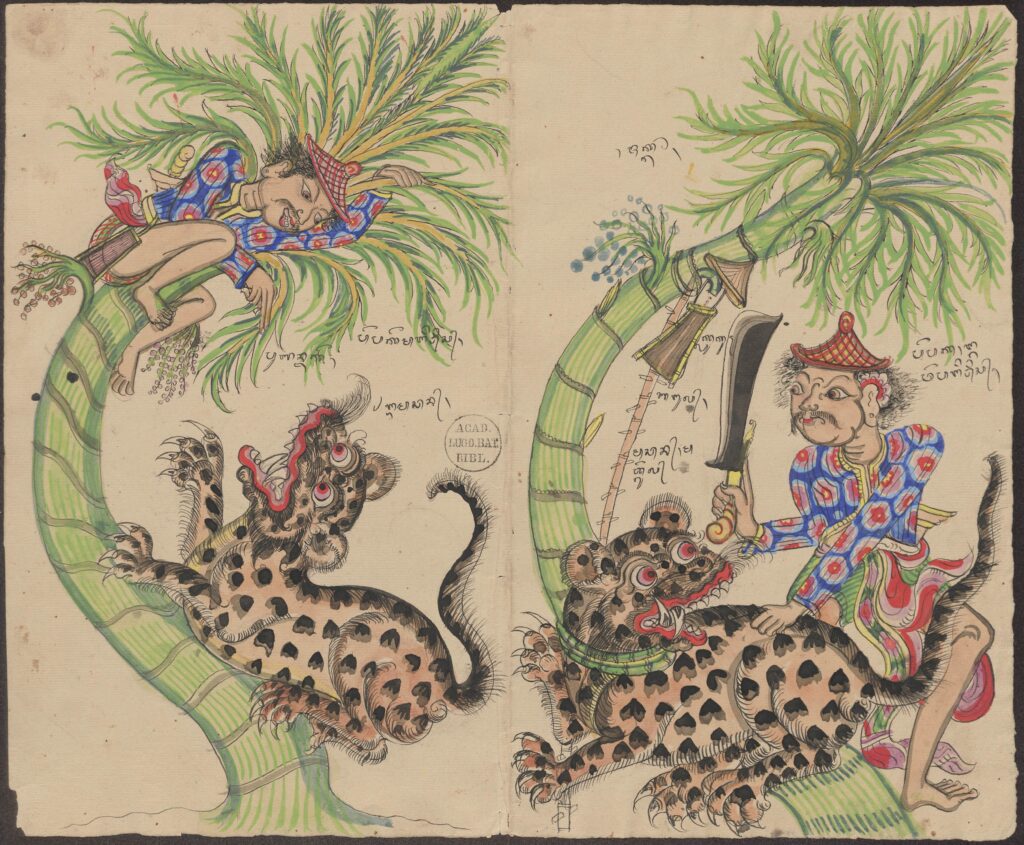
We begin this edition (The Drinks Edition) with a fabulous illustration by the Balinese artist I Ketut Gede, titled ‘Fable of the bull, the tiger and the palm-wine tapper’ (c.1890), displaying an early depiction of a Balinese character harvesting ‘tuak’ from a palm tree.
The illustration was commissioned by the Dutch linguist Herman Neubronner van der Tuuk, who lived and worked in the Dutch East Indies, best known for founding the first lontar (Balinese manuscript) library in Singaraja, today known as Gedong Kirtya, North Bali.
A lover of Balinese stories, V.D. Tuuk commissioned I Ketut Gede to create a vast series of Balinese drawings on ink, following the folk stories of I Papaka, the character depicted in the illustration. This particular illustration captures the moment I Papaka, described as a ‘palm wine tapper,’ is attacked by a tiger as he is collecting the ‘tuak’ from the top of a jaka palm tree.
According to Leiden University, the narrative behind this particular scene was that the tiger wanted to prove that he was the highest being on earth by killing man, in this case, I Papaka the palm-wine tapper. Outsmarted, the tiger ends up being tied up to the jaka tree, showing the superiority of man.
I Papaka in the Tantri Kamandaka
Whilst this particular scene sees the tiger as the villain, the wider story turns this around completely.
The I Papala story is one of many fables from the Tantri Kamandaka, a classical story tradition that became deeply established in Bali – akin to the Indian Panchatantra. The Tantri Kamandaka is structured as a chain of interconnected fables, in which stories are told within other stories. At its centre is Diah Tantri, who uses storytelling to teach and ultimately reform the behaviour of King Eswaryadala. The individual tales use animals and humans to illustrate different aspects of human character and morality.
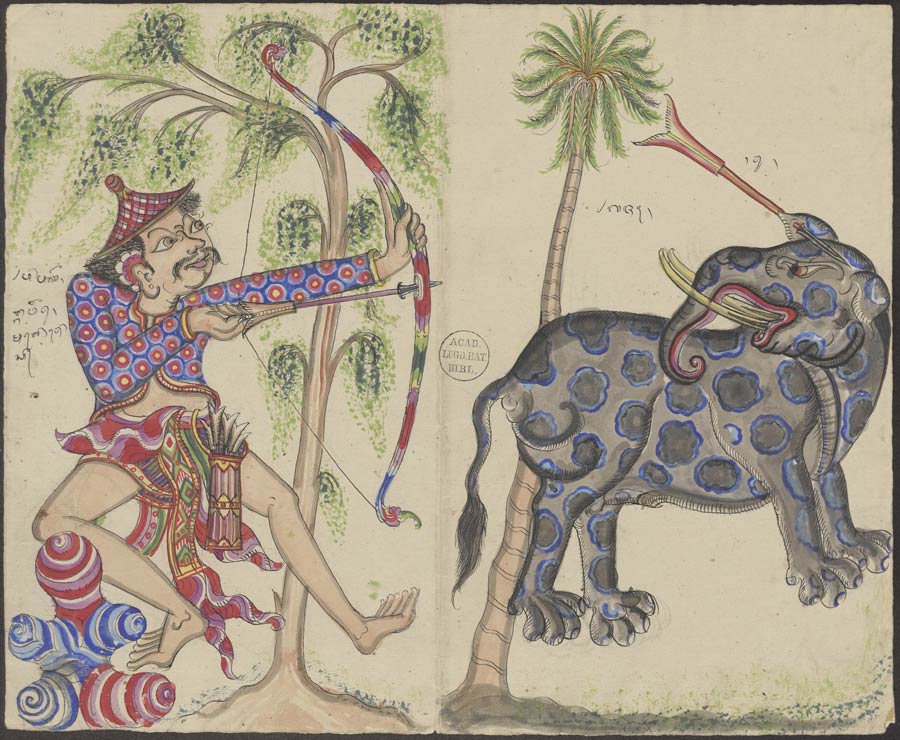
In the original version, it is I Papaka who is shown as the true villain. A cruel hunter, he goes into the forest and shoots at an unsuspecting elephant, who flees into the bush badly injured. The elephant encounters the tiger who complains that such a huge creature shouldn’t be scared of one man, to which the elephant argues it is man’s skill and smarts that makes him dangerous.
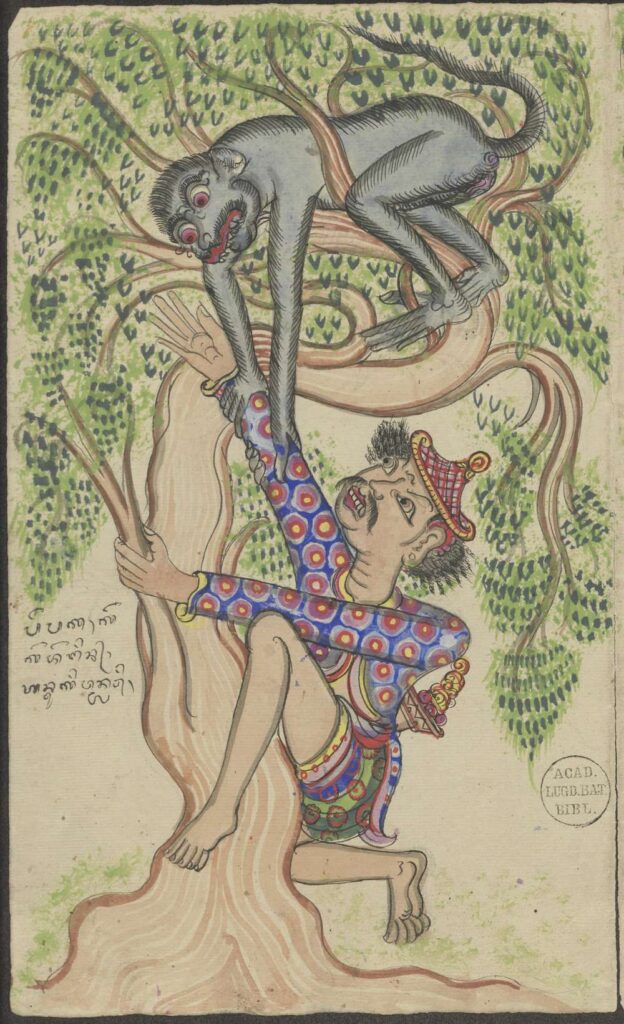
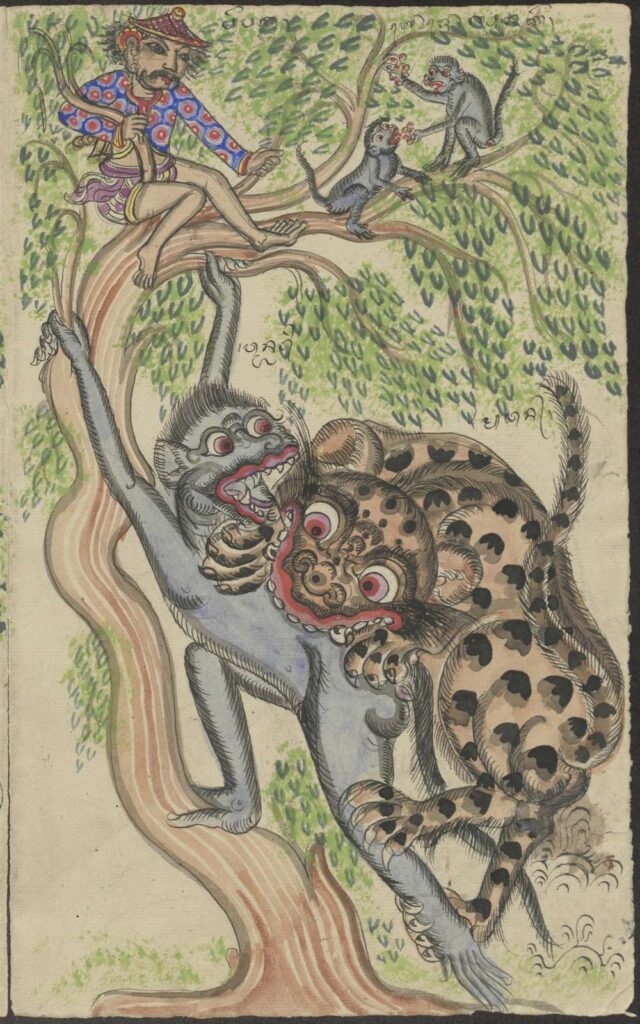
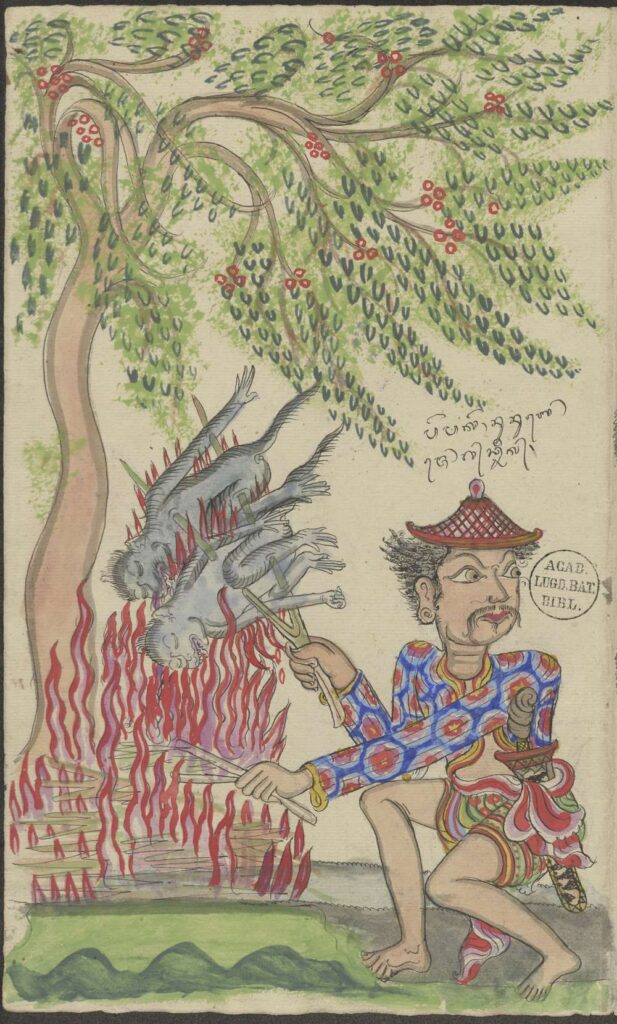
The tiger, intent on proving this theory wrong, goes after I Papaka. The fear-stricken hunter attempts to run and is saved by Wanari, a monkey, who helps him up the tree – the Wanari is killed by the tiger. And instead of being grateful, the cruel, cruel hunter then kills the monkey’s two children.
Ultimately, the story was told to draw Papaka as an archetype of total moral failure in a person: he saw the kindness of the monkey as a debt of obligation, leading ultimate betrayal.
Whilst the versions in the image and original story differ (as happens with folk stories!), we nonetheless gifted with a fabulous depiction of the tuak harvest as seen in the 19th century Bali!