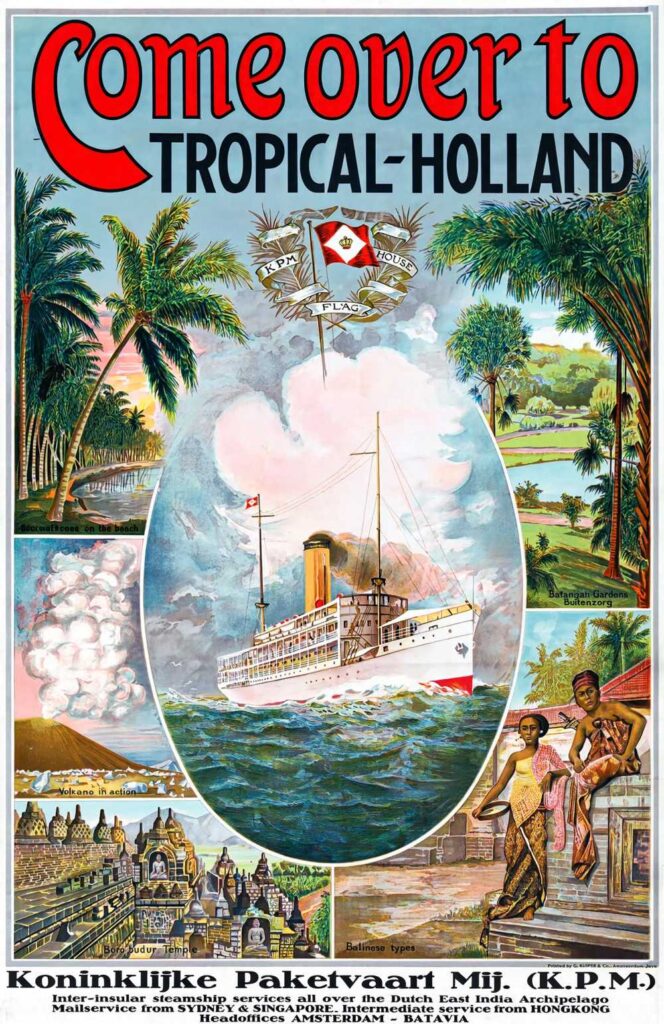
Right: One of the earliest well-documented European travel posters depicting Indonesia, made around the year 1913 for the Koninklijke Paketvaart Maatschappij (K.P.M.) shipping line promoting travel to the “Tropical-Holland” (Dutch East Indies).
In the late 19th and early 20th centuries, long before a single click could secure an entire holiday, travel posters were far more than advertisements for destinations. They served as graphic ambassadors for hotels, airlines, railroads, and tourism agencies, promoting their services with bold, persuasive imagery.
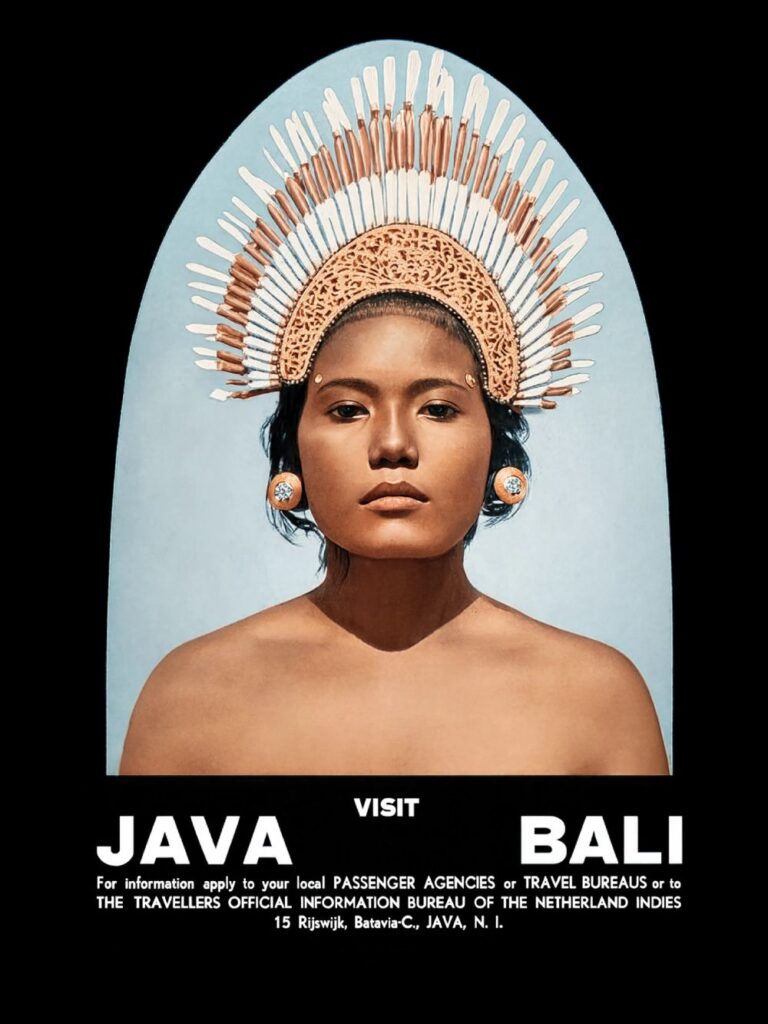
Reflecting broader shifts in tourism, society, and art, these advertisements offer windows into social and cultural history. Treated as artworks in their own right, their styles ranged from the flowing elegance of Art Nouveau to the clean geometries of mid-century modern. At their peak, many leading graphic and fine artists devoted their talents to them. Created largely under colonial auspices, these images aimed to attract European and American tourists seeking the “Orient.” These materials were widely distributed across Europe, North America, and Australia, appearing in newspapers, hotels, and exhibitions, and helped draw thousands of international visitors. In this period the Dutch East Indies emerged as a romantic destination in European travel advertising: an exotic paradise of volcanic landscapes, ancient temples, rice terraces, and vibrant cultures. Today such posters are highly collectible and often command significant value. In this article, Sake Santema of Indies Gallery shares a selection of his early travel advertisements and offers a brief history of these works of art.
The Birth of the Modern Poster
Early lithographic posters, often for books, events, or simple advertisements, appeared in Europe from roughly the 1830s–1850s, but were limited in scale, colour, and artistic ambition. The process that made this possible worked as follows: A lithographic poster is made by an image drawn or transferred onto a flat stone (originally limestone) or metal plate with a greasy crayon, ink, or transfer. The surface is dampened with water; the greasy image areas repel water and attract oil-based ink, while the non-image areas attract water and repel ink. Paper is pressed against the inked surface to transfer the image.
The true breakthrough for large-scale, vibrant, artistic advertising posters came with French artist and lithographer Jules Chéret. He established his own lithographic printing firm in Paris in 1866 and refined a practical three-stone colour process (typically red, yellow/blue, and black) that made bright, large-format posters commercially viable. From the late 1860s through the 1880s–1890s, Chéret and others turned the lithographic poster into a major art form and mass-advertising medium. This period is widely regarded as the birth of the modern poster.
The Rise of Commercial Travel to the Dutch East Indies
The invention and refining of poster-printing techniques in the late nineteenth century coincided with the opening of the Suez Canal in 1869, a development that transformed travel to the Dutch East Indies from a rare and arduous undertaking into a practical commercial enterprise.
Another major milestone in travel to Asia was with the evolution of primarily sail voyages to steamship travel. After 1871, the situation changed rapidly as the voyage of the Prins van Oranje launched practical steamship travel between Europe and Indonesia.
These faster, more comfortable modern steamers made the passage feasible for ordinary travellers. The first passengers were still largely colonial officials, traders, military personnel and their families, yet the same vessels increasingly carried leisure travellers from Europe, Singapore, Australia and beyond. Shipping companies and tour organisers seized the opportunity, using the new poster medium to advertise organised trips and thereby converting distant islands into marketable tourist destinations.
Jan Lavies: Art Deco Advertising Pioneer in the Dutch East Indies
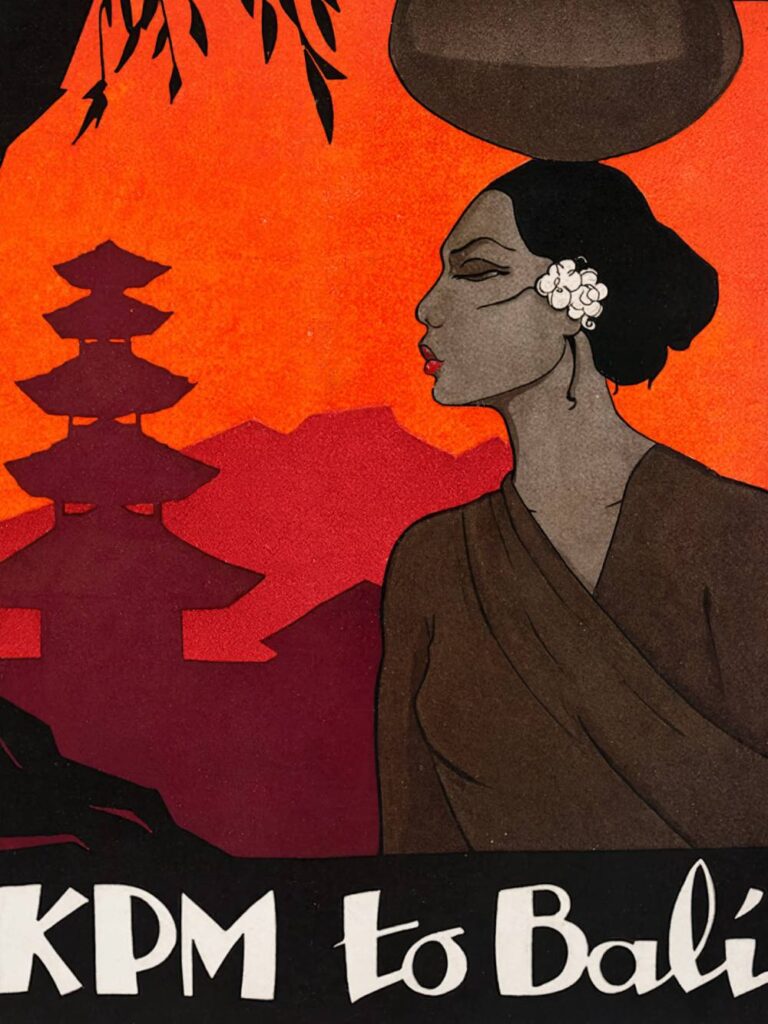
One artist worth mentioning is the Dutch advertisement artist Jan Lavies (1902 – 2005). Lavies lived in the Dutch East Indies from 1925 to 1932 and was best known for his Art Deco posters for Dutch shipping and import companies.
In 1925 Lavies established himself as a freelance advertising artist in the Dutch East Indies, where he soon made his breakthrough with a cover design for the weekly magazine d’Oriënt. In Java, Lavies designed exhibition stands, folders, suitcase labels for hotels, magazine covers, advertisements, and posters for import companies. Typical of Lavies’ work in the Dutch East Indies are his stylized depiction of local scenes and his bright yet sophisticated colour palette.
Discover more travel advertisements in our online article on the NOW! Bali website. The prints in this article are available for purchase through Indies Gallery, while high-quality reprints can be found at Old East Indies.
Indies Gallery & Old East Indies
Jl. Gambuh No.17, Denpasar, Bali
www.indiesgallery.com / www.oldeastindies.com