For a Balinese Hindu ceremony to be ‘complete’, five essential sounds – the Panca Gita – must be present.
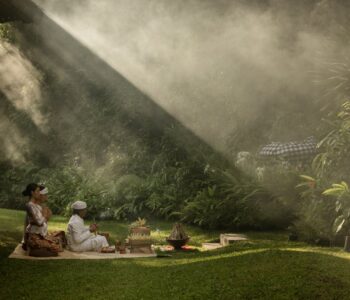
Ceremonies in Bali are a feast for the senses. The crowds of white-clad worshippers, bustling off of bikes, alighting from pickups and emptying car boots of the various offerings and necessary apparatus.
The temples themselves are embellished from top to bottom, penjor bamboo poles erected and tedung umbrellas perched at entranceways. Meanwhile every colour on the spectrum makes an appearance: the extravagant rejang dancers’ headdresses, the vibrant rice-flour mosaics of the grand and towering sarad offerings.
Not only is it a sight to behold, but it is also an olfactory sensation, as the multitude of burning incense sticks deodorise the temple compound; the wispy trails of rising smoke bestowing an ethereal air across the grounds.
Of all the sensory stimuli, however, it is perhaps sound that makes a Balinese ceremony so unmistakable. Voices and percussion, clangs, tones and rings. These reverberations are persistent throughout such religious affairs. And among this cacophony of assembled noises, five specific sounds stand out as ceremonial necessities. These are the Panca Gita.
Social and Sacred Sounds
The Trimurti, three principal gods; Tri Mandala, three zones of a temple; the Panca Maha Bhuta, five essential elements; the Sapta Loka, seven planes of existence. Lists and numbers permeate Balinese cosmology and ritual; indeed, the universe is a place of order, and everything has its place. This is how balance and harmony are assured.
Is it really a surprise then, that sound too has a part to play in this organised universe? It is, after all, a force, a form of energy, the vibration of communication! And in Bali, sound is a medium through which people commune with the gods, ancestors and niskala (unseen) realms.
The Panca Gita – literally five (Panca) and sounds (Gita) in Balinese – consists of: the sound of the kul-kul (or kentongan), the slit drum used as a call to gather; the gamelan, or Balinese percussive orchestra; the kidung sacred singing; the genta ritual bell, held and rung by the priests; and mantras, incanted by the same priests as ritual prayers.
These distinct sonic elements create the conditions necessary for ceremony; conditions that are both social and sacral. Through these sounds (and the actions of these sounds), people are gathered, roused, elevated and cleansed; but also sound connects our world (Bwah) to those above (Swah) and below (Bhur).
Auditory Alignments
The Panca Gita need not sound off simultaneously. They each have their time, place and function, and more specific rules apply depending on the ceremony at hand.
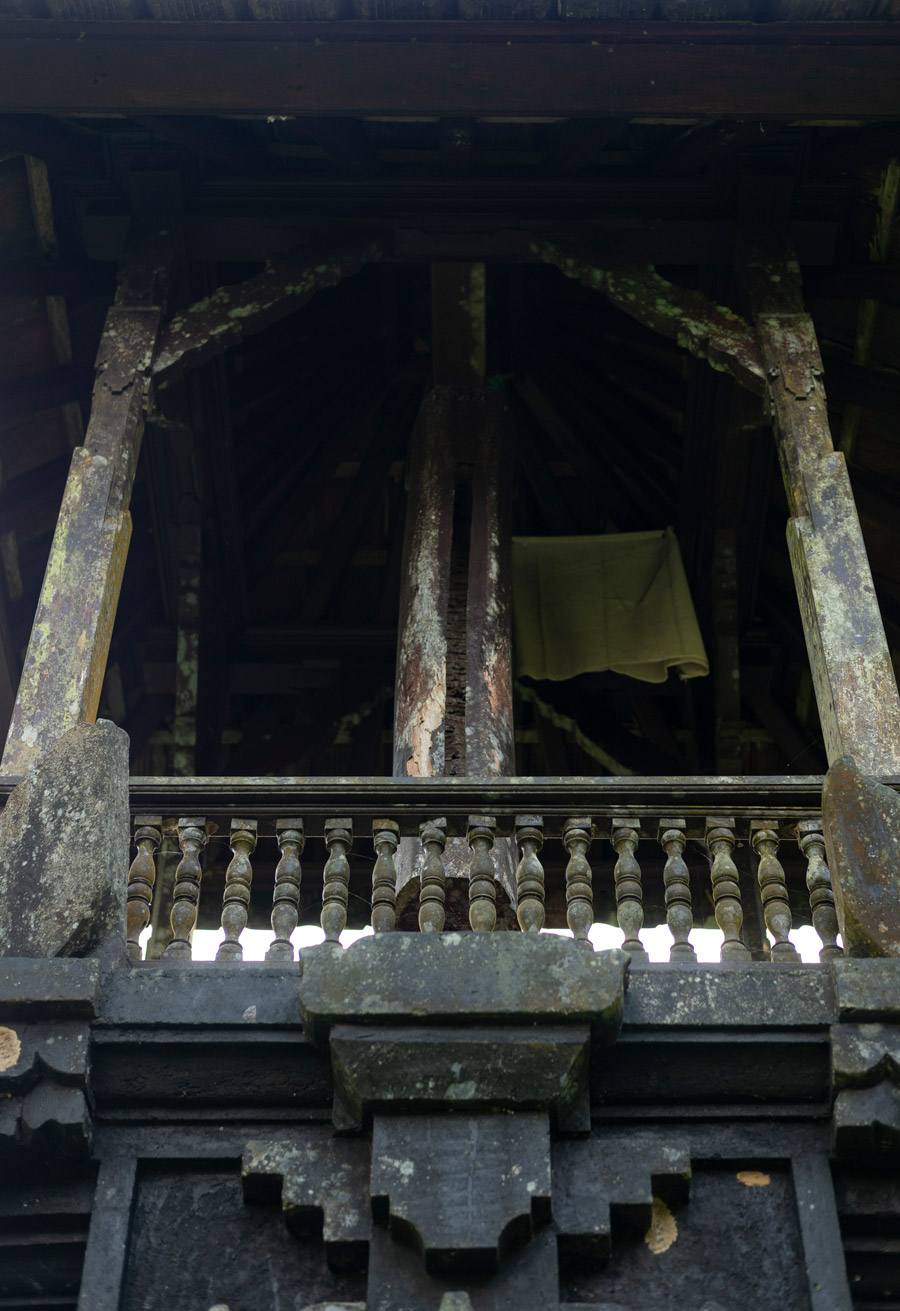
The first sound is that of the kul-kul slit drum, a long, hollowed piece of timber, often located high above in a dedicated tower. When hit, the wooden clonks signal the surrounding community when it is time for ceremony. This first sound begins the collective participation, transitioning ordinary time to ritual time; its rhythmic knocking welcomes the deities ‘down’.
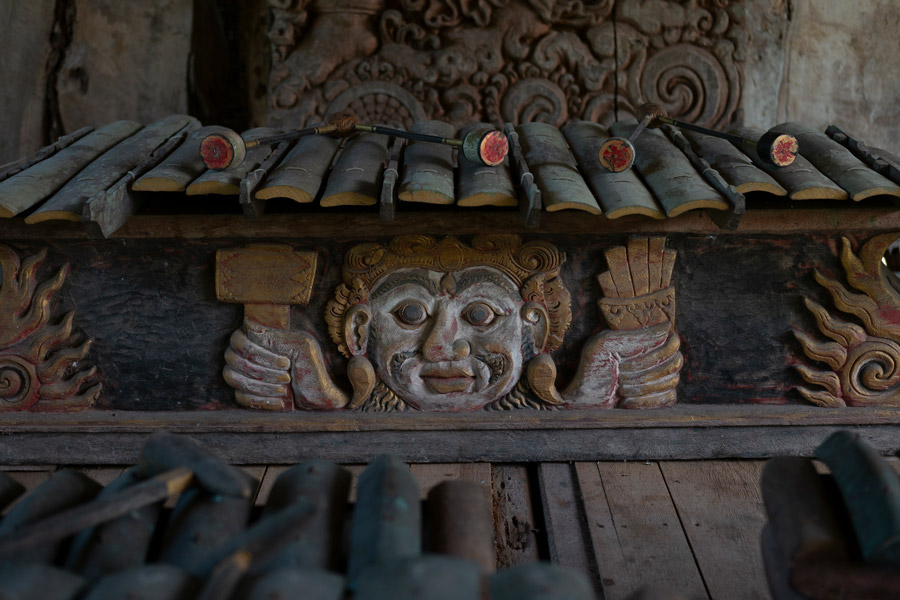
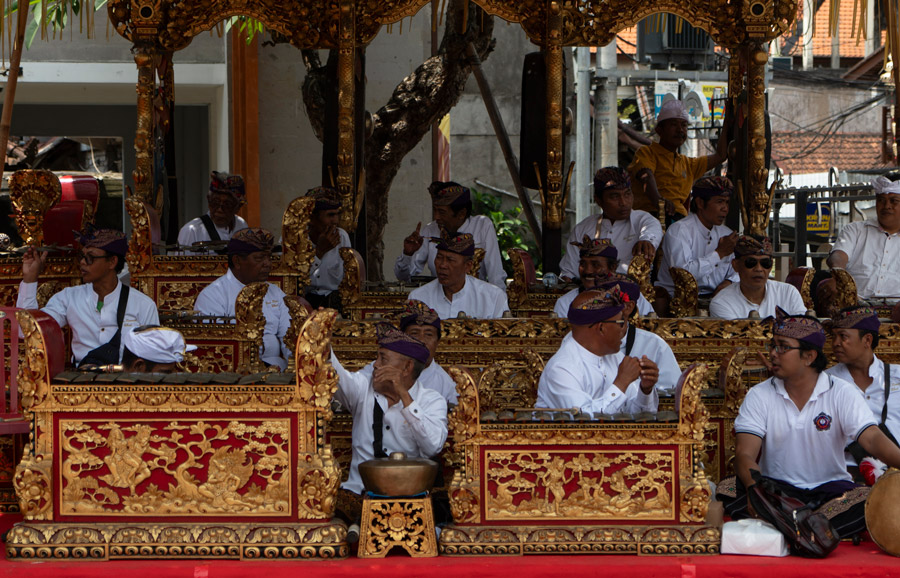
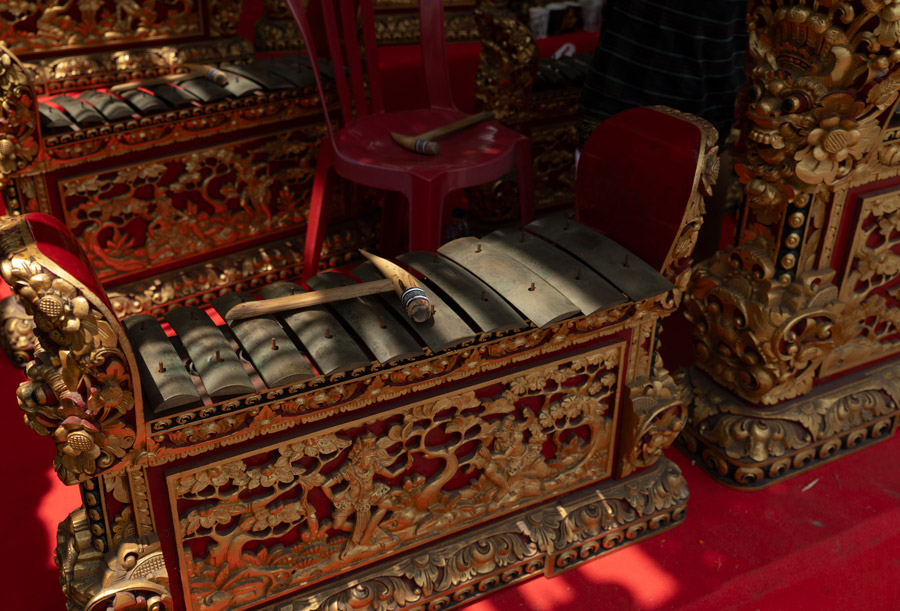
The gamelan – made up of various metallophones, gongs, drums, flutes and more – is multifunctional. Importantly, it provides the music for the prerequisite ritual dances for specific ceremonies: dance and music are both considered a form of offering in themselves. Performances take place in the middle courtyard of the temple, as a necessary phase in ceremony; a centralising focus for those present and performing. It is said that the rhythmic beats and chromatic tones help to bring the dancers to the state of taksu, the ultimate flow state, into connection with the cosmos.
The tones of the gamelan and gongs are by no means arbitrary. Though its pentatonic scale (pelog) may sound awkward to Western ears, these notes are specific and in fact have their defined place in the ‘arrangement’ of the universe. But more on this later…
Next we have the kidung, the sacred singing. Also known as dharmagita, these are melodic recitations of Old Javanese texts known as kakawin, epic Hindu stories written in poetic metre, like the Arjuna Wiwaha — a tale from the Mahabharata, regaling the spiritual quest of Arjuna. The lilting, incantatory singing is ethereal, like a voice floating in the space between heaven and earth. Part music, part prayer, kidung is an essential step in worship, sometimes accompanied by gamelan, or hauntingly sung as the backdrop to the sanghyang trance dances.
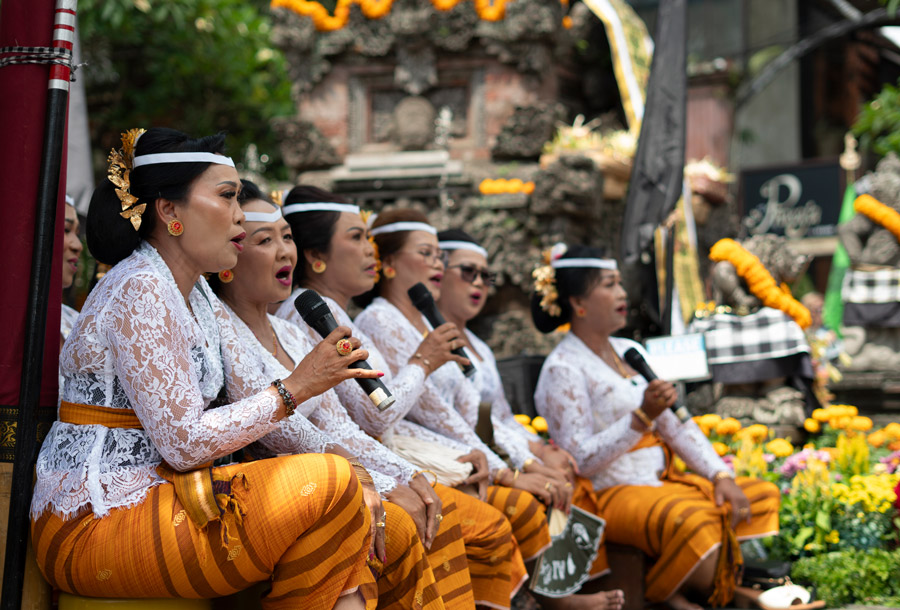
Importantly, certain kidung must be paired with particular types of ceremony, as Edward Herbst writes: “Wargasari is a ritual genre of musical offering most often for dewa yadnya ‘ceremonies honouring deities’ as well as pitra yadnya ‘ceremonies honouring ancestors’ such as ngabén and nyekah rituals associated with death and cremation”(2014, pp. 80–81).
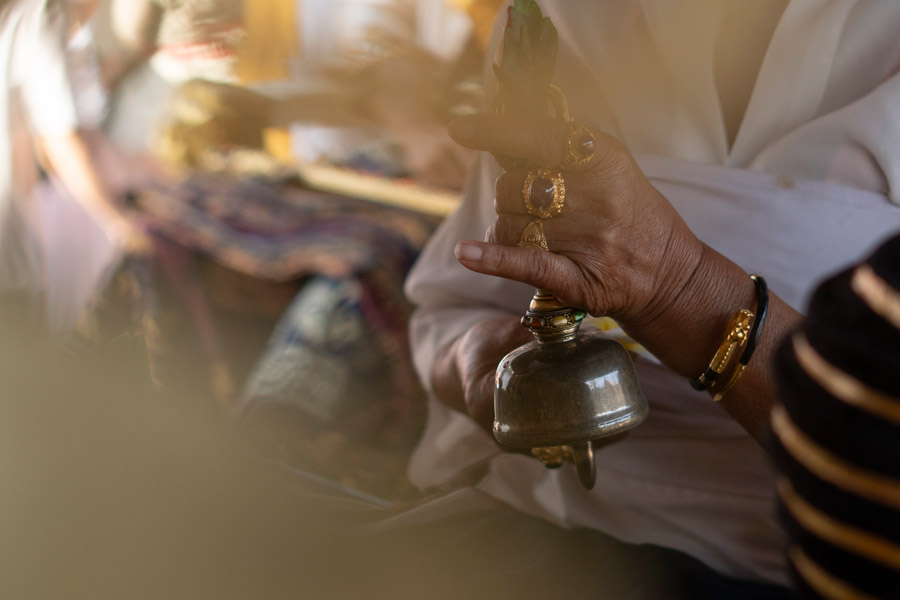
Finally, we have the sounds from the priests, who are responsible for two essential auditory inclusions. The mantras, done either by temple priests (pemangku) or high priests (pedande/sulinggih) depending on the scale of ceremony, are the Vedic recitations, which he or she has memorised. Mantras codify the connection to God, done in conjunction with specific mudra, holy hand gestures, and of course the recurrent rings of the genta or bajra ritual bell.
One of the most sacred items among Bali’s various religious paraphernalia, this carefully crafted metal bell is a highly specific instrument, necessary in prayer, cleansing and in the creation of holy water. Before use, it is spiritually ‘activated’ (pasupati), after which only an initiated priest may handle it.
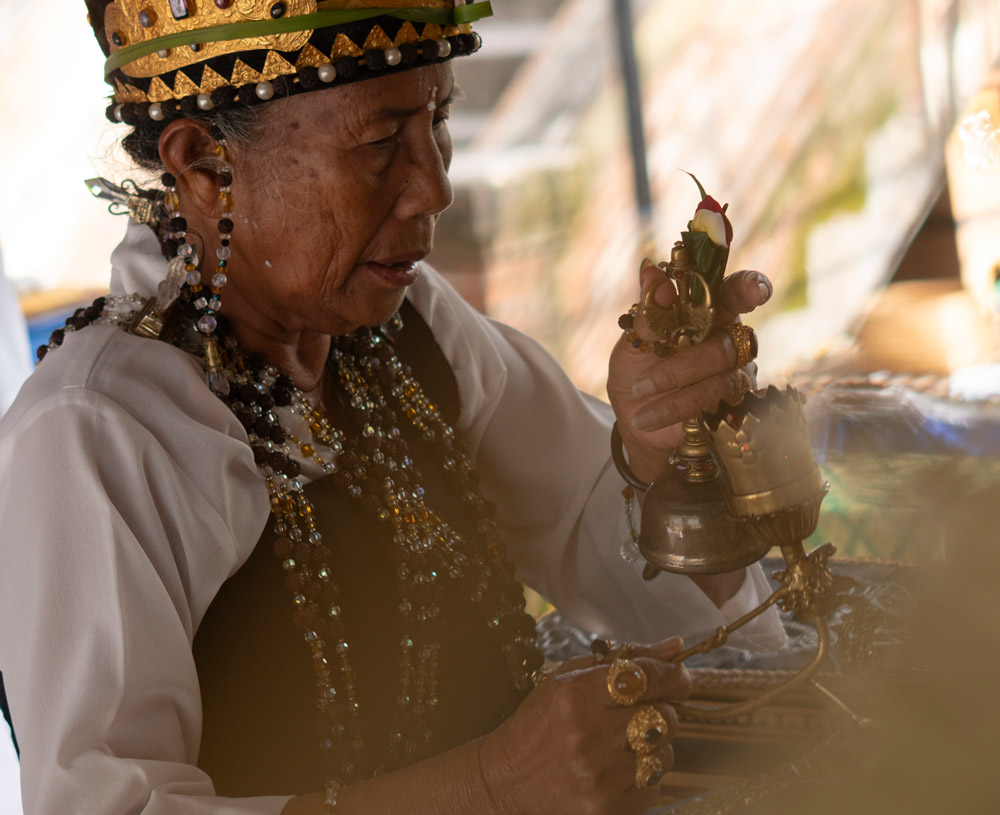
Rung during prayers, its piercing chimes sound at a frequency range of 1,500 Hz to 20,000 Hz (Wahyuningsih, I., & Kiswanto, 2025), its resonance purifying holy spaces but also creating a direct connection to the upper realm, Swar Loka. It plays a practical function too, creating a meditative focus point for praying worshippers, as well as cueing the next phase of prayer.
Again, the cadence of rings is intentional. For example, the loud and forceful ‘teng teng teng teng’ expels the negative forces in a mecaru ceremony; whilst the calm ‘teng, teng, teng, tang, tang, teng’ concludes a sequence of worship.
A Time, Place and Note for Everything
As mentioned before, the Balinese Hindu love their lists and numbers. This order and organisation is part of their continuous effort in maintaining balance in the world. That is the function of all rituals and ceremonies, of which there are five main categories, the Panca Yadnya, or five ‘offerings’: human ceremonies (manusa yadnya), ancestral ceremonies (pitra yadnya), lower realm ceremonies (Bhuta yadnya), spiritual leader ceremonies (Rsi yadnya) and Godly ceremonies (Dewa yadnya). These categories address the balance in both the microcosm (within ourselves) and the macrocosm (the universe around us).
This organisation has a strict system. For example, the complex Pawukon calendar determines the holiness of days, determining the ‘temporal’ organisation of which ceremonies must happen when. Another system is the Pangider Bhuana (also, Nawasanga), a ‘spatial’ organisation that maps gods, goddesses, colours, temples, letters (aksara), calendar days and more to one of the nine cardinal directions (including ‘centre’).
For example, North points to the god Wisnu, represented by the colour black, venerated at Ulundanu Temple. This system determines many elements of ritual life; for example, in the preparation of the canang sari offering, it defines the colours of the flowers and where they are placed.
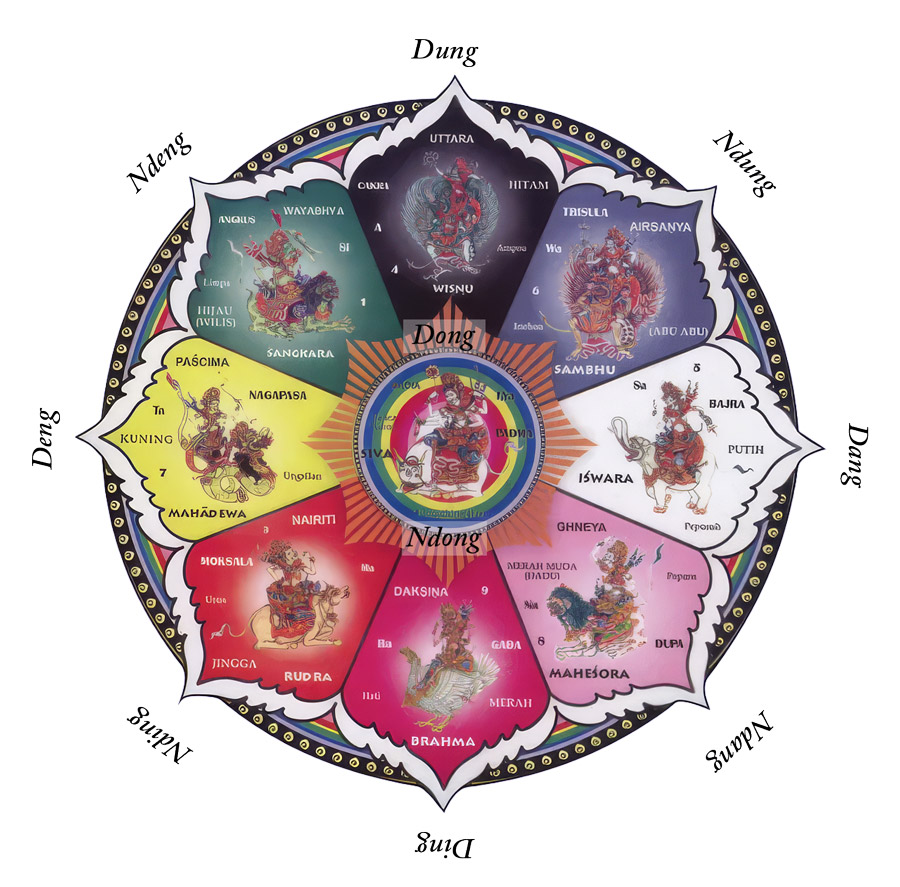
But where does sound come into this? Interestingly, in a Balinese palm-leaf manuscript called the Lontar Prakempa, the authoritative literature on all things Balinese music, it is written that a specific ‘note’ or ‘tone’ is mapped to a cardinal direction, and therefore represents a specified deity.
In ‘Prakempa: Sebuah Lontar Gambelan Bali’ (1986), the famous translation of the lontar by Prof. Dr I Made Bandem – Bali’s foremost expert on traditional performing arts – the author explains how this association affects music, writing:
“In order to associate a gamelan composition with the gods, the composition usually has one note that is played more frequently in the composition. The note chosen is also used as the final note played together with a gong at the end of a cycle or piece. For example, to relate a gamelan piece to Shang Hyang Siwa, the composition would have more dong tone, and it would end with the dong tone as well.” (Translation from Suryanegara, I. P. A. D. [2022]).
The lontar expands in great detail on the origins of sound, the spiritual philosophy of music, how to play the gamelan, including spiritual discipline. It offers a breakdown of musical scales and compositions, correct tuning, and the offerings and ceremonies one must do to honour music and instruments.
So, these nine tones (dang, ding, ndeng, etc.) are more than just musical notes. They are part of the fundamental organisation of the Balinese cosmology. And all five sonic elements of the Panca Gita are thus part of this continuous endeavour for cosmic balance; and just as music aims for harmony, music itself brings harmony to the universe.
References
Herbst, Edward (2014), “Bali 1928 – Volume II. Tembang Kuna: Songs from an Earlier Time,” Arbiter of Cultural Traditions, pp. 1–116
I Kadek Widiantana (2024). “Eksistensi Kakawin Arjuna Wiwāha dalam Agama dan Budaya Hindu di Bali” Manuskripta, Vol. 14, No. 2, 2024 pp. 335-369
Suryanegara, I. P. A. D. (2022). “Trance and Dance in Bali (1951). On the Musical Selections of Mead and Bateson’s Film” Revue musicale OICRM, 9(1), pp. 93–11
Wahyuningsih, I., & Kiswanto. (2025). “Suara Genta Dalam Ritual Persembahyangan Melasti Oleh Umat Hindu Di Blitar, Jawa Timur.” Jurnal Mebang: Kajian Budaya Musik dan Pendidikan Musik, 5(1), pp. 21-32