


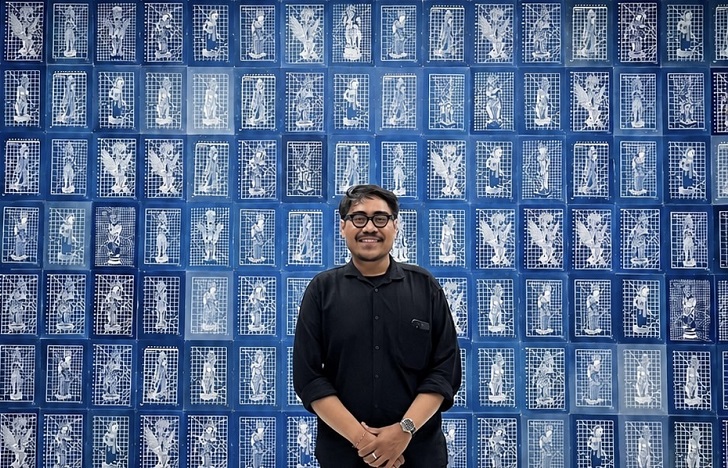
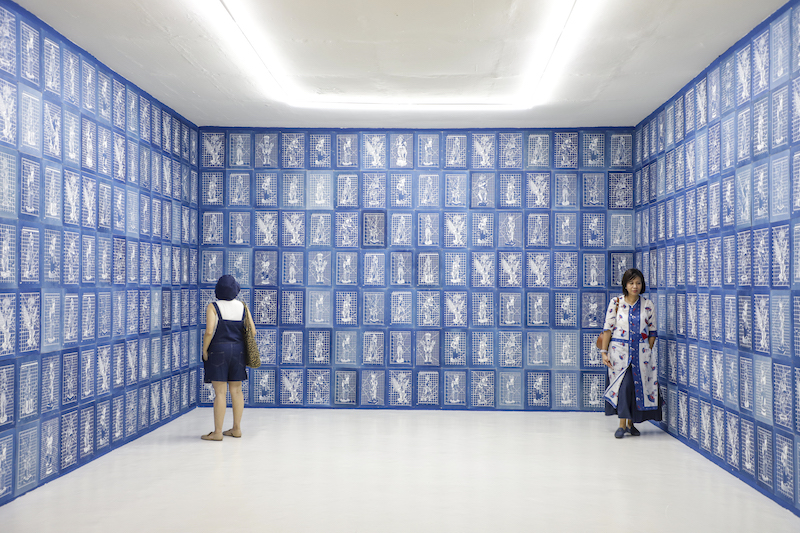
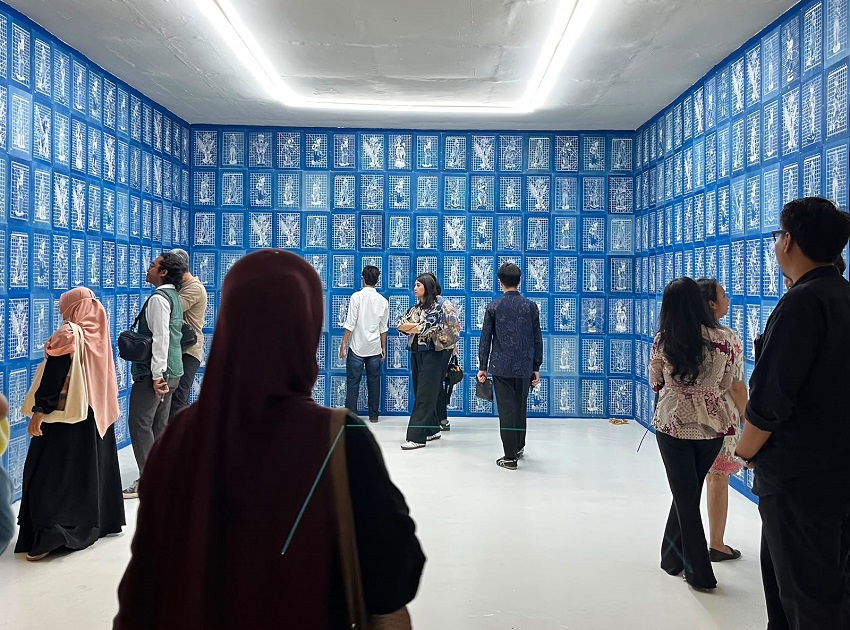
Three hundred and thirty-six blue and white cyanotype prints, 20 by 15cm, arranged floor to ceiling within a 6-meter-deep by 5-meter-wide alcove of the Jogja National Museum (JNM), distinguish *After Exotic 1931*, a contemporary art installation by Balinese printmaker Agung Pramana.
Immediately captivating, Pramana’s visual formula pulsates. Reproduction archival images, Balinese sculptures of mythical creatures, Hindu Gods, and human figures, are layered on horizontal and vertical measurement grids, characteristic of technical documentation. The repetitive imagery is a simplified Pop Art formula of white designs on a deep blue background, intentionally blurred to create ambiguous meaning, allowing for reinterpretation.
*After Exotic 1931* on display at Indonesia’s premier contemporary art festival, ARTJOG 2026 ARS LONGA: GENERATIO, from 19 July – 31 August 2026 at JNM, references the 1931 Paris Colonial Exhibition. During an era of imperial global conquest, the pioneering international showcase of colonial plunder was instrumental in shaping Western views of non-European cultures like Bali. From the 1850s onwards, colonial officials and missionaries collected Balinese artefacts for European museums, including Amsterdam’s Tropenmuseum.
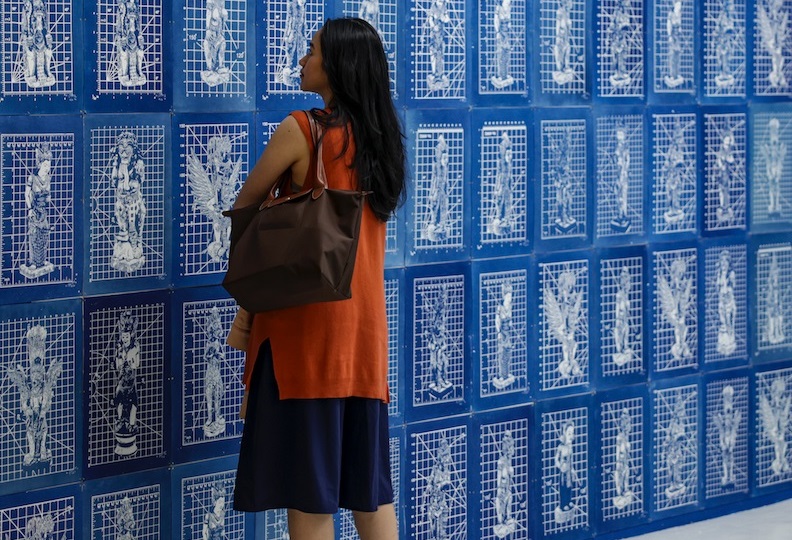
Traversing new aesthetic territory, Agung Pramana introduces a fresh contemporary art language by adopting the cyanotype printing technique and making an historical association with colonial practices employed for construction blueprints and archaeological records throughout colonial territories. Discovered in 1842, cyanotype is a slow-reacting printing formulation sensitive to a limited near-ultraviolet and blue light spectrum.
Pramana’s cyanotype process creates blue images by placing objects on paper coated with a light-sensitive solution of iron salts and exposing it to a UV lamp machine to keep the colour intensity consistent. The areas exposed to light turn blue, while the areas covered by the objects remain white, resulting in a striking contrast known as Prussian Blue.
“My interest in colonialism grew after the beginning of the Russia-Ukraine war, which escalated into a full-scale invasion by Russia in early 2022 and witnessing many Russians, Ukrainians and other nationalities settle in Southeast Asia, especially Bali. I then contemplated the relationship between tourists and local communities, and the impact of mass tourism,” Agung Pramana told NOW!Bali Magazine. “I realised the issue isn’t just about tourists; it’s also about corrupt officials and weak regulations, and the attitude of the Balinese people.”
“I then researched colonialism, post-colonialism, and de-colonialism; reading from diverse perspectives deepening my interest in historical issues: their origins, how knowledge systems evolve, and how we might re-examine that history today,” said Pramana, born in 1998 in Jembarna, West Bali, whose solo exhibition Print-Mapping: Decolonial Axis at SIKA Gallery in Ubud was open throughout January 2026.
“I sourced images of Balinese sculptures and reliefs from European museums, then reworked them into critical, confrontational art pieces. One of my early works depicts a curved keris (ceremonial dagger) piercing its holder, symbolising how power and relationships can harm both sides—what we use for protection can also become a threat. The series, “Looting Back,” evolved into my exhibition, “Print-Mapping: Decolonial Axis.”
“Yet I then became trapped in a cycle of anger and anxiety—mainly about copyright, image sources, and the possibility of my work being misinterpreted. This added to my distress, so I shifted my research focus more toward historical aspects,” said Pramana, who is one of the team at DEVFTO Printmaking Institute, located at SIKA Gallery, Ubud.
“I examined the original catalogue from the 1931 Paris Colonial Exposition, learning that the Dutch brought Balinese sculptures and artefacts to Paris, displaying them as exotic objects, aiming to present the administration as a humanist power that introduced colonial cultures to Europe. This made me rethink decolonisation and how Eastern societies have been portrayed. Too often, we are seen as objects—defined and labelled by others—instead of as self-defining sovereign subjects.”
“I addressed this issue by replicating colonial systems of mapping, documentation, archiving, and classification from my Eastern perspective. Using their visual language and methods, I reconstructed “exoticism” from a new vantage point,” Pramana stated. “I used cyanotype, historically tied to reproducing blueprints and technical documents. My aim was to invert the colonial gaze—shifting from how the West mapped the East to how I, as part of the East, remap that history and the idea of exoticism.”
Pramana was invited to exhibit at ARTJOG 2026 via the Open Call program curated by Farah Wardani; through this process, he was then selected as a nominee for the Young Artist Award.
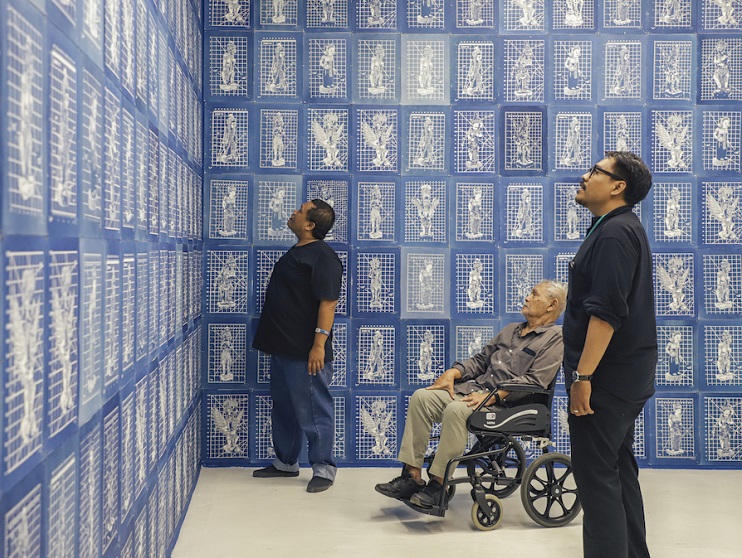
Blending printmaking traditions with experimental contemporary ideas, Agung Pramana offers a vibrant and accessible perspective on Bali’s cultural heritage. He represents an emerging generation of artists driven by renewed inquiry into identity and a deeper interrogation of the Dutch colonial norms of exoticism and exploitation that informed Western ideas about Balinese culture.
Sharing his thoughts about exhibiting in ARTJOG 2026, Pramana said, “I hope the ideas I explore, especially around history, colonialism, and how representation is constructed, can spark conversations and connect with a wider audience.”
ARTJOG 2026 ARS LONGGA is open from 19 June to 31 August 2026 at the Jogja National Museum (JNM) – located at Soboman no. 234 RT 06 DK.X, Ngestiharjo, Kasihan, Bantul, DIY, Indonesia.