


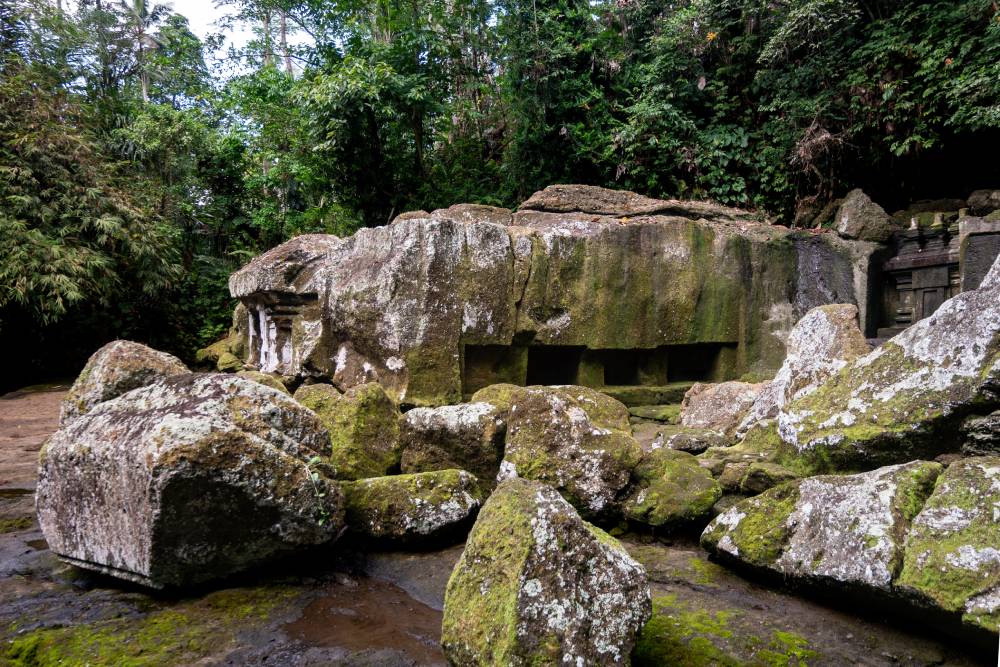
A hidden archaeological site remains a quiet testament to Bali’s ancient Warmadewa dynasty, deep in the Pakerisan River valley.
“Haji lumahing jalu,” reads an inscription at Candi Gunung Kawi, one of Bali’s most prominent archaeological sites dating back to the 11th century. Written in Ancient Javanese script, known as Kawi, the inscription loosely translates to “The king was enshrined here at Jalu.”
Jalu, it is believed by linguists, was used in the inscription to refer to either this particular site or for the Pakerisan River itself. But what has led archaeologists to believe it refers to the latter is that this Kawi word refers to the jalu/taji blade used in cockfighting (a cockspur). Meanwhile the river’s contemporary name Pakerisan, is believed to originate from the sacred Keris dagger. Thus both names refer to a type of blade, both poetic associations speak of the flowing waters that cut through the dramatic upland landscape of central Gianyar.
With a major source of its water coming from the Tirta Empul Holy Spring, and its importance for irrigation and domestic use, the Pakerisan River basin was both a spiritual and strategic location, which the Warmadewa dynasty would take root and call their heartland. Its banks became a ceremonial landscape, upon which monuments, from shrines to hermitages, were built. These stand almost a millennia later. Among them are: the aforementioned Candi Gunung Kawi, a complex of colossal rock-cut shrines carved into the cliffside; the boulder-gate and meditation site of Goa Garba; as well as Yeh Pulu, with its sprawling stone-carved relief leading towards the river. Furthest south is the famous Goa Gajah ‘Elephant Cave’, along with its many bathing pools.
One site of this period, however, has remained relatively off the history books and main tourist trails: Candi Tebing Tegalinggah.
Only around 100 people a month visit Candi Tebing Tegalinggah, shares Bapak Made, the site’s caretaker for the last 17 years. Crumbs compared to the 208,000 people that walked through the gates of the Elephant Cave in 2025, only 3.5km away. Yet, the site’s keepers aren’t too concerned about its lack of popularity. ‘It’s not the kind of place that suits crowds,’ comments one of them. ‘People take their time here, they really try to soak up the atmosphere, especially if they’re by themselves.’
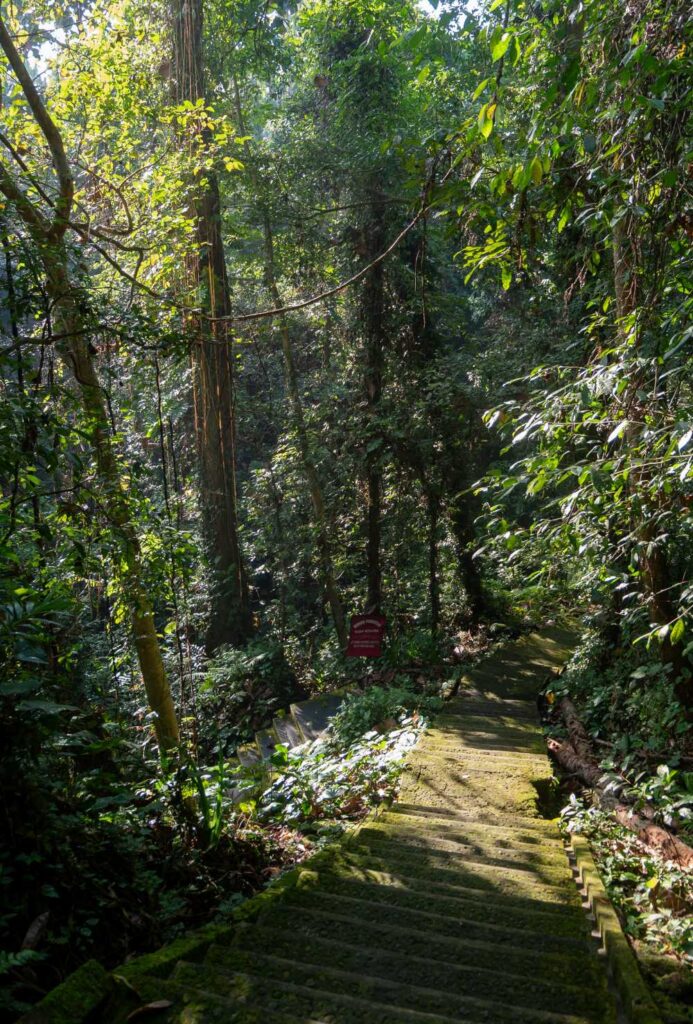
From behind a quiet village cul-de-sac of sorts, where an informal ticket booth is found, 300 moss-covered steps descend down the Pakerisan River valley. Wild ferns cling and sprout from the earthen mounds that line the stairway, vines droop, climb and tangle across the canopy, upon the trees stretching towards the sun. The valley walls heave with this dense vegetation, setting the atmosphere for the ancient site that sits below.
Near their end, the steps turn parallel to the valley and reveal below a bedrock shelf, a terrace-like opening of volcanic rock that juts above the Pakerisan flowing metres below. The aptly-named ‘cliff shrine of Tegallingah’ – Candi Tebing Tegallingah – nestles in this serene pocket of the valley, bordered on all sides by forest, stone and river.
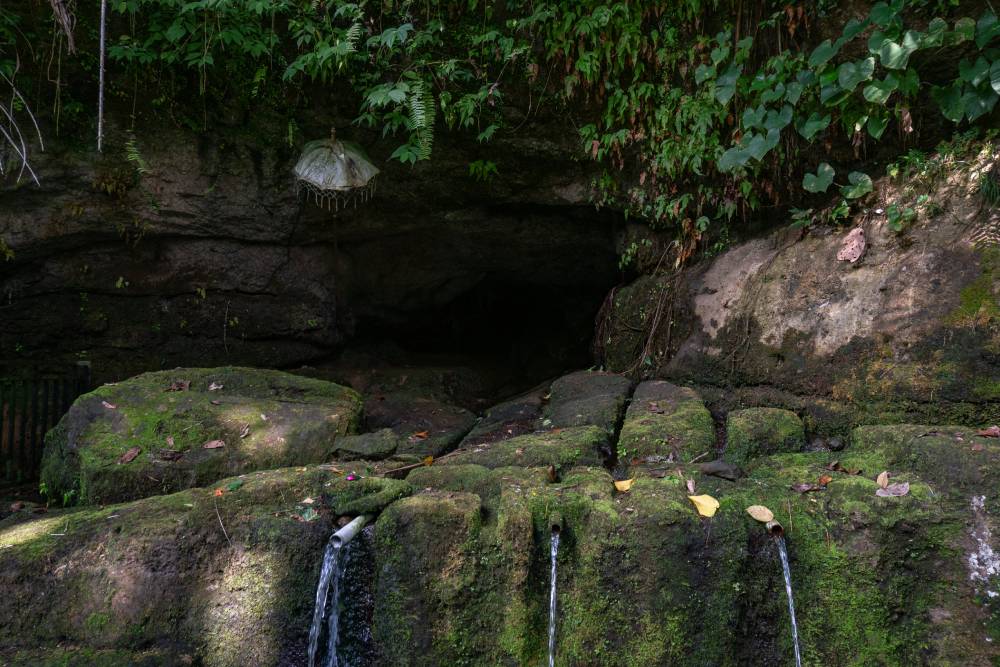
At its entrance, a natural stone cave feeds fresh spring water from out of the bedrock, channelled into a simple bathing pool where the worshipping Balinese Hindu will conduct their melukat water cleanse, or collect these holy spring waters for specific ceremonies. This is part of the archaeological site that remains the most functional today, but the history lies below, on a lower section of this rocky promontory.
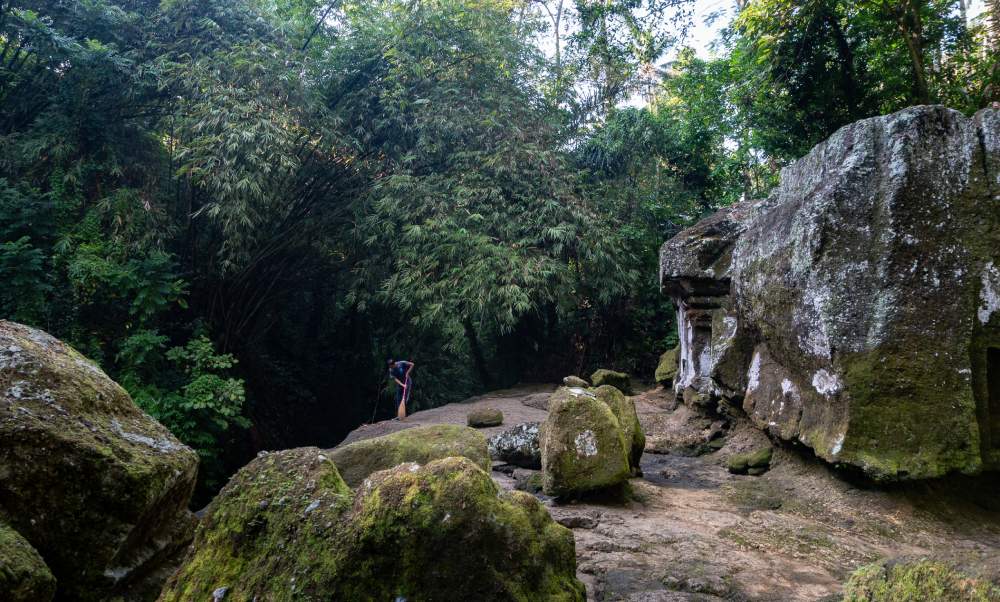
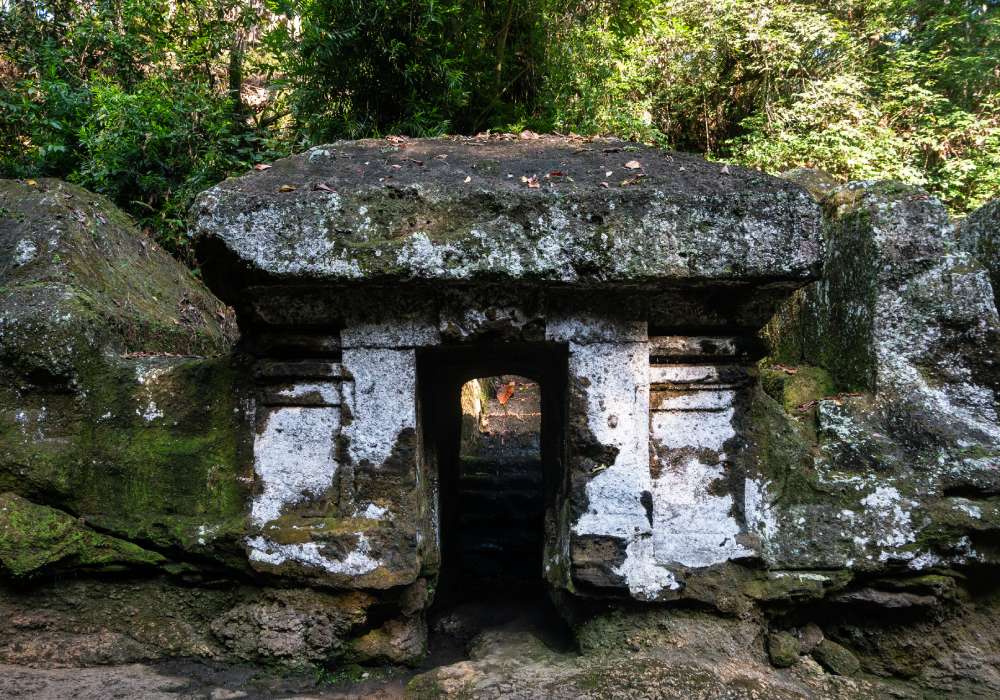
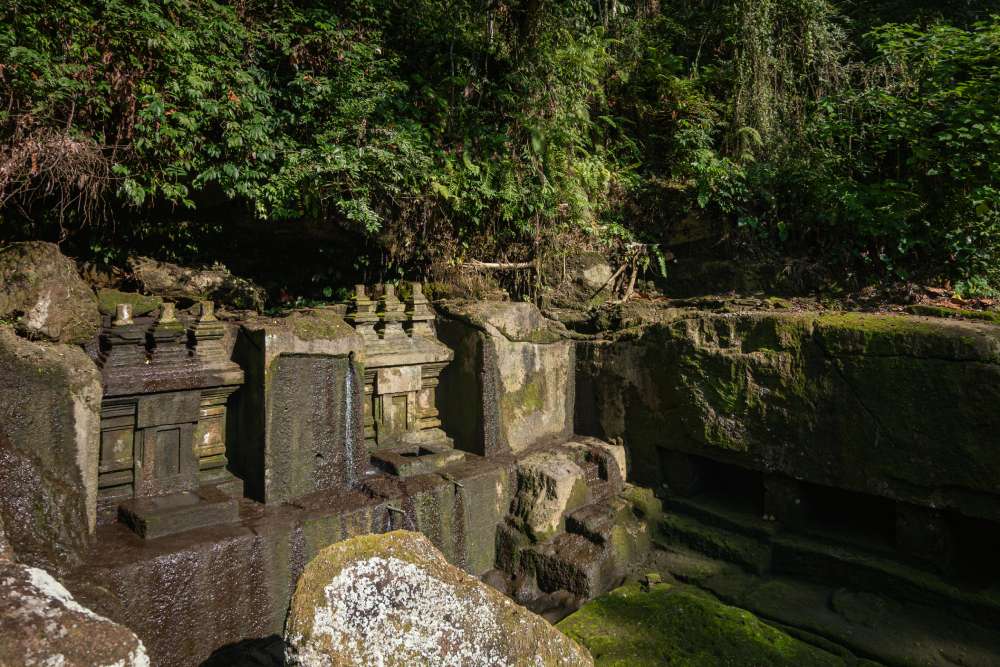
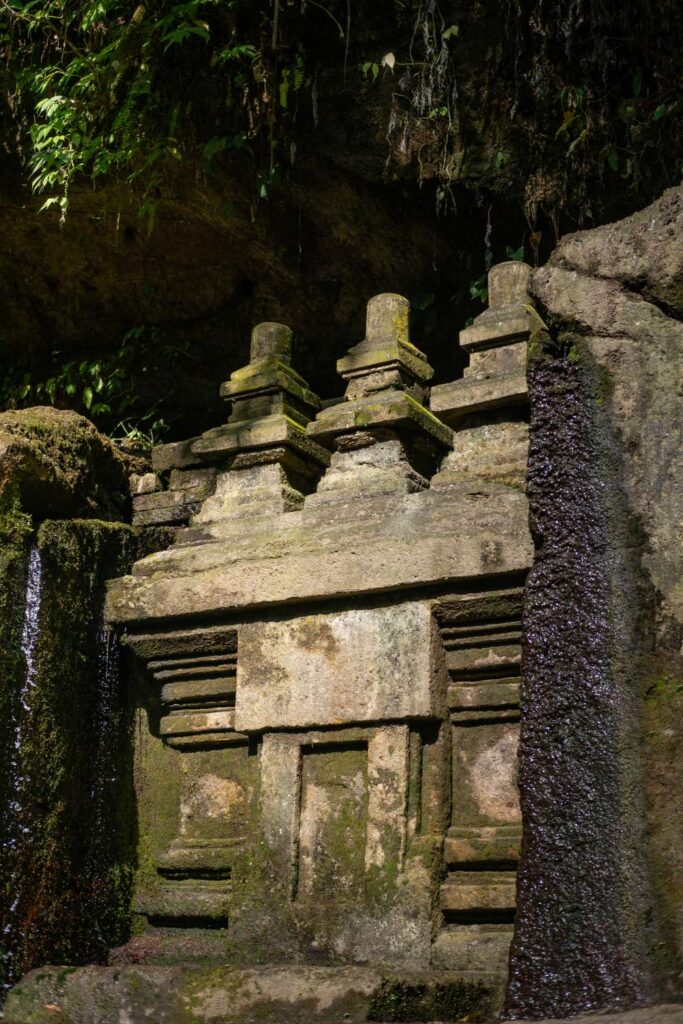
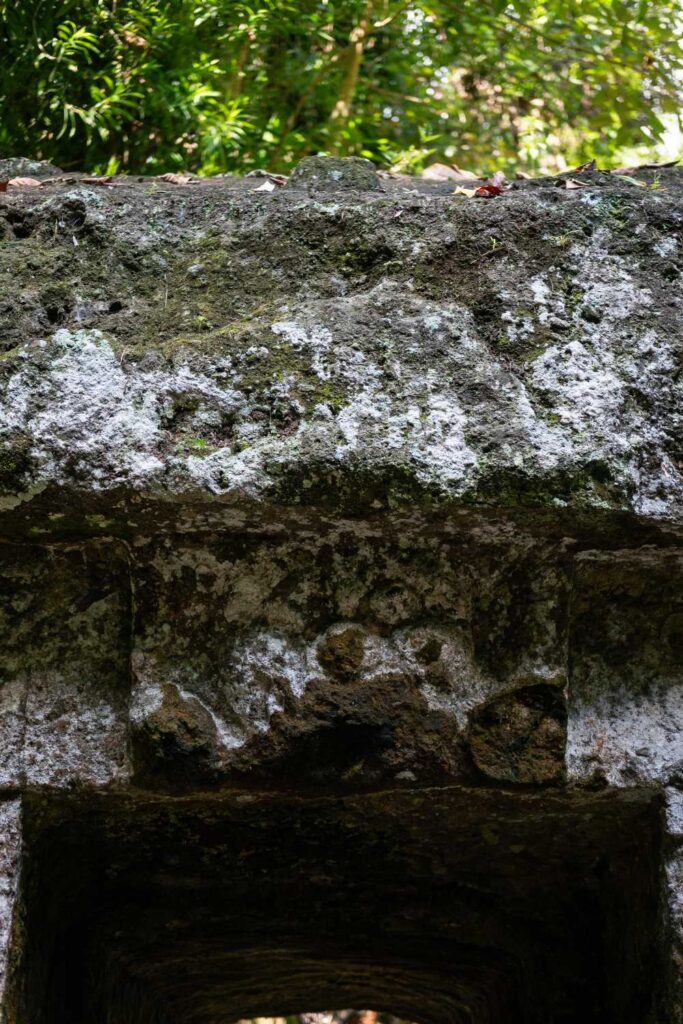
Rather than rising vertically from the river or spreading across a broad temple courtyard, the Candi Tebing Tegallingiah complex follows the natural contours of the broad rock shelf that runs alongside the Pakerisan. Moving along the shelf, the site unfolds in three principal sections. At the upstream end are a series of ceruk, or rock-cut chambers used for meditation and retreat. Further along is the heart of the complex: the main shrine area, where two rock-cut candi shrines, topped with three lingga each, stand elevated above a defined, square space, with more ceruk niches carved into the rock perpendicular to the shrines. At the downstream end, the shelf culminates at a monumental stone gateway, its lintel marked by the weathered face of Kala.
For those who have been to Goa Garba or Gunung Kawi, Candi Tebing offers a mix of both of these more popular sites, boasting its very own stone-carved gateway and rock-cut shrines. But where Gunung Kawi feels colossal and imposing, Candi Tebing comes across like a sanctuary; a peaceful alcove of meditation and reverence tucked deep in a valley forest. Similar to Gunung Kawi, water is a big feature here, travelling through the site from mountain to river, trickling down the shrines, rock faces, pools and bedrock – the affected waters would further consecrate the Pakerisan channel.
It was only 74 years ago that this entire site was still completely buried. Dutch archaeologist, J.C. Krijgsman, excavated the area in 1952, having been informed by a local Tegallingih resident that there was some kind of carved rock near the river. Yet, even after excavation, more questions arose… There were no inscriptions on the shrines like at Gunung Kawi, the temporary footholds of the stonemasons were still in place, and there were no stone box offerings (pripih) placed in the alcoves, as was customary for shrines. The architectural style and layout of the compound place Candi Tebing’s creation close to Gunung Kawi’s (10th-12th century), but it appears that the site was never properly completed. In fact, archaeologist A. J. Bernet Kempers (Monumental Bali, 1991), writes that the evidence actually suggests a rapid abandonment during the site’s creation – with some scholars suggesting an earthquake being the likely cause.
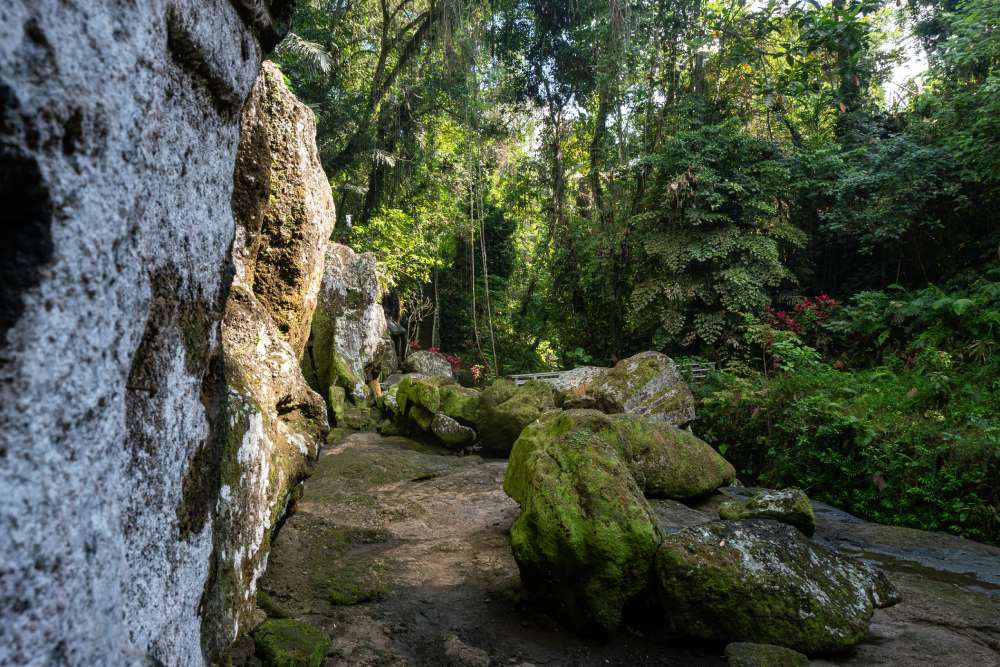
Whilst it appears that the royal and religious figures of the Warmadewa dynasty weren’t able to use this planned sanctuary, as visitors we are able to fully appreciate their vision for the site, their affinity with this river, and their knack for finding truly serene locations.
As the temple caretakers said, Candi Tebing Tegallingah is not a site for big crowds. Its lack of popularity may be its best asset, ensuring visitors can actually experience what the creators intended to be: a sanctuary of meditation deep in the forest.
A Note for Potential Visitors
There is difficult accessibility at Candi Tebing Tegallingah, with 300, potentially-slippery stairs, and a need to clamber down some rock face whilst the main staircase is in disrepair. The site also sits at the edge of a cliff with no safety ropes at its edge. Not advised for young children, elderly or handicapped; not advised during heavy rain season. Please visit with care and caution. Entry prices cap at IDR 30.000 for international adult visitors.