



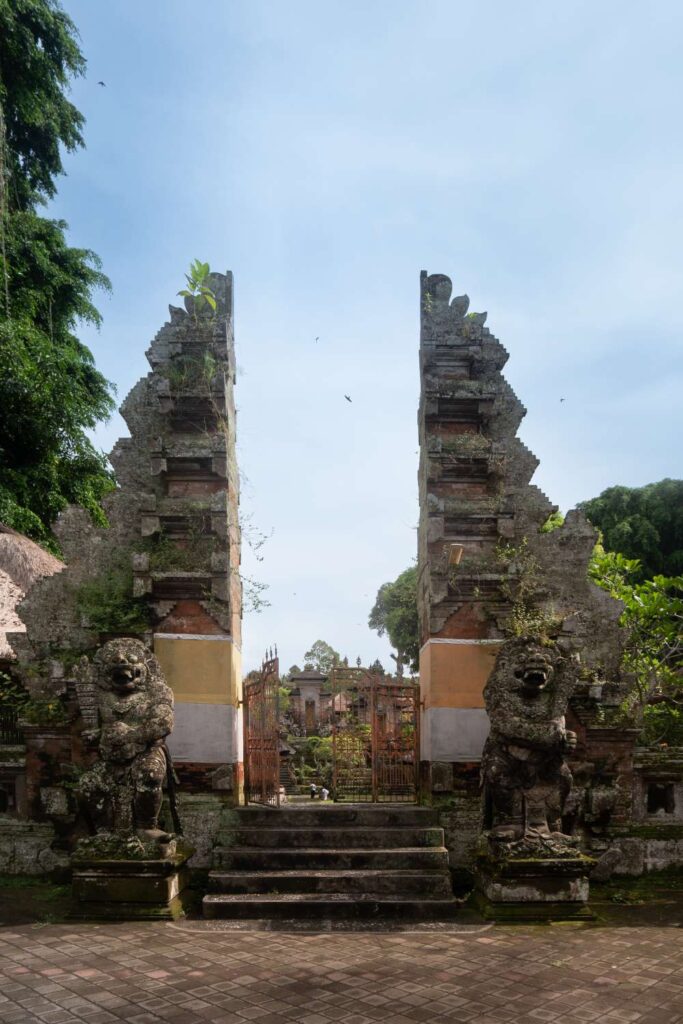
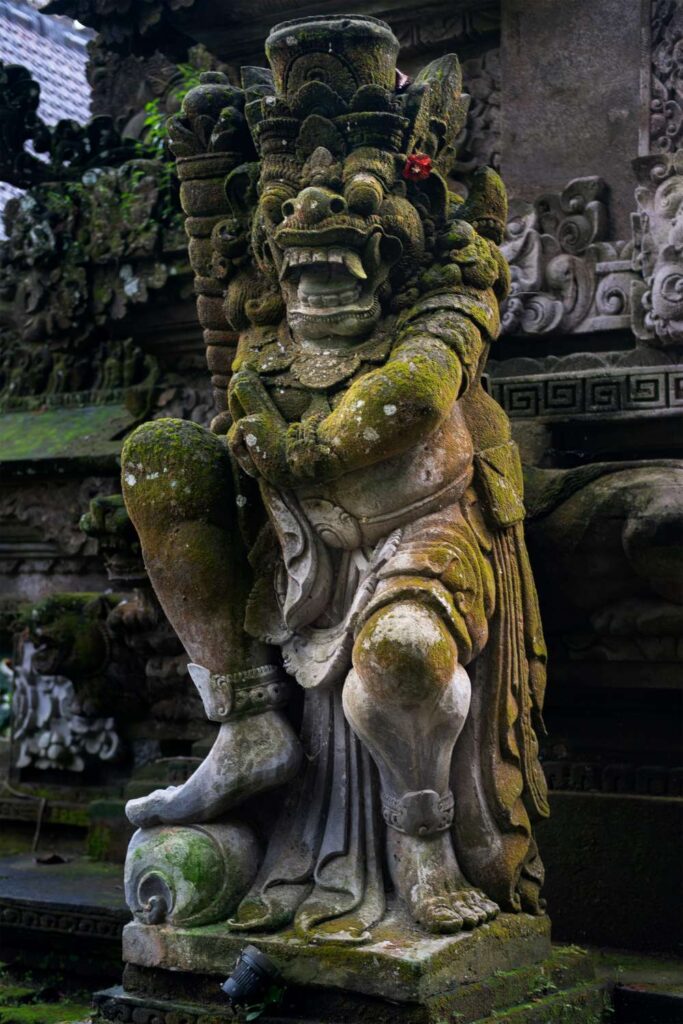
On the right: Close-up of a Dwarapala statue at Pura Gunung Lebah, Ubud. Photo by Edward Speirs.
When travelling in Bali and passing certain buildings, whether temples or houses, it is common to see two statues positioned on the right and left sides of the entrance, as if they standing guard– and indeed, they are. These two statues are known as Dwarapala.
Derived from the words Dwara, meaning door, and Pala, meaning guardian, Dwarapala literally means guardian of the door. They are depicted as sturdy figures with serious or angry expressions, bulging eyes, and long, prominent fangs, their subtle smiles simultaneously conveying a sense of friendliness and firmness. They hold clubs and are ready to protect the sanctity of the buildings from disturbances from both sekala (physical) and niskala (non-physical/spiritual) realms.
Pairs of these statues each have their own distinctive characteristics and may consist of two figures who differ in character, status and position. Usually, the more sacred the area, the higher the status of the Dwarapala guarding it. The pairing of two different characters reflects the philosophy of duality known as Rwa Bhineda in Balinese tradition and cultural order.
Examples of commonly encountered pairs include the siblings Subali and Sugriwa, the husband-and-wife pair of Pan Brayut and Men Brayut, the father-and-son pair of Merdah and Tualen, and pairs of twin giants. In some areas, Dwarapala pairs also reflect the customs and traditions of their local surroundings. For example, in Uluwatu and Sangeh, which are natural habitats for monkeys, the statues are often associated with monkeys.
As for their placement, the masculine Dwarapala, or the one regarded as the older or ‘higher’ figure, is usually placed on the left side of the entrance gate and symbolises the upper realm. Meanwhile, the feminine Dwarapala, or the one regarded as the younger or ‘lower’ figure, is placed on the right side and symbolises the lower realm.
Many believe that Dwarapala serve as selectors, meaning that those with bad intentions may encounter difficulties when attempting to enter a sacred place. On the other hand, Dwarapala also serve as guides, receivers and escorts, as these figures are regarded as symbols that guide and lead worshippers towards a higher path.
Balinese Hindus also make offerings as a form of gratitude to the Dwarapala. Even in homes or buildings without Dwarapala statues at their entrances, offerings are made on both sides of the doorway, as people believe that unseen figures are present to help guard the premises.