


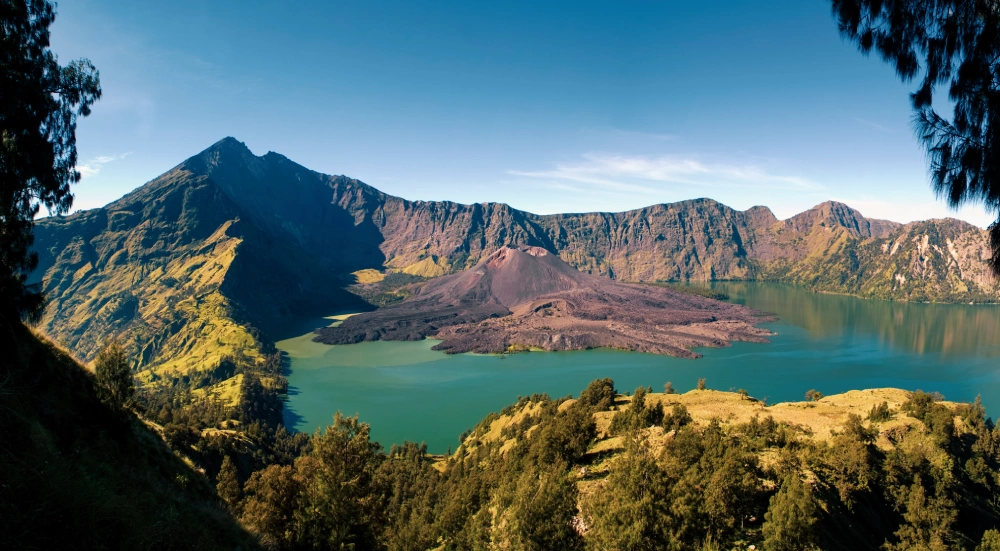
Rinjani is a dramatic, dreamy kind of place. A landscape that could have been lifted from the pages of a graphic fantasy novel. The peak is around 3,700 metres above sea level, and on three sides the mountain drops almost directly into that sea. The lake is said to be 200 meters deep in places. Huge waterfalls gush over wooded escarpments and into deep valleys to the west and south, creating their own misty weather patterns among the vertical greens of gorges and rushing rivers. And, in the southeastern corner of Lake Segara Anak, the ever-growing cone of Barujari sits smoking beneath the caldera walls. The name means ‘Newly Made.’
Every so often, the infant volcano erupts, sending showers of glowing volcanic material into the sky. Towering clouds of hot ash settle around the island and drift into the upper atmosphere.
For many on Lombok, Mount Rinjani is the centre of the world. Like Agung on Bali, Rinjani is a sacred mountain, a bridge between heaven and earth, between God and man, the human and the divine.
It is perhaps unsurprising that there are so many local legends, stories, rituals, and beliefs associated with the mountain. Local people see evidence of the divine in the island’s occasional volcanic eruptions, in the shuddering of the earth, the coming together of the basic elements of earth, fire, water, and smoke.
Both Hindus and Muslims pilgrimage to Mount Rinjani to pay homage to the god of the mountain, the goddess of the lake. Each year in the light of a full moon, traditional leaders from Sembalun Village climb Rinjani to perform the ritual of Jambeq Gunung.
The 360-degree view from the peak takes in the whole of Lombok – and beyond to Sumbawa in the east and Bali in the west. I once climbed the mountain, but by the time we made it to the top, the morning’s misty cloud cover was already beginning to form. We had just a few minutes to enjoy the view before it was gone. Enjoyment is perhaps not what I was feeling at the time, though. A step or two beyond where we squatted, the ground dropped almost vertically to the lake, some 1,600 metres below. That wide, airy void felt very threatening to me.
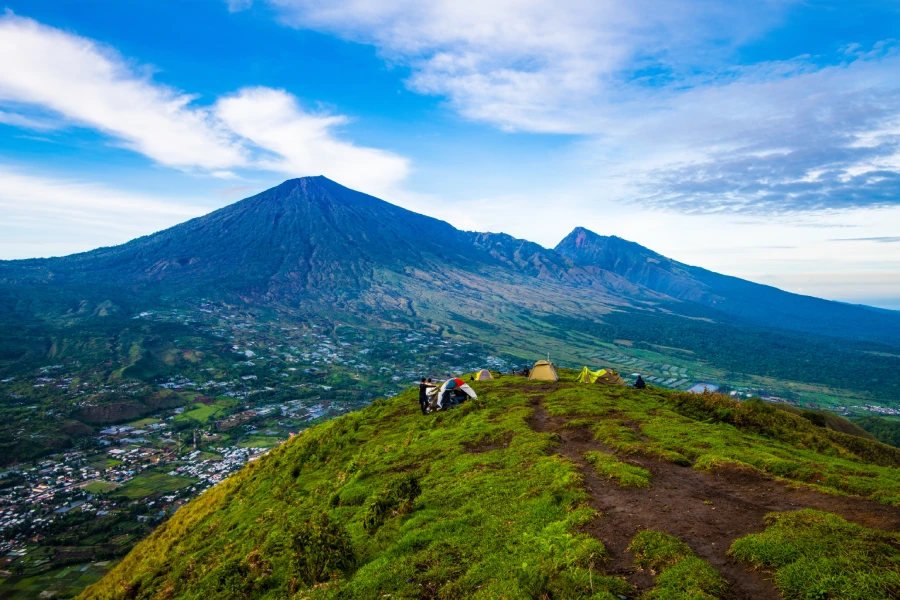
Sembalun and Mount Rinjani, photo by David Metcalf
Overcome by vertigo, short of breath, and exhausted by the climb, my knees shook as I crouched on the rim for a photo, before easing myself back down to a somewhat safer sitting position and shuffling backwards off the ledge. And it is there, by the peak, that the locals pray and make offerings to appease the mountain and its gods, hoping to stave off misfortune, hoping that the sacred water will continue to flow, that their crops will grow abundant.
‘We are part of the nature,’ explains Pak Haedi, a village elder from Sembalun. ‘We humans have a responsibility, given by God, to take care of the environment. So, we try to communicate with the mountain.’
Mount Rinjani is believed by many to be inhabited by a community of Jinn (sometimes known as Genies), most of whom are good Jinn. This Jinn nation is led by a queen named Dewi Anjani, who lives at the top of the mountain, to which she gave her name. Southeast of the peak is a caldera called Segara Muncar, or ‘Sea of Dust’. It is said that sometimes, when the conditions are right, you can see the palace of the Jinn queen there. The guides and porters who take trekkers up the mountain tell of sightings of Dewi Anjani near the hot springs where we bathed. Apparently, after a series of misfortunes, the face of the Goddess was transformed into that of a monkey. It is not clear to me how you can tell it’s the queen, if she now looks like a monkey, but mysteries abound.
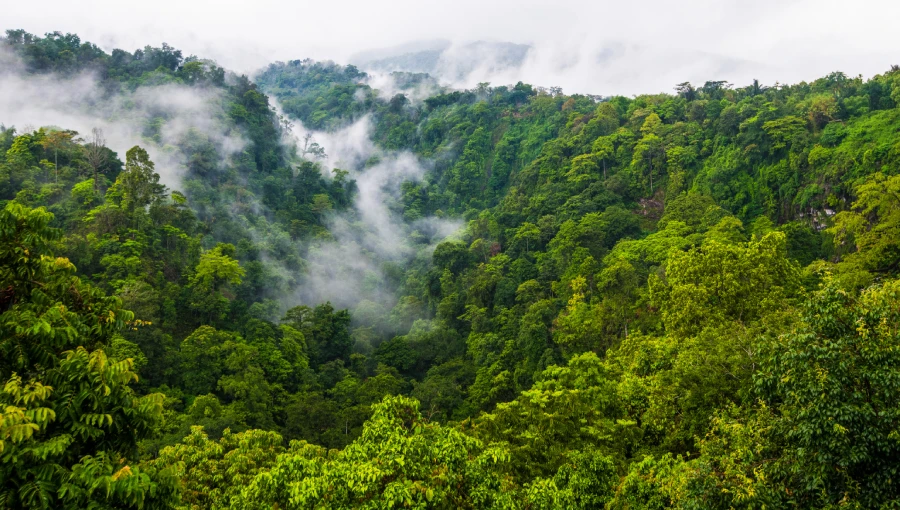
Mist folds into the foothills of Mount Rinjani, photo by David Metcalf
Various versions of Dewi Anjani’s story can be found – some in old manuscripts such as Babad Lombok, Babad Sakra, and the Doyan Neda. The stories, written variously in old Javanese, Balinese, Arabic, and Bugis scripts, weave together local history, mythology, Islamic and Hindu traditions, and the Ramayana into convoluted tales – some dating back as far as the early 14th century. In one story, Dewi Anjani owned a pair of powerful birds, one with an iron beak and iron claws. The birds flattened the mountain, and it became an island. Lombok.
Dewi Anjani’s ancestor, the Prophet Adam, of Adam-and-Eve fame, urged her to populate the new island by turning a group of Jinn nobles into humans. For the Sasak people, it is not a bad thing to have a story in which you and your ancestors are descendants of the first prophet, of Jinn nobility – and perhaps of a Jinn queen, Dewi Anjani, Goddess of the Lake.
A visit to the old mosque in Bayan in the foothills of Rinjani may offer some more clues: Bayan is the heartland of the Wetu Telu Islamic faith in Lombok. The little mosque sits comfortably in a scenic setting; a fold in the hills by a small stream. Neatly trimmed lawns and huge shade trees. Positioned on a small rise, elevated by a natural stone retaining wall, the mosque is walled with woven bamboo, its dominant feature a high thatched roof, tiered with a clerestory near the top in the Balinese and old Javanese style. An echo of the pre-Islamic Hindu culture.
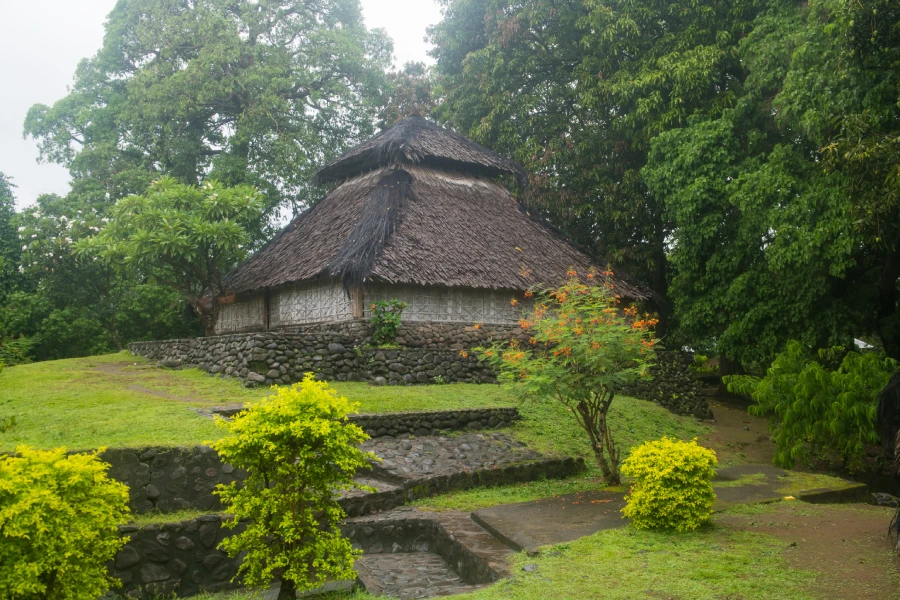
The old mosque at Bayan, photo by David Metcalf
A local official meets us at the gate. Dressed casually in a loose shirt, sarong, and batik cloth headband, he smiles and checks that we pay the modest entrance fee and are dressed appropriately. Long trousers for me, a sarong for my wife. Formalities out of the way, we stroll together into the shady compound, and the official begins to explain the history of the mosque.
‘This is the first mosque on Lombok,’ he says. ‘It was built by Sheik Gaus Abdul Razak – a holy man who brought Islam to Bayan in the 16th century.’
The mosque is locked, but bending low and peering through slits in the exterior wall reveals a dim interior. Four coconut palm pillars support the central tiered roof, like a Javanese joglo. A big old drum is suspended from the roof, used to signal the time for Islamic prayers. Tied to a frangipani tree in front of the mosque is a traditional clay pot for wudhu, the ritual washing required before prayer. Several old structures in the compound house the tombs of Bayan’s early Islamic leaders.
‘Do people here follow the Wetu Tulu traditions?’ I ask. ‘How many times a day do you pray?’ According to one interpretation, Wetu Tulu adherents pray three times a day – a deviation from the standard of five daily prayers.
‘We follow normal practices,’ he turns a quizzical look at me. ‘Our Islam is the same as others.’ Perhaps this is a sensitive topic. I wonder. Or perhaps the old Wetu Tulu is dying out.
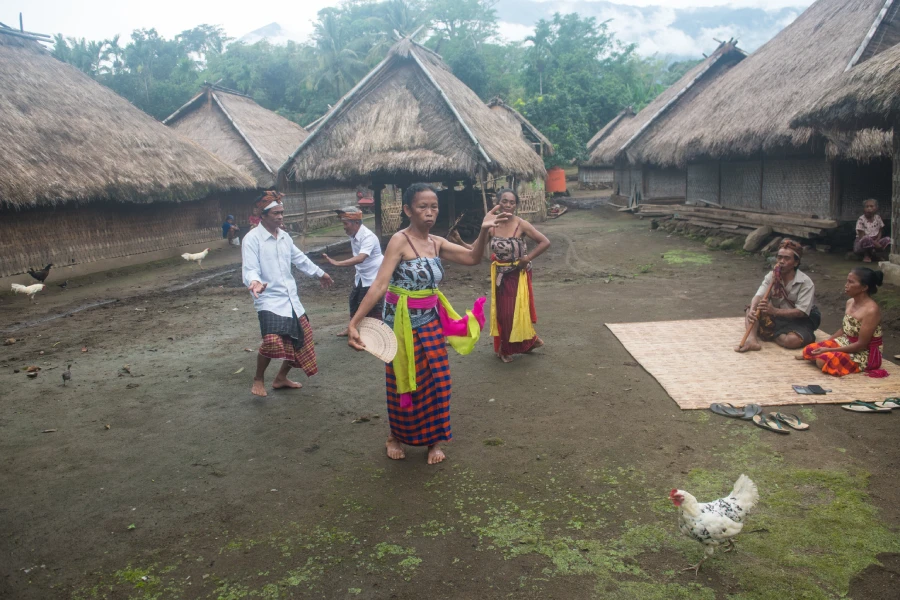
Sasak villagers dance at Bayan village, photo by David Metcalf
Late morning sunshine filters through the trees. The guide’s unhurried stories, his gentle smile; the peaceful atmosphere – we are the only visitors; a faint murmur of water flowing over smooth rocks in the stream below and the sound of birds high in the trees above; the scent of the frangipani, associated with graveyards in the Indonesian Islamic tradition – it all combines to create a deep sense of calm. A quiet reverence for the past and the present, for the ways in which people the world over have found meaning in spiritual traditions, integrating respect for the natural world, ancient animist beliefs and the big religious traditions, into more contemporary understandings of the world. I find myself admiring the way in which these traditions have been maintained over time, evolving into the present, rooted in the past.
Whilst most travellers are lured to the pristine and rugged coastlines, it is here in Rinjani, at the island’s centre, where one can discover Lombok’s true heart and mystic history.
This story is an adapted extract from The Lands Below the Winds, Mark Heyward’s upcoming book on travels to eastern Indonesia. This follows the author’s best-selling travel memoirs, Crazy Little Heaven, an Indonesian journey, and The Glass Islands, a year in Lombok, along with a novel, The Quality of Light.