


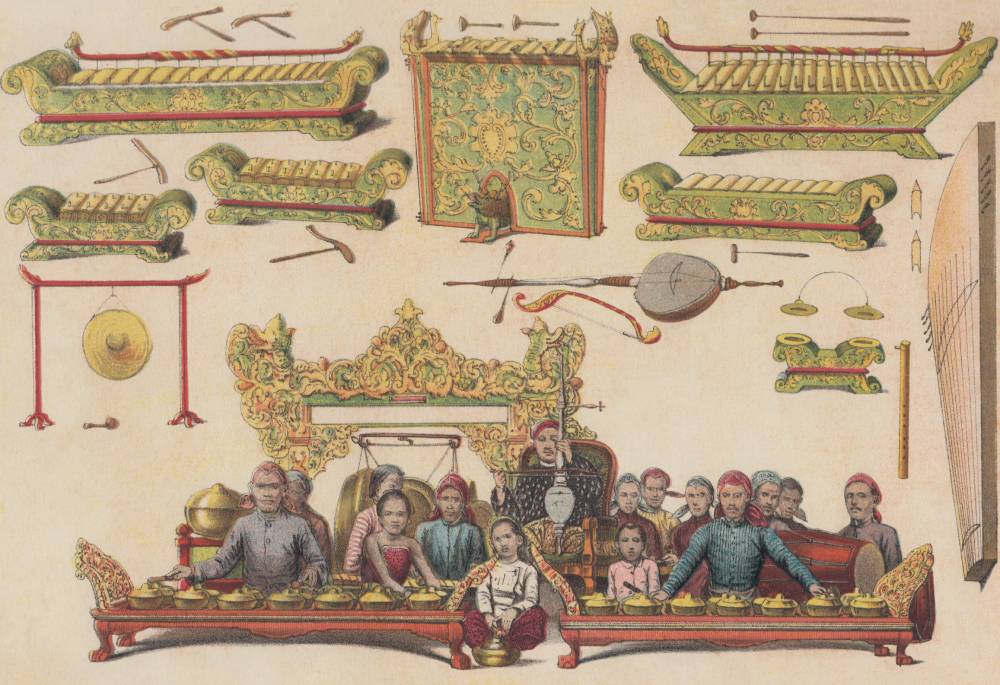
Traditional music in Indonesia reflects the country’s multicultural heritage, drawing influences from Hindu, Buddhist, Islamic, and indigenous traditions. The archipelago is home to many musical styles and instruments. Music here is not just entertainment, but a rhythm that courses through daily life, festivals, politics and spiritual rituals. From ancient courts to bustling markets, music unites Indonesians and preserves stories passed down for centuries. In this article, Sake Santema from Indies Gallery shows a few of his antique prints and photographs depicting common instruments in Javanese and Balinese traditional music. These instruments, when brought together, form the renowned gamelan ensemble.
About the Gamelan
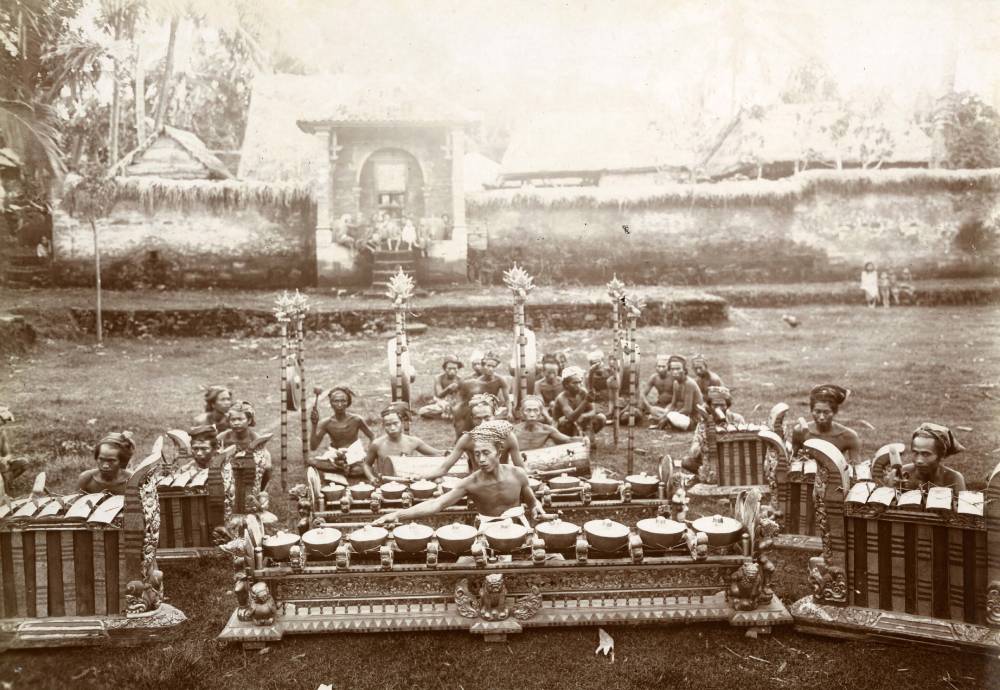
According to Javanese mythology, gamelan was created around 230 C.E. by Sang Hyang Guru, a god who ruled Java. Sang Hyang Guru needed a signal to summon the gods, so he crafted the first gong. To convey more complex messages, he created two additional gongs, forming the original gamelan set. Gamelan-like musical ensembles appear on the reliefs of the Borobudur Temple which dates back to the 8th century. The form and development of gamelan music continued through the Majapahit Empire period (12th to 15th century) and evolved over the centuries.
When the Majapahit Empire was succeeded by Muslim rulers in the 15th century, many Javanese moved to Bali, bringing their culture, religion and art forms. This migration led to the preservation of Javanese Hindu culture in Bali and had a notable impact on Balinese music, particularly the gamelan ensemble and other forms of traditional music.
Despite these historical connections, distinct differences exist between Balinese and Javanese musical styles and performance contexts. Balinese gamelan is typically characterised by a faster tempo, higher volume, and greater vibrancy, whereas Javanese gamelan is generally slower, softer, and more meditative. These distinctions are further reflected in their respective functions: Balinese gamelan is closely integrated into village life and temple ceremonies, while Javanese gamelan traditionally accompanies courtly or ritual occasions and is considered more refined.
Gamelan is not a single instrument, but rather an ensemble made up of a variety of musicians playing gongs, metallophones such as the bonang, xylophones like the saron, and drums known as kendang. The ensemble produces a mesmerising, metallic sound that is a defining feature of the musical traditions of Java and Bali. Each gamelan ensemble is uniquely tuned, so no two are exactly the same. The enchanting sound of gamelan music has even influenced Western composers, including Claude Debussy, who encountered it at the 1889 Paris World Exposition.
Kendang Drum
The kendang, a double-headed drum, is considered the heartbeat of many Indonesian musical ensembles. It is responsible for setting the rhythm in gamelan performances and plays a vital role in wayang shows. Skilled kendang players have the ability to change tempos and signal dramatic moments in dance or theatre, guiding the progression of the narrative. Good kendang instruments are said to be made from the wood of jackfruit or coconut trees. Buffalo hide is often used to create low-pitch beats, while soft goatskin is used for high-pitch beats. The thinner the leather the sharper the sound. It is most likely that the kendang drums existed long before they were part of the gamelan ensemble. We find drawings of different shapes and sizes on the walls of temples, some dating back to the 8th century.
Bonang Gong
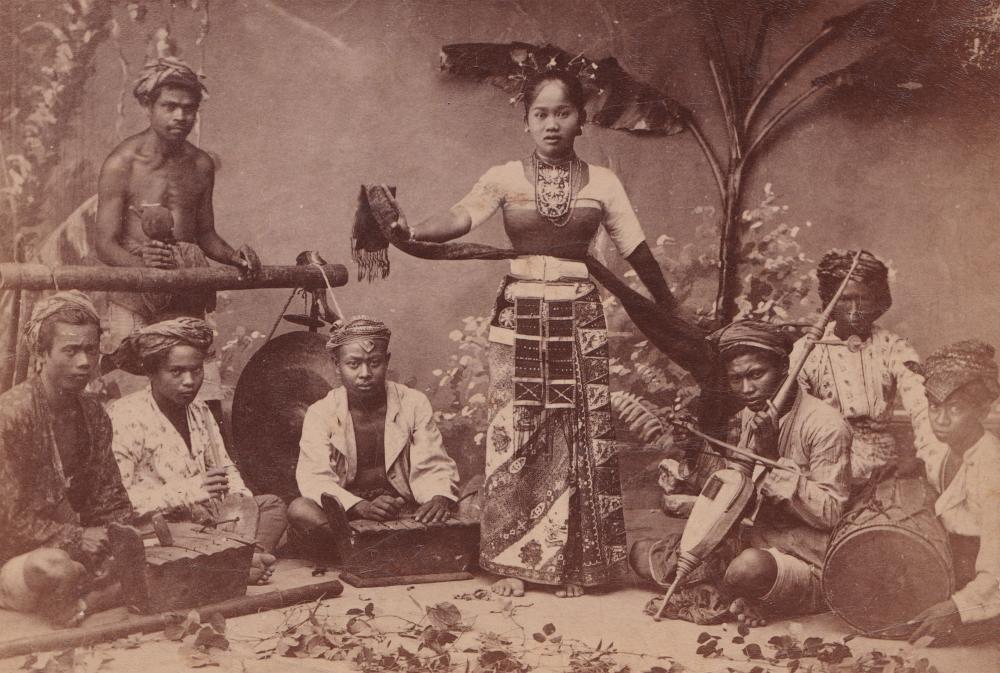
The bonang consists of a set of small gongs that are played with mallets or sticks. It is a central instrument in gamelan ensembles, providing both rhythmic drive and melodic variation. The metallic tones of the bonang blend with other instruments, creating lively and intricate rhythms that are characteristic of traditional Indonesian music.
Rebab String Instrument
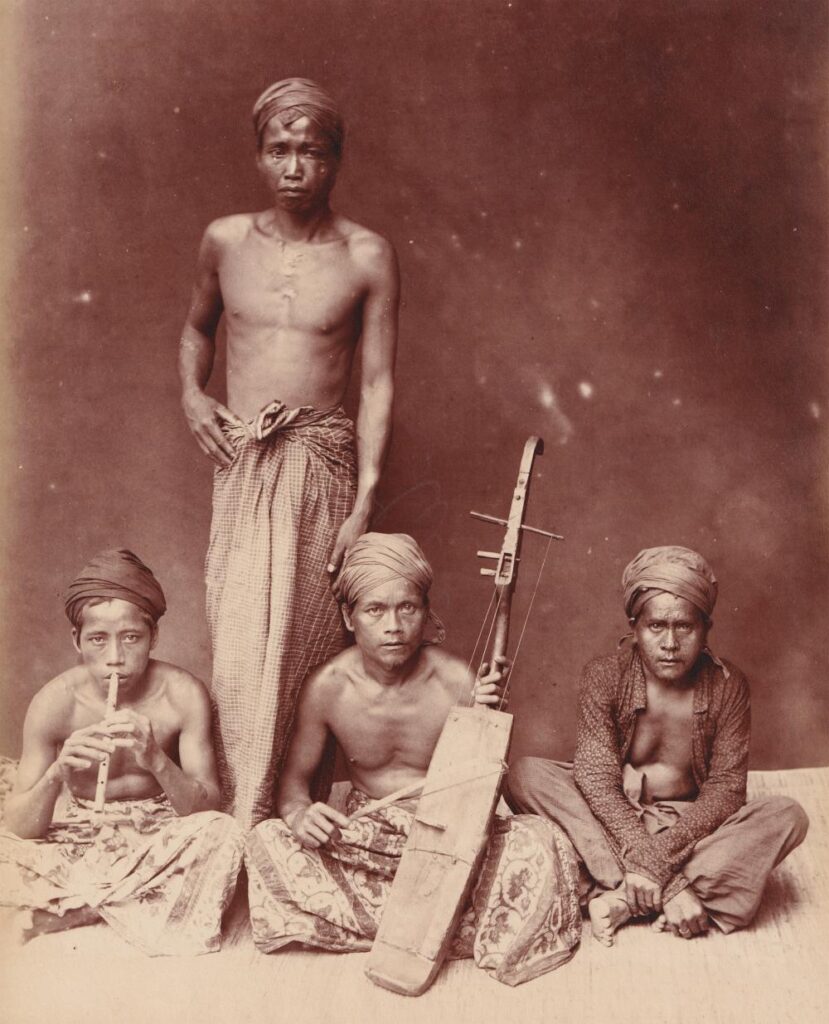
Left: Taken around 1870, this photograph features four musicians in a studio setting, with the young man in the centre holding a rebab. Their attire and instruments suggest they were humble musicians, perhaps traveling performers who hoped to one day gain recognition by playing in a renowned gamelan ensemble. (Sake Santema Collection)
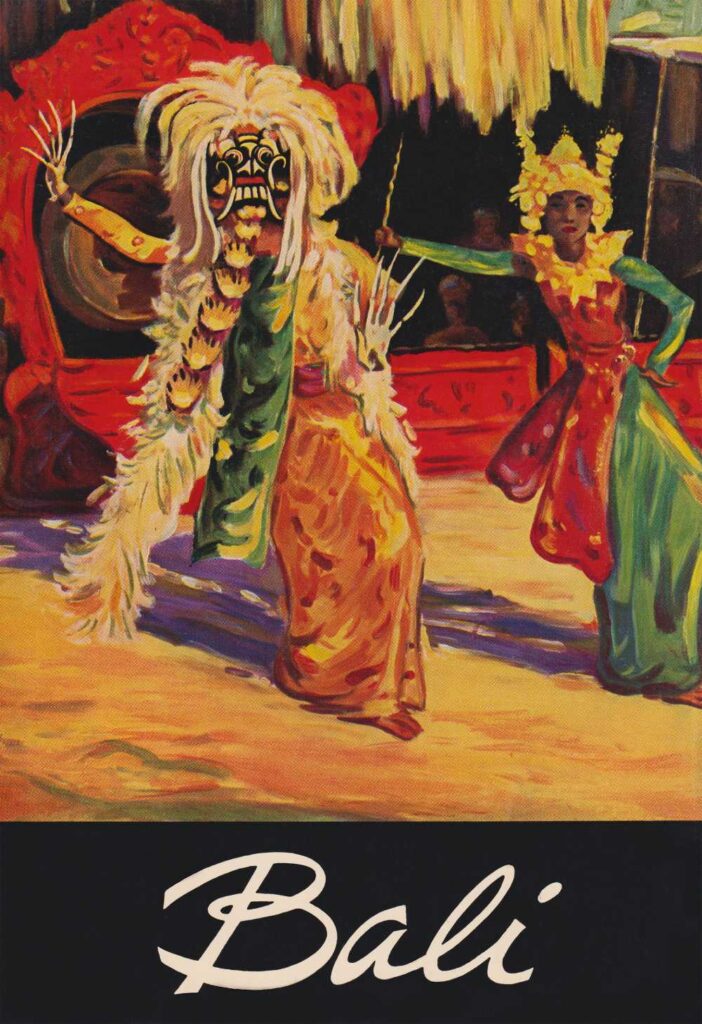
Right: A 1930’s travel guide cover showing two Balinese dancers standing in front of a gamelan ensemble. (Sake Santema Collection)
The rebab is one of the earliest known bowed string instruments, with origins tracing back to Central Asia and the Middle East around the 8th century. It arrived in Indonesia through Islamic trading routes, likely in the 15th century. A rebab can be one, two or three strings. Played in an upright position with the musician sitting cross-legged behind it, the rebab’s high-pitched sound can mimic the human voice, making it a powerful tool for expressing emotion during storytelling and rituals. It often leads the melody in both gamelan and folk ensembles and is found across Java, Bali, Sumatra, and Sulawesi.
Suling Flute
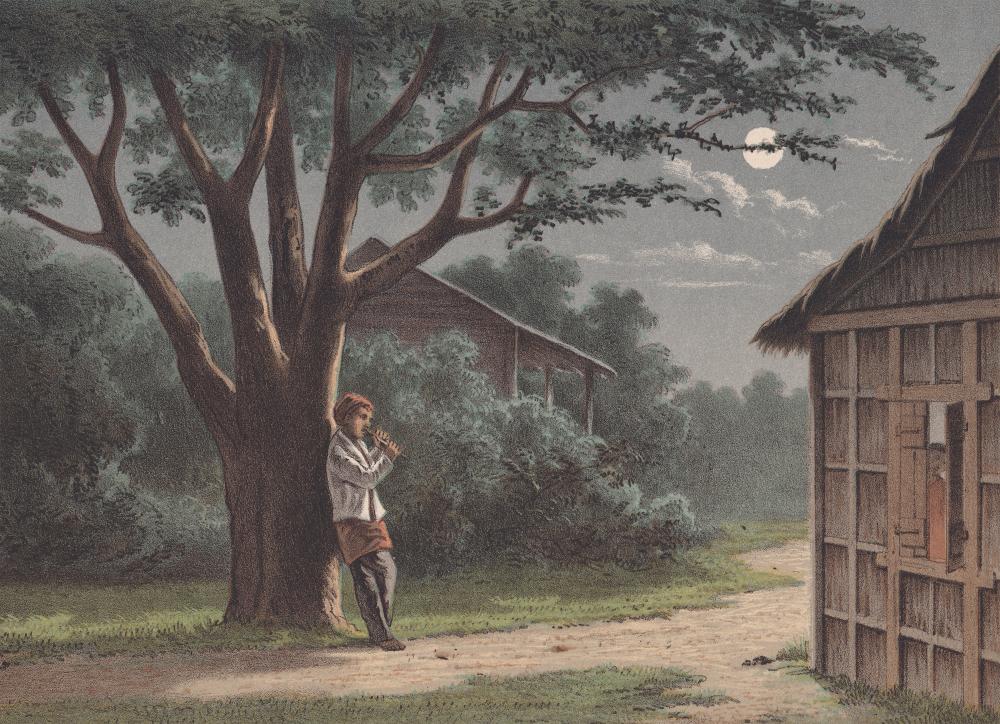
The suling is a bamboo flute originating from Bali and Java. Made from a single piece of bamboo, it produces soft melodic tones by blowing through one end and adjusting pitch by covering finger holes. The flute is the world’s oldest known musical instrument, with some ancient examples crafted from mammoth and cave bear bones dating back over 40,000 years. While the earliest known flutes were discovered in Europe, Asia also boasts a rich flute-playing heritage. In fact, a remarkably well-preserved, playable bone flute unearthed in China dates back an impressive 9,000 years.
Occasions for Gamelan Performance
Gamelan music in Indonesia isn’t just for grand occasions—it’s woven into the fabric of daily life.
Traditional Ceremonies
Gamelan music is considered sacred in Bali and Java, and believed to invite ancestral spirits and purify the environment during royal ceremonies, religious rituals, temple festivals, weddings and cremations. Some ancient gamelan sets are said to be “alive,” and are treated with offerings and respect as if they possess spirits. Performances often take place on open pavilions called pendopo or joglo, particularly in Java, where they can last from 6 to 8 hours, usually at night. In Bali, it accompanies sacred temple ceremonies and ritual dances like Legong or Barong.
Cultural Festivals and Performances
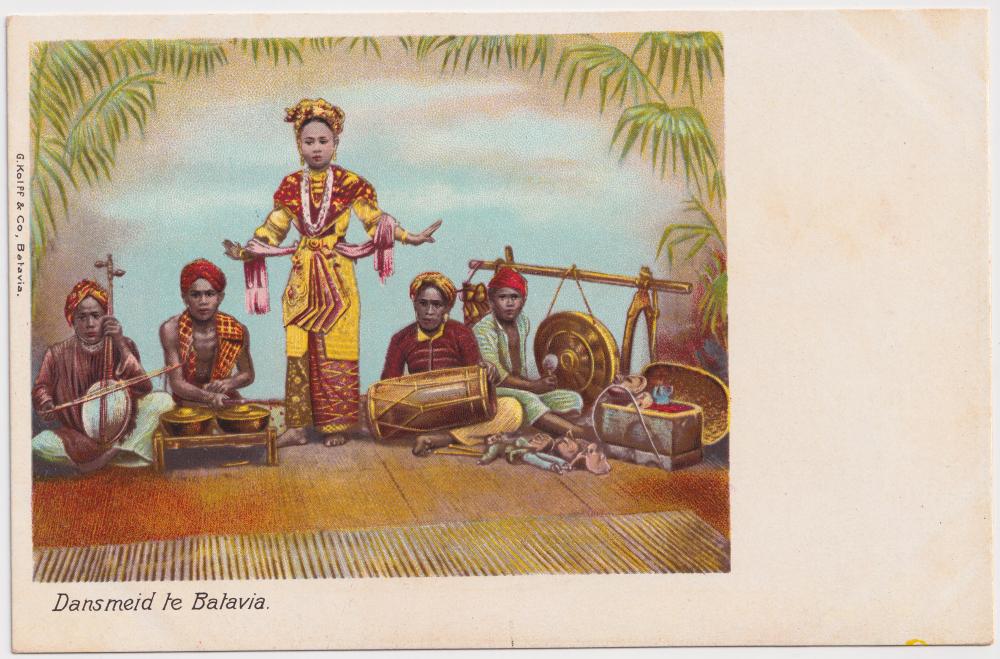
Beyond ceremonies, gamelan is used for entertainment in community halls, cultural venues, and radio broadcasts. Traditional music genres such as Javanese poetry, Bedhaya dance, Topeng masked dance drama and wayang kulit (shadow puppetry) are often accompanied by gamelan ensembles. Performances can be both structured concerts (klenengan) for musical enjoyment and public cultural events lasting many hours.
Gamelan is played at cultural festivals like the Bali Arts Festival, the Gamelan Festival in Solo, and the Yogyakarta International Gamelan Festival. During the annual Bali Arts Festival, thousands gather to witness spellbinding gamelan performances and traditional dances.
National and Local Holidays
Gamelan music is also featured during major holidays such as Galungan and Kuningan in Bali, local parades, and musical competitions, connecting communities and reinforcing cultural identity.
Indonesia’s traditional music encompasses a diverse array of styles reflective of the nation’s many islands and cultural groups. Preserved across generations, these musical forms play a significant role in fostering community connections, reinforcing cultural identity, and engaging audiences at home and abroad.
The authentic prints in this article are available for purchase through Indies Gallery, while high-quality reprints can be found at Old East Indies.
Indies Gallery & Old East Indies
Jl. Gambuh No.17, Denpasar, Bali
www.indiesgallery.com
www.oldeastindies.com