



On the morning of 20 October 2025, around ten thousand villagers will set out on a 25-kilometre walk in procession from the cooling mists of Tamblingan, the mountainous lake in central Bali, down to the north coast. This grand procession is a ceremony observed once every two years by the joint community of Catur Desa, literally the ‘four villages’, nestled around the twin lakes of Tamblingan and Buyan.
This special mountain community, known as ‘Catur Desa Adat Dalem Tamblingan’ –– the four villages of the traditional community of Tamblingan – is said to have been established in the mountainous regions of Bali since before the 9th century. Mention of their settlements can be found in ancient inscriptions of Balinese kings: Ugrasena (922 AD), Udayana (991–1018 AD), and Suradipa (1119 AD).
For generations the communities of Adat Dalem Tamblingan have remained committed to the ecological and spiritual conservation of their surrounding environment – the lakes and forests found on the foothills of Mt. Lesung. Descended from a Hindu sect devoted to Wisnu (Bhujangga Waisnawa), the God of Water, they follow a traditional doctrine that reveres water as a sacred element (Piagem Gama Tirta).
Before modern science could prove their beliefs right, the community understood the importance of these mountain lakes as main sources of water for much of lowland Bali. A centuries-old accounts tells the story of agricultural leaders of Jatiluwih, Tabanan, on their search for water. They travelled deep into the highlands and found Tamblingan Lake. They pleaded with the elders of the community to create a water channel (no wider than a lidi, the spine of a palm leaf) that could lead to the lowlands and irrigate their crops. The elders agreed, but as they began to dig, the narrow lidi channel widened to the breadth of a human head, giving Jatiluwih an abundance of water. Now, the famous, terraced rice fields are a UNESCO-listed area.
The forests, Alas Mertajati, which capture the water and feed it into the lakes, are given just as much respect, with its name meaning merta (life) and jati (essence or source) – the source of life. Meanwhile, the lake’s name, Tamblingan, is derived from the words tambe (cure) and eling (consciousness), given after a mass healing event said to have taken place in the 10th century. In the darkness of the new moon (tilem), the community living in the Mertajati forests all fell ill, and it was the waters of the lake, and the mantras of a sage by the name of Dalem Bahem, that cured them.
It was this very same sage, Dalem Bahem (later Dalem Tamblingan) who was said to have founded the original Alas Mertajati settlement, after finding a spiritual connection to a deep cave in the mountain forests (Goa Naga Loka). In the 14th century, the community agreed to leave Mertajati forest to preserve its sanctity and purity, disbanding and resettling into four villages: Gobleg, Munduk, Gesing and Umajero. This gave rise to the ‘Catur Desa’, the four villages, who share the responsibility of safeguarding the sanctity of the region.
Conservation Through Customs
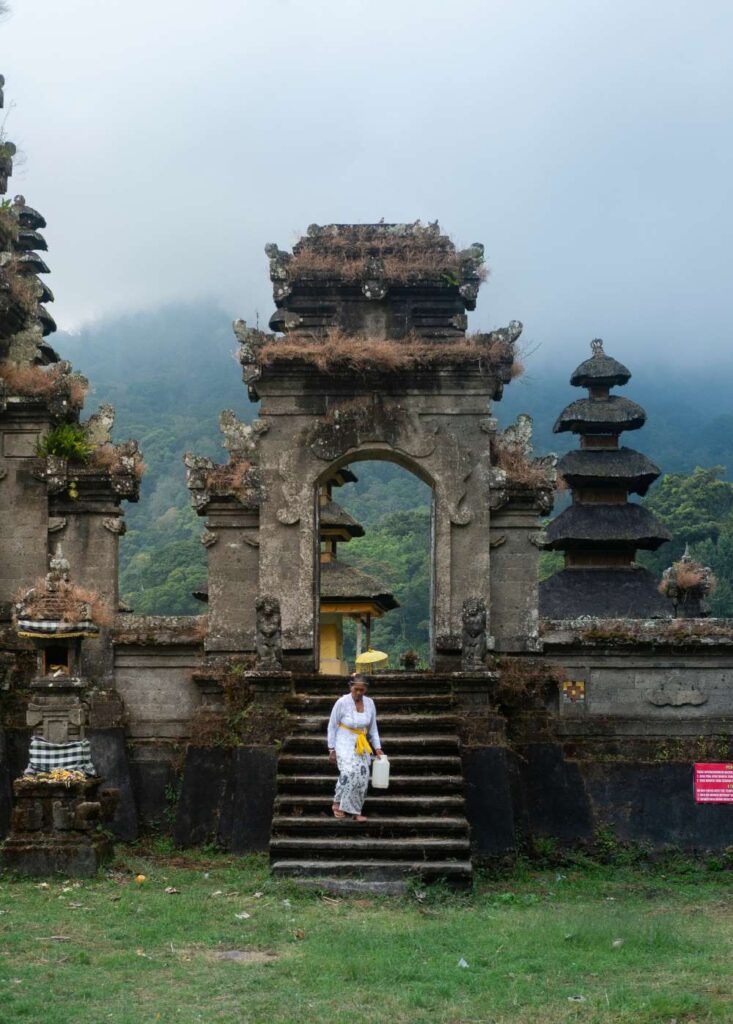
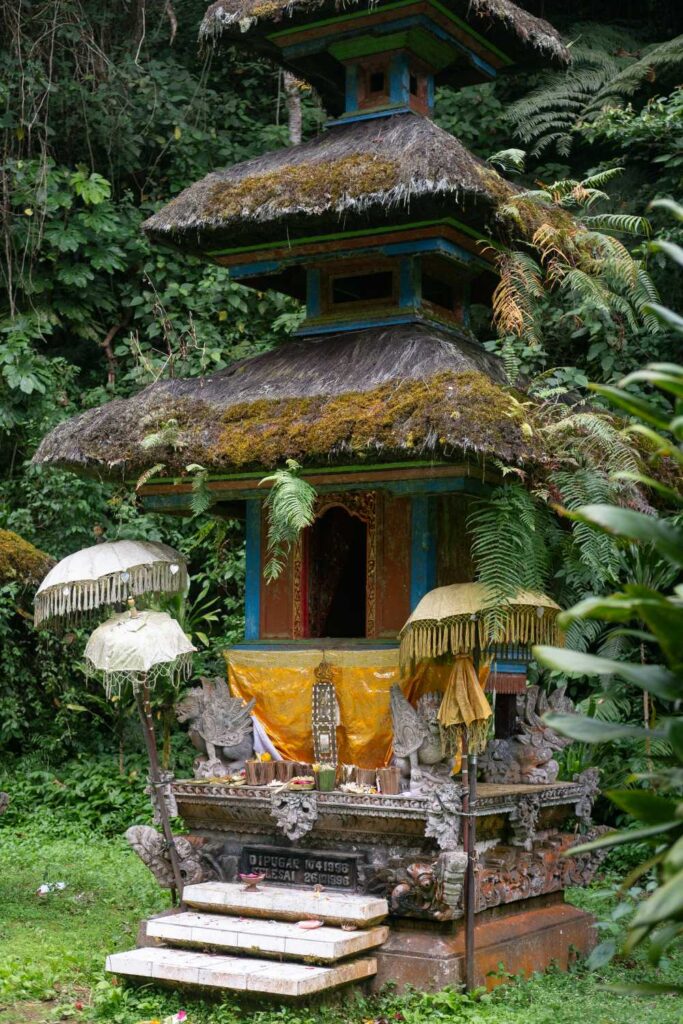
There are 17 temples scattered across the Mertajati forest, some believed to be as old as the original settlements. They rest beneath the shadows of giant trees, as old as the temples themselves. This relationship between trees and temples is not unique to Mertajati of course, it is echoed all across Bali: the majestic Kayu Putih Tree next to Pura Babakan in Marga, Tabanan, is said to be 700 years old, towering over 50 metres; or the old banyan that shades the grounds of Pura Samuan Tiga, Gianyar, surviving over 800 years. Trees, forests and nature are revered alongside the spiritual here in Bali, symbolised through mythology like the Barong, the symbol of good and guardian of the forest.
The Adat Dalem Tamblingan community share the responsibility of tending to each of these 17 temples, with the spiritual centre found at the Pura Dalem Tamblingan and Pura Luhur Ulun Danu temples. But this stewardship transcends prayers and offerings, as strict customary laws (awig-awig) ensure also ensure the physical protection of the sacred forests.
Some of the awig-awig prohibitions include no cutting of living trees without ritual sanction, no killing of protected wildlife, no entry into certain zones except during specified ceremonial periods, no introduction of pollutants into water sources. Abiding by these laws –and certainly applying sanctions and punishments for those who don’t – the communities have found a way to live in symbiosis with the natural forest, cultivating crops through an agroforestry system, taking nothing from the forest itself.
Karya Alilitan: A Total Cleanse
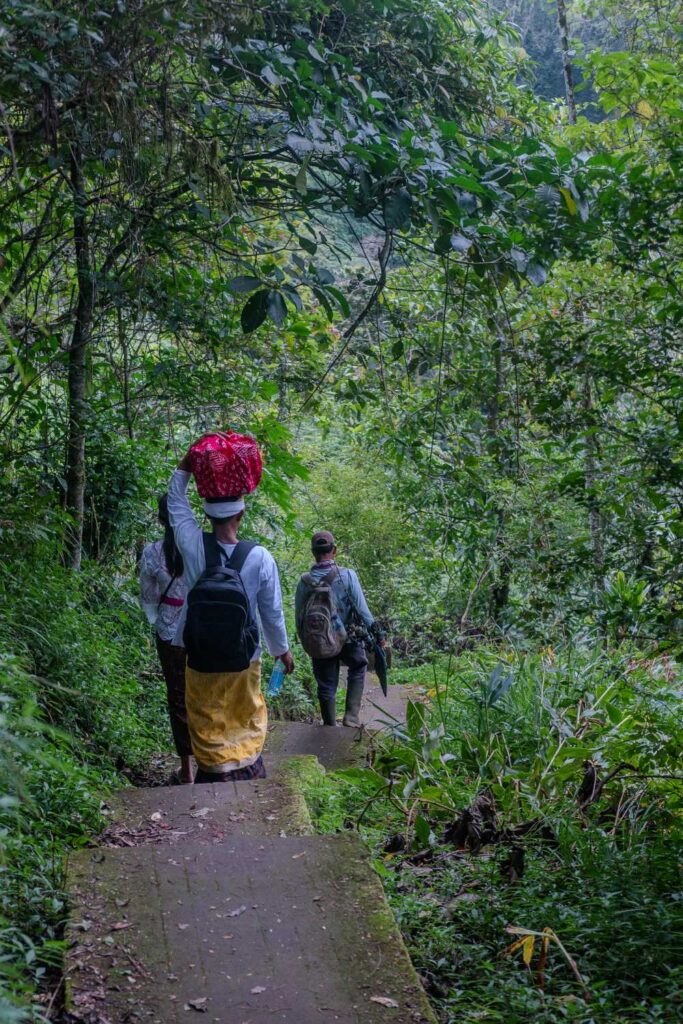
Every two years, Catur Desa Adat Dalem Tamblingan undergo a colossal cleansing ceremony known as Karya Alilitan. This requires all four villages to come together for a processional journey from the mountain to the sea, a 25 kilometre walk with around 10,000 people.
This year, the ceremony is set to take place on 20 October 2025, starting in Tamblingan and making their down to the North Bali coastline, tying in the riverbeds and springs found along the way. The journey of the water, ceremonially cleansed. Villages along the way will welcome these passing pilgrims with food and water, small offerings of gratitude for those who continue to do their part to guard the waters and forests.
But before this more universal ceremony, the cleansing begins at a much smaller scale.
“We must begin with cleansing our mind and spirit to if we want to protect nature, the forest and lake,” says Putu Ardana, who is among the leaders of Catur Desa. “If we keep our own intentions pure, we can be steadfast in our commitment to guard this forest, to ensure it is not used or destroyed for short-term gains.”
A series of ceremonies – starting from the individual level (ngaturang ngandeng) and ending with an area-wide ceremony (ngaturang pengraki) – begins three months before the big procession date. An important trio of ceremonies must be performed: the Wana Kertih ceremony (wana meaning forest), Danu Kertih ceremony (danu meaning lake), Mrasista Danu ceremony (mrasista meaning the lake surrounding), all centred on cleansing different aspects of the surrounding environment.
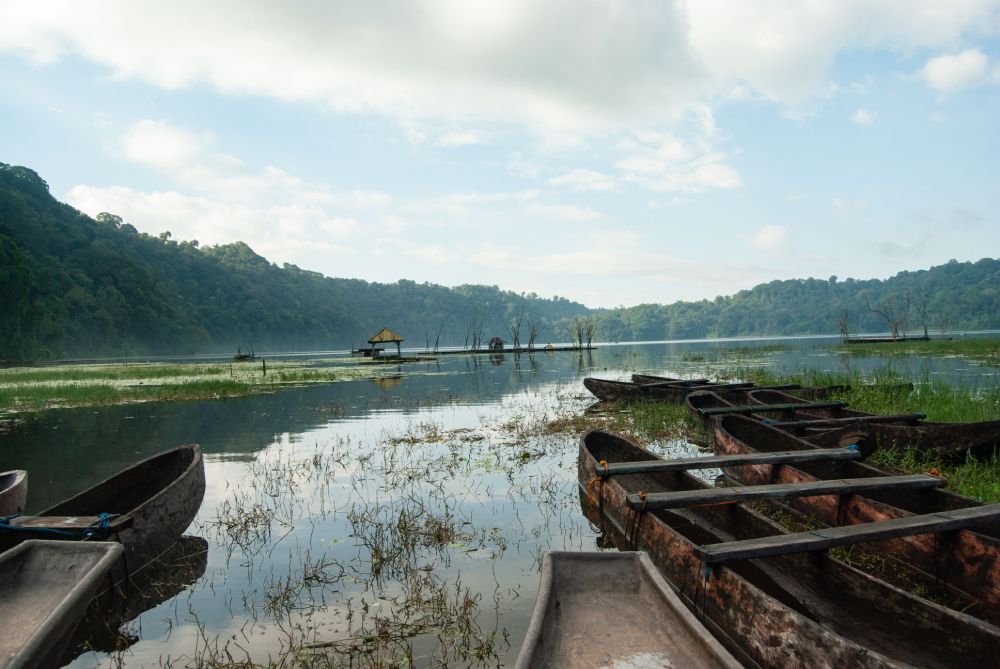
I have been fortunate enough to witness one of these ceremonies, where the connection between forest, community and spirit at palpable. Pilgrims gather on the banks of Tamblingan Lake to reach the different temples. There’s no loud buzz and whirr of motor boats, as they are not permitted in the awig-awig, only the gentle splash of paddles as wooden row boats glide across the waters. In the night, especially during the full or new moon, the atmosphere deepens. People pray through the evening, in the damp mountain air, an enveloping fog and the shrill of insects and owls filling the swallowing darkness.
The sanctity of nature is certainly felt on these special ceremonial days.
Traditional Stewardship in the Modern Age
When Bali came under Dutch colonial rule, the colonial government recognised the importance of Alas Mertajati forest and the role of the Catur Desa. In 1927, they designated Tamblingan as a protected forest area (Hutan Tutupan) and a ‘tourism forest’. Later, after Indonesia gained independence, the national government also declared Tamblingan and Mertajati as protected areas (Taman Wisata Alam, or a Nature Tourism Park) which has helped to keep development at bay.
However, this has meant official management of the area remains under government authority, which does not protect the area to the extent outlined by the traditional awig-awig. Catur Desa Adat Dalem Tamblingan have suggested to change the status of the forest to a hutan adat, or a customary forest, which returns the management of the forest back to the local community. A recent shift in Indonesia’s forestry law makes this possible, which allows indigenous communities to formally reclaim stewardship of their ancestral forests, as they have for centuries.
These forests are rich. One of the Tamblingan temple priests shared of the many medicinal plants that can be found in the forest depths; another community leader tells of a researching professor who has identified 100 species of medicinal plants with the help of the community.
The waters collected and stored at Lake Tamblingan don’t just feed the nearby rice fields. This lake, alongside Buyan and Beratan, are Bali’s reservoirs, supporting the flow of water that nourishes villages, and towns, even hotel complexes and the tourist industry. Whilst we turn the tap and enjoy this free flowing waters, rarely do we remember the forests, springs and lakes that make it possible – or indeed the Catur Desa community that continue to protect this vital source.