


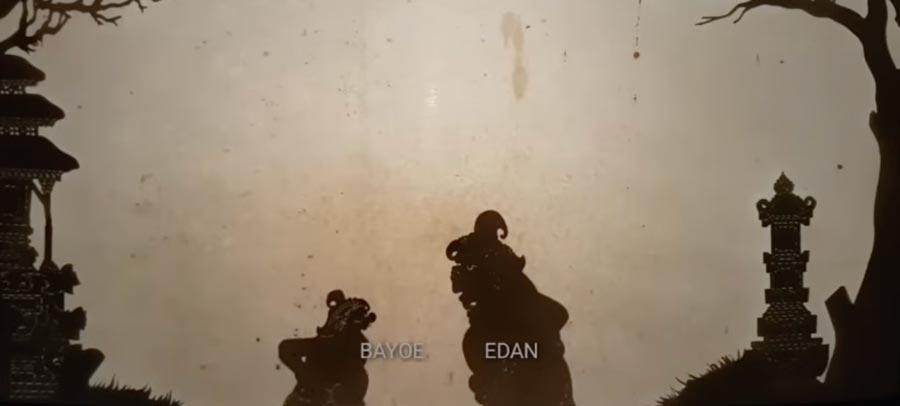
A shadow puppet master (dalang) goes off-script, off-stage and online, reimagining a traditional medium of social teaching and repurposing it for modern audiences and media.
How is Bali resisting the relentless transformation of its original being? The rising tide is indeed from the Sea. In some instances, this manifests as intellectual debate or political manoeuvring; in others, it translates into a more visceral tension—personal disorder, a surge in trance séances, or the proliferation of self-styled gurus of every stripe.
Nowhere is this shift more visible than in the island’s cultural life. Dance has been redirected toward the altar of “Budaya” (Culture) at the request of the global tourism market. In traditional theatre – Arja and Drama Gong and wayang puppet shows – the clowns have staged a coup, expelling the stories to take over the centre of the stage. Even the priestly mantras have sometimes turned into professors’ sermons which has migrated to the digital screen.
Yet, in the midst of this shift, there is resistance. One of its most arresting manifestations is the invention of a digital shadow theater at the initiative of a dalang (puppet master) who calls himself Bayoe Edan—the “Crazy Wind.” His purpose is no longer to merely translate the vertical mysteries of the Mountain above. He does not recount the standard myths, nor does he fulfill the ritual functions of the past. Instead, through his YouTube channel, he engages in a free-flowing dialogue with today’s somewhat lost public, using anecdotes to dissect the friction between tradition and modern religious change. He is a negotiator of the transition, advising his followers on how to navigate the waves.
The Genesis of the “Crazy Wind”
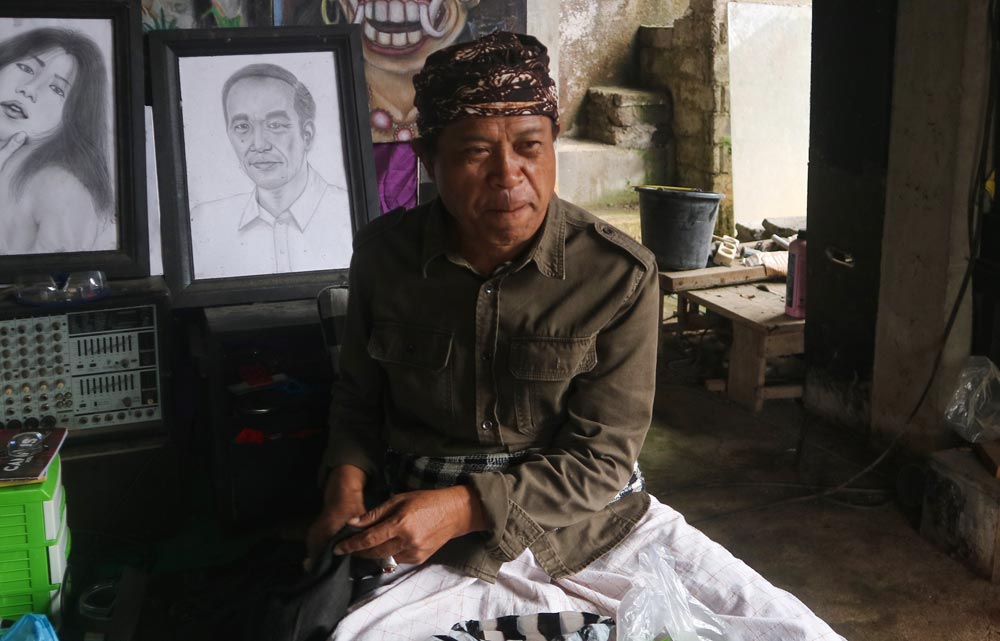
Was he born to be such a dalang? Perhaps. Born in 1972 as Wayan Sutama, he possessed every inheritance required to be a teller of the “Mountain” stories. His father was the Pemangku of the village temple; thus, the rhythmic mantras and sesonteng utterances addressed to the gods were among the first languages that shaped his memory.
Throughout the late 1970s and early 1980s, he could always be found in the front ranks of children attending village shows, mesmerised by the wayang, the topeng mask dances, and the arja local operas. At the temples, he was a frequent witness to the village jero dasaran in deep trance, channeling the visceral demands of the gods to his pemangku priest father. So, he was a child of the moss-covered shrines, breathing in the “damp mystery” before he could even read.
Yet, even then, he was already “crazy”—a misfit of sorts. He collected bad grades with a certain academic flair, entering a technical school not to master a craft, but to better fail on his own terms. He became a nomad of the educational system, drifting from technical schools to the reputed Dwijendra in Denpasar, all to no avail. His path seemed to be a horizontal sprawl of aimlessness, a refusal to fit the “lettered” expectations of the modern classroom.
His trajectory might have ended in permanent failure if his father had not noticed, in the mid-1990s, that something was fundamentally awry. In the Balinese world-vision, the problem was not the boy’s character, but the way his birth had been “read” on a calendar cosmic dewasa chart.
In a classic Balinese move of spiritual engineering, his father took him through a Bayuh Oton ceremony, a ritual designed to “reset” the cosmic clock that had been poorly set at the moment of his birth. Simultaneously, recognising his son’s lingering obsession with the shadows stories, he initiated him as a dalang through the Mewinten ceremony, granting him the Niskala permission to tell myths and perform the cleansing functions of the puppeeter’s magical trade.
From Ritual to Reality
This recalibration was the catalyst required. In 1996, the “Crazy Wind” blew into the Denpasar Art School (STSI), registering in the Wayang department. Simultaneously—and perhaps more importantly for the sharpening of his craft—he became a sisya (disciple) of the renowned Dalang Buduk, the master behind the Ceng Blong style, whose shadow he followed for years.
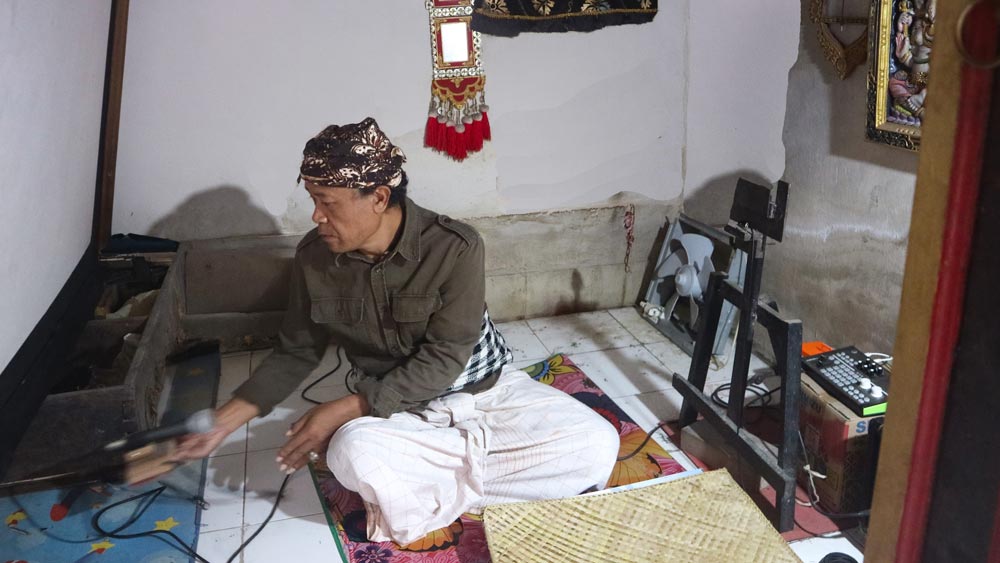
By 2001, his transformation was complete. He emerged as a full-fledged dalang, a master of the niskala uniquely equipped to navigate the island’s spiritual shadows. He became a guardian of the “Mountain” traditions, performing the arduous Sapu Leger – the rare cleansing ritual required to ngruwat (purify) those “wrongly born” children whose lives were shadowed by cosmic misalignment. In the stillness of the afternoon, he could sometimes be found performing the Wayang Lemah, his puppets vibrating in silence to accompany the high priest’s mantras of some odalan festival, weaving sound and shadow to seal the sacred rites.
This rhythmic life of ritual, even slowing down, continued until 2020, when a sudden, heavy silence fell over the island. As the world withdrew under the shadow of COVID-19, the temple courtyards grew empty. It was in this vacuum of stillness that Wayan Sutama fully embraced the persona of Bayoe Edan.
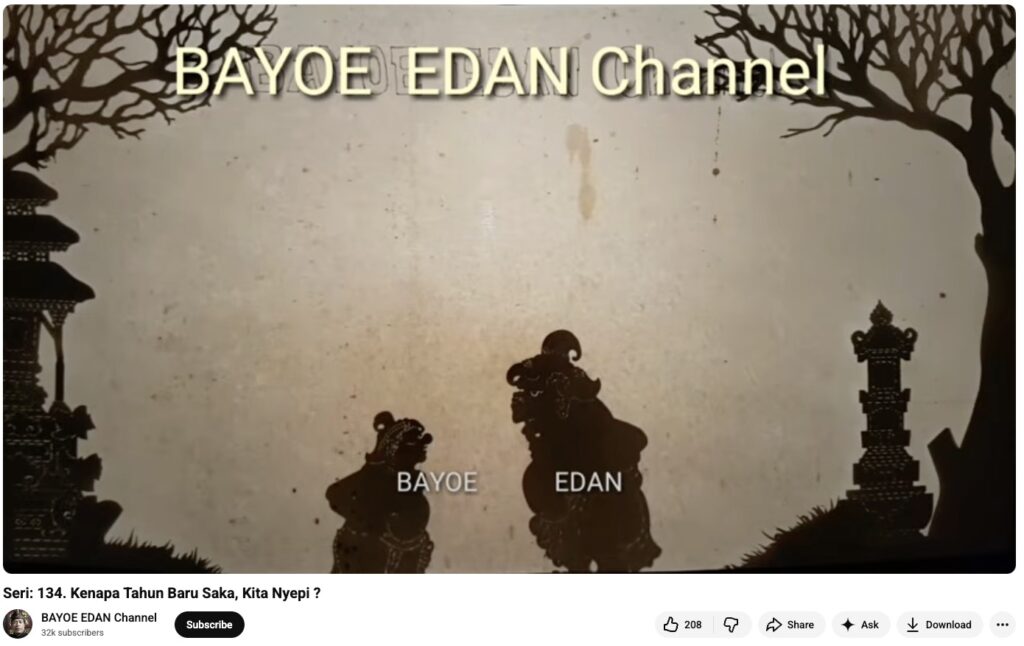
Retreating into a modest studio measuring just two by three meters, with a simple screen, he reinvented the ancient wayang art for a modern crisis. Abandoning the epic sprawl of traditional performance, he used only two puppets at a time, transforming the shadow play into an intimate theater of the Balinese soul. He no longer recounted the mythical stories of yore; instead, he offered anecdotes and sharp reflections on the shifting state of the Balinese soul.
The “Crazy Wind” in a Cultural Storm
Bayoe Edan was uniquely armed, possessing not only the ancestral inheritance of the dalang but a perspective sharpened by a peculiar brand of Western reflection discovered, ironically, in New Age books. Through the lens of writers exploring quantum mechanics and unendingly recuperated cosmic energy, he found a surprising reconciliation with the ancient truths of Balinese philosophy: those laws that allow the soul to transmigrate and return once more to the world of the living.
Today, armed with this “tamed memory,” he transforms the puppet box into a digital site of spiritual counseling. From the solitude of his tiny cell, he sends messages vibrating across the digital landscape, offering a practical resistance to the encroaching “Sea.”
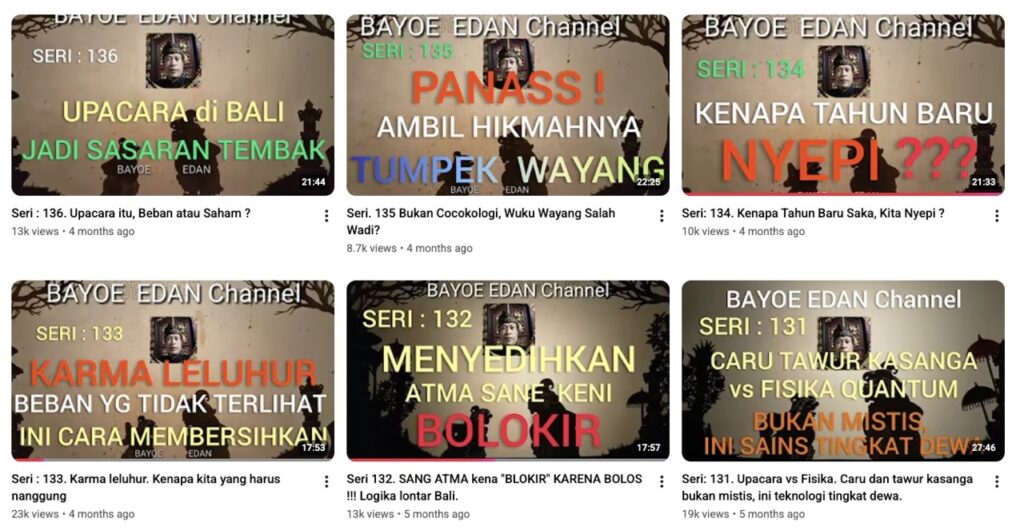
In a single show, he might advise his followers on the necessity of the correct holy water for a modern cremation; he might elucidate the function of the ngrurah household shrine. He might even map the perilous post-death path of the soul, dramatising its trial before Suratma, the Saint-Peter-like guardian of purgatory (tegal penyangsaran), as it faces the heat of the Candradimuka cauldron in wait for its cleansing.
In an age where schools and sermonising high priests dictate a rigid, standardised religious “truth,” Bayoe Edan leads his public back to the mindset of yore. He reminds them that the Balinese tradition is, at its heart, a state of deep being rather than a matter of shallow believing.
Preserving Balinese Language
Perhaps most significantly, Bayoe Edan’s stories are told almost exclusively in Balinese. This is a profound departure from the typical exposition of modern Balinese culture, which is often presented, by the Balinese themselves, in a sabir—a linguistic mish-mash that uses Balinese for the depiction of things but reverts to Indonesian for the utterance of ideas. This linguistic split is the hallmark of a declining language. In his refusal to compromise in the matter, Bayoe Edan stands as a solitary force, waiting for other “Crazy Winds” to join him in a full-fledged revival of the Balinese deep being of yore, including its language.
Thus, Bayoe Edan has found a new audience. Translating this traditional ‘medium’ of communal storytelling into the digital sphere, shifting his dalang skills to communicate topics better suited to a curious, modern audience. With 32,000 subscribers on YouTube, and over 140 episodes, the message of the dalang now spreads far beyond the confines of a village temple compound, like the one he used to sit mesmerized to watch his father’s own performances.
For those curious, Bayoe Edan’s channel can be found on YouTube here.