


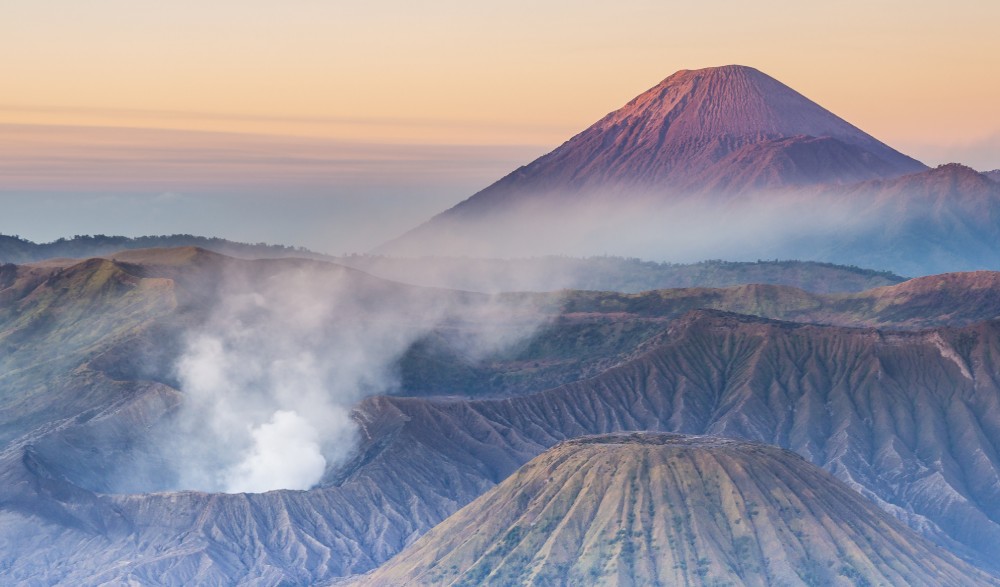
In the Balinese psyche, Java is never a distant memory. It exists as a physical and psychical tether, illustrated by the myth of Bali as a dragon’s tail severed from the Great Body of Java.This link is explicitly evoked in the 15th-century Tantu Panggelaran, which first describes the gods transporting fragments of India’s cosmic Meru to stabilise the unruly archipelago. Chunks of Java’s Semeru were then carried further east to steady Bali, becoming the peaks of Agung, Batur, and Batukaru. This lineage is even carved into domestic life; most Balinese homes maintain a Menjangan Salwang (deer-head) shrine, an architectural testament to the Javanese priest-architect Empu Kuturan.
Today’s historical foundation of this link was the “Norman-like” conquest of 1343, an invasion that transplanted an entire civilization—its literature, caste system, and creed—to the island. This bond was later reinforced in the 16th century when, as Islam was deepening its hold over the Javanese heartland, high priests of the Siwa-Buda tradition chose exodus to Bali. They ensured that the treasures of Majapahit spirituality survived the empire’s collapse, remaining to this day at the core of the Balinese high-priesthood’s regalia and mantras.
Under such circumstances, Majapahit memory has long remained a potent force. In the early 18th century, the Great King of Mengwi, Cokorda Sakti Blambangan—already lord of Java’s eastern tip—launched a spiritual Reconquista. According to Mengwi chronicles, he drove his forces deep into the old Majapahit heartland, reaching the mist-shrouded slopes of the Tengger-Semeru massif. There, he encountered “old believers” and the sacred water temple of Batu Klosot—a living mirror of the Balinese world surviving on Javanese soil.
The Dutch Intervention: From Myth to Linear History
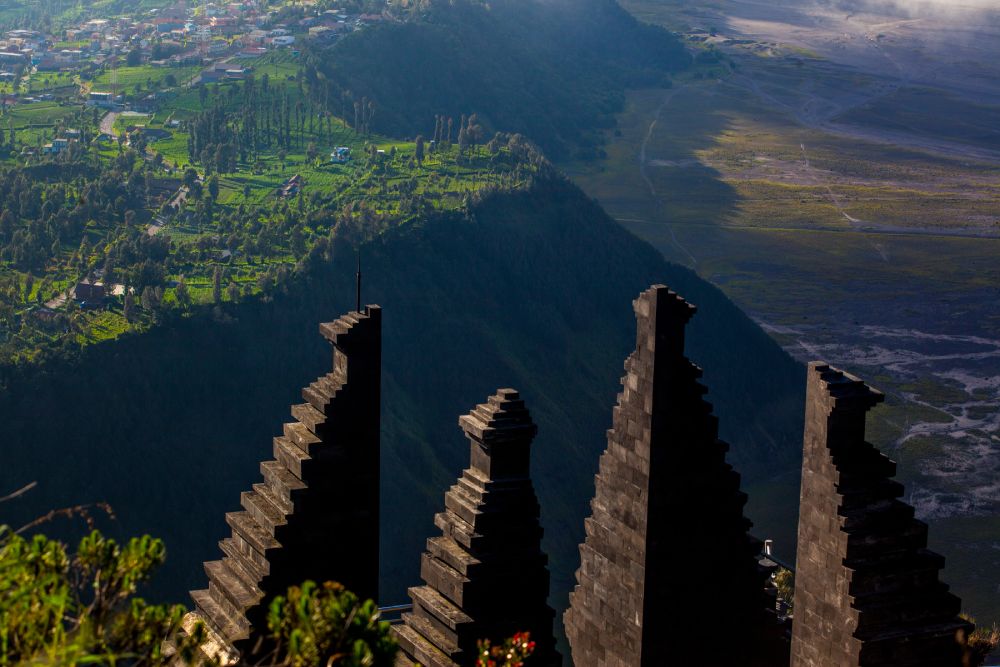
With the arrival of the Dutch, linear history replaced mythic memory. This shift began at the end of the 19th century with the opening of the Hoofdenschool (School for Chiefs) in Probolinggo. Young students, such as the Ubud prince Cokorde Raka Sukawati, could not ignore the presence of “old believers”—heirs of Majapahit like themselves—living in the mountains only a few dozen kilometers away.
As these educated Balinese began adopting the term “Hinduism” to define their faith within a modern framework, pilgrims from Bali soon reappeared in the Semeru area. To their surprise, they were discovering a surviving centre of worship that bridged the severed halves of the “Dragon.”
Meanwhile, the inhabitants of the Semeru slopes, particularly in Senduro, were undergoing a parallel identity evolution, accelerated by the intrusion of Christianity. For many Senduro-area inhabitants who had only been lightly Islamized, the introduction of printed Qurans and orthodox commentaries led to a concretising of their Islamic identity. But for “old believers” eager to retain their ancestral Javanese roots, the encounter with the Balinese provided a powerful catalyst, leading to the reinforcement of an “Old Javanese” Hindu identity that stood in opposition to the new scriptural Islam.
Independence and the Rise of Pak Sarjo
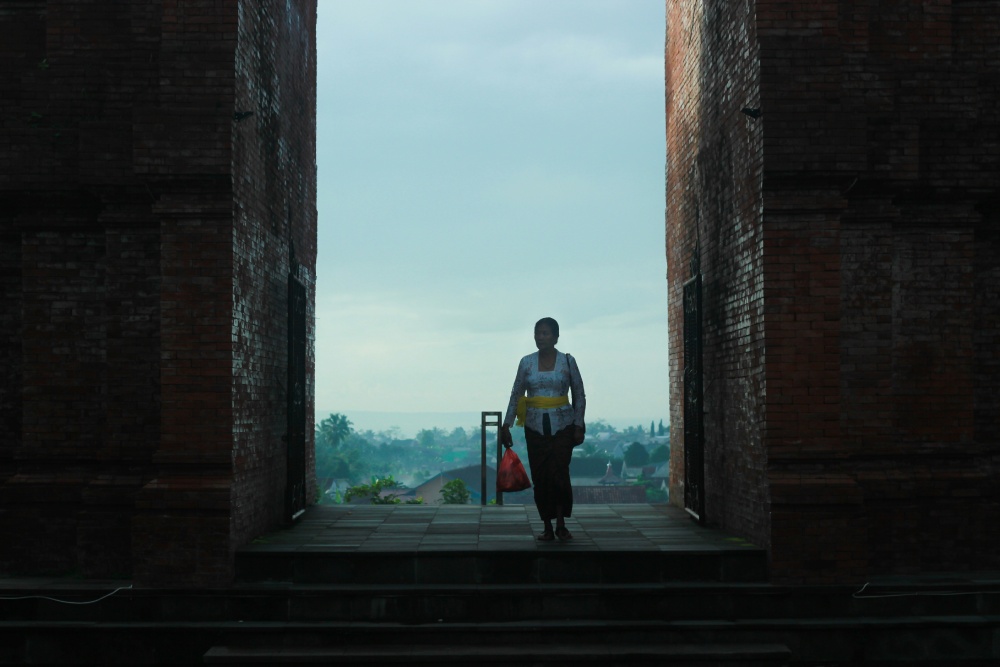
With Independence, these trends accelerated, further spurred reactively by the remnants of the Dutch occupation—an encampment in Senduro set up to monitor guerrillas. Out of this flux emerged a leader among the “old believers,” Pak Sarjo. Born in the 1920s and rooted in the Javanese culture of kebatinan, he saw in the Balinese Siwa-Buda references to the Majapahit syncretism a resurrection of the Javanese past and hence looked East, toward Bali, for support for his growing Senduro following.
Yet, for a decade, the Balinese could offer little help. Their Hinduism had a name, but not yet a legal status. To achieve this, it had to fulfill the conditions of being a “religion of the book.” Under the guidance of Gusti Bagus Sugriwa, and with the political support of Indonesia’s first President Sukarno, himself half-Balinese, theological juggling eventually did the job. Official registration was ensured in 1958 and formal recognition in 1959.
The Balinese belief system was now codified as a full-fledged religion, with its credo based on a holy book and a prophetic revelation (Markandeya), its pantheism reframed as monotheism, and its adoption of the transmigration of souls. While in Bali this translated into a structuring of belief, on the Semeru slopes, it meant salvation. The Ministry of Religion’s previous refusal to recognise “local beliefs” had left Pak Sarjo’s community without legal standing for marriages, burials, and civil rights. The situation on the ground changed in 1962, when Pak Sarjo and his following of no less than 7,000 people formally integrated into the newly recognised Parisada Hindu Dharma Bali. Their Majapahit-inherited rituals were thus categorised, as in Bali, as “Hindu Dharma,” which in 1963 was fully integrated as an official state religion.
A Reestablished Order
All this brought about enduring changes. For the Balinese, the presence of a brother group in Java reestablished the order of yore. Not only could they now return to Semeru to fetch their holy water (tirta amerta), but the hierarchy formalised in the Tantu Panggelaran was restored: the Balinese mountains were again recognised as extensions of Semeru, itself a chunk of the cosmic Meru.
In parallel to this fight for recognition, the Balinese aristocracy—particularly the members of the House of Sukawati of Ubud—played a decisive role. Tjokorde Gde Raka Soekawati never forgot his days at the “School for Chiefs” in Probolinggo. As part of one of the most modern aristocratic families on the island—aware of the role of religion in nation-building and enriched by early tourism—the Sukawatis accompanied the “old believers” in their full emancipation. In doing so, they enhanced their own power and image in both Bali and Indonesia as a whole.
The 1963 Eka Dasa Rudra Mission
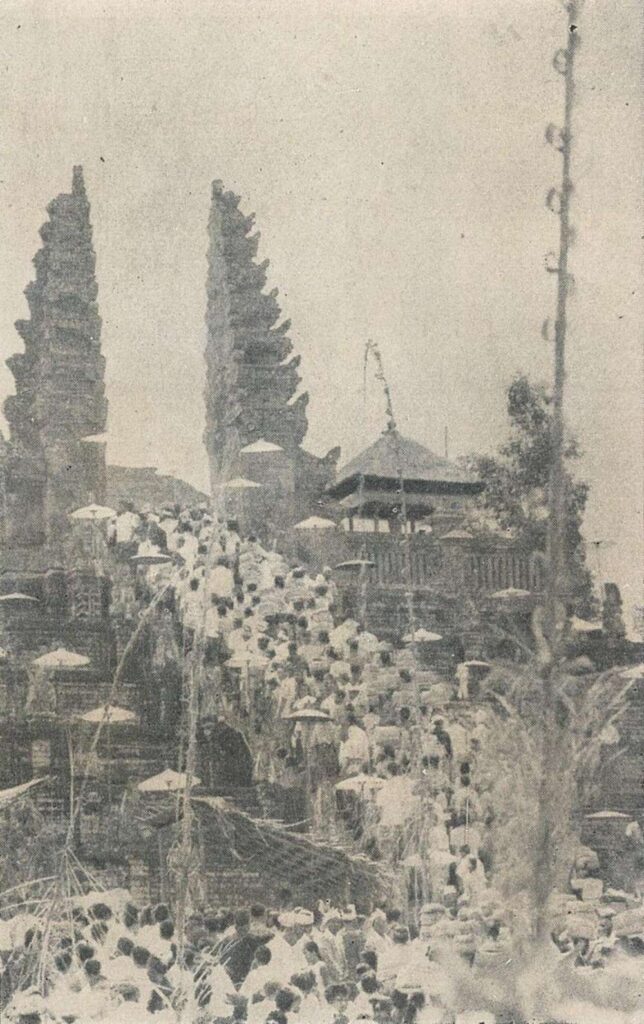
Thousands of pilgrims climb the steps of Pura Besakih, Mt Agung, for the Karya Pudja Pancha Wali Krama Ceremony (1960), a precursor to Eka Dasa Rudra.
The apex of the encounter of Bali with the newly “converted” old-believers was when a high-level delegation of priests and royalty went to Semeru to fetch holy water (tirta) and make offerings for the huge, once-in-a-century Eka Dasa Rudra purification ceremony. At the head of this mission was the famous prince of Ubud, Cokorde Gede Agung Sukawati, with a selection of Balinese high priests.
Once in Senduro, they performed rituals to “invite” the deities of the mountain (Sang Hyang Pasupati) to descend and participate in the purification of the world. They collected Tirta Kamandalu (the water of immortality) from the sacred springs of Semeru. This water was considered essential to “activate” the ceremony at Pura Besakih, Bali’s Mother Temple. It was believed that without the Javanese “father” water, the Balinese “mother” water would be incomplete.
The ceremony famously coincided with the cataclysmic eruption of Mount Agung in March 1963. While many saw this as a sign of spiritual imbalance, for the Sukawatis and the priests, it reinforced the terrifying power and necessity of the Semeru–Agung connection. It was the first time the Balinese religious hierarchy formally recognised Semeru as an indispensable part of a “Greater Hindu” ritual landscape.
The 1965 Coup Aftermath
The 1965 coup acted as a historical centrifuge. In the paranoid atmosphere of the New Order, the “in-between” space vanished. To have no formal religion was to be suspect; to be an “Old Believer” was to be dangerously close to the “atheist” label of the communist party. In this crucible, the “Hindu” shield built by Pak Sarjo and the Sukawatis, and tolerated by Majapahit-dreaming army officers, offered a sanctuary where Majapahit could hide in plain sight behind a state-approved status. By 1966, what had been a slow spiritual crystallisation turned into a mass migration of identity—thousands of souls seeking the safety of the Bali-Semeru axis.
As security was restored and the economy improved under the New Order, Balinese pilgrimages to Senduro became more frequent from the 1970s onward. The funding for the temple was a feat of collective will. While resources flowed through official channels, much of the capital was raised through the networking of the House of Sukawati. They mobilised their own mangku (priests), ritual specialists, and artists, turning the construction of the temple into a pan-Balinese cause. They didn’t just provide funds, they exported the very soul of Ubud’s artistry to the slopes of Semeru.
Yet, shifts in religious allegiance do not go well if the losers are able to submit the scriptures to their cause. Local legend still recalls a skeptic who swore that if the Balinese ever succeeded in building their temple on Javanese soil, he would cut off his own hand. This oath, he reportedly fulfilled when the temple was constructed; today, a handless local celebrity, he runs a popular restaurant.
Results and the Liturgy of Water
What are the results today? The structure of religion in Senduro has been heavily “Balinese-ised.” The famous local temple, Pura Mandara Giri, was built on a Balinese pattern (split gates, meru towers, padmasana). For the modern Senduro Hindu, the “look” of worship is now largely Balinese. The same applies to the calendar, where the adoption of the Saka/Wuku systems has synchronised Senduro’s ritual cycle with Bali’s.
In formal ceremonies, one hears Balinese mantras and sees Balinese-style offerings (banten). Many young Javanese Hindus have been trained in Bali, reinforcing this influence. As a result, the holy waters produced are less and less those “raw” flows coming directly from the veins of the mountain, as in the old cult. Instead, though still collected from local water temples like Batu Klosot, they are now sanctified through the mantras of modern, ritually twice-born Hindu high priests.
The Equilibrium of the Sacred
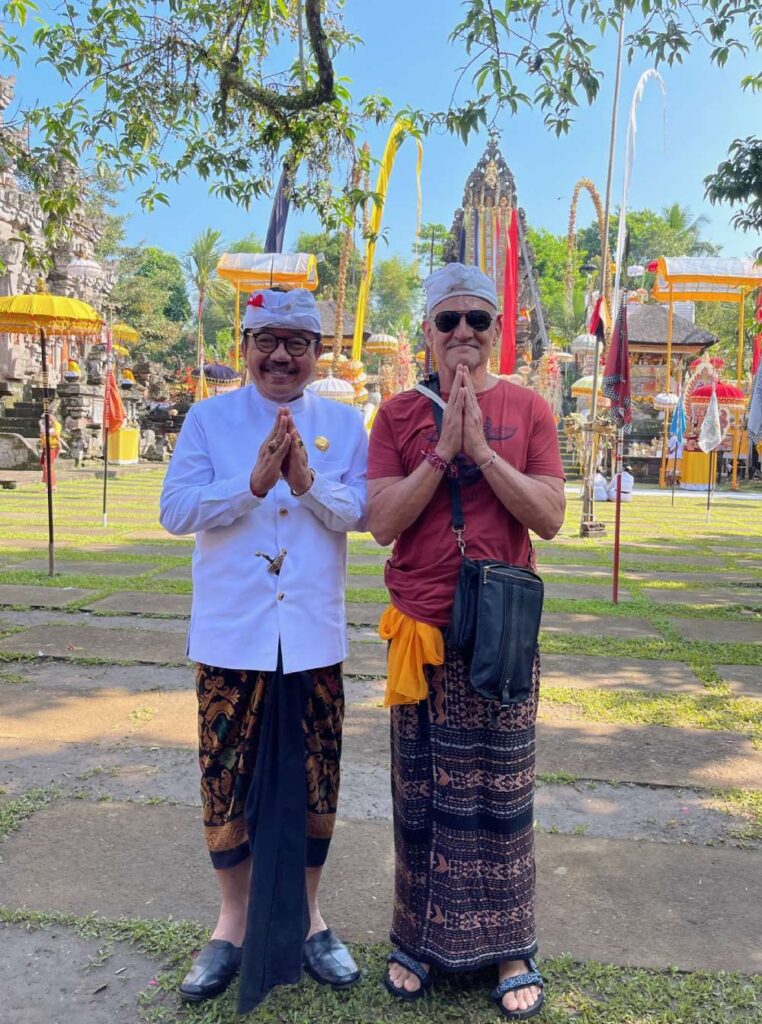
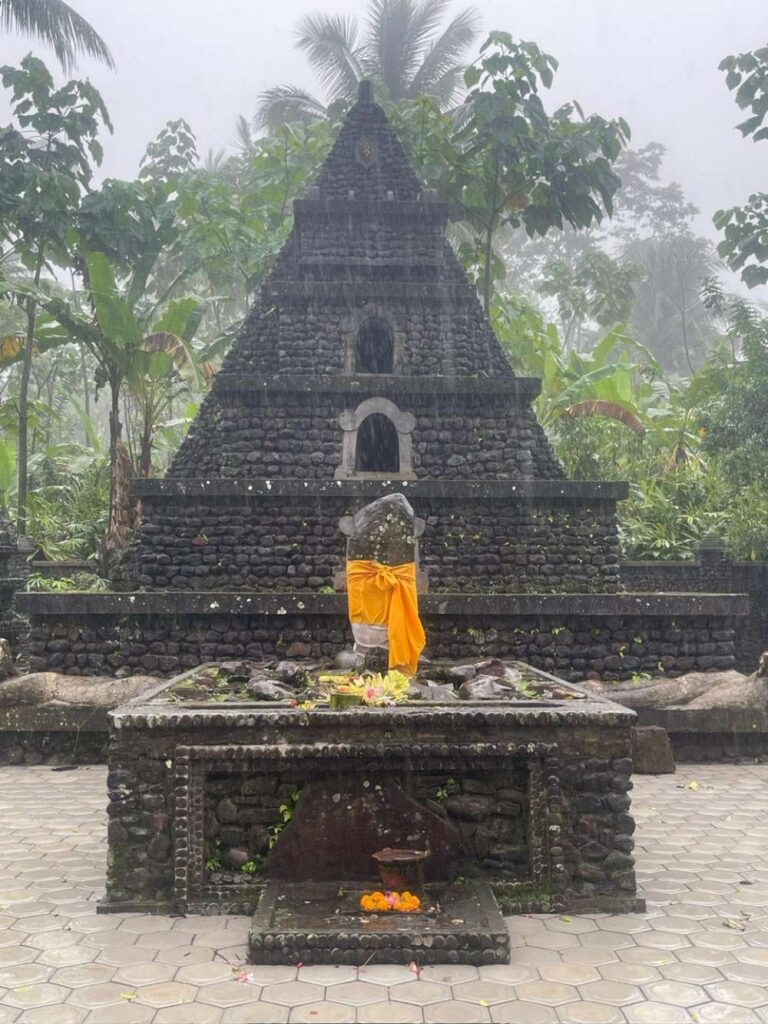
Rituals in Senduro today are neither a pure “Majapahit-derived” fossil nor a total Balinese imitation. Their incantations often employ an Old Javanese dialect, preserving litanies that have long since vanished elsewhere. Family-related rites have retained their distinct Javanese flavour. Yet, these traditions exist within a hybrid framework: several traditional dukun have indeed gained access to the formal status of sulinggih (high priests)—a path first blazed by the visionary Pak Sarjo.
Despite this Balinese “shell,” the core of ritual life—particularly at the village and family level—remains stubbornly and beautifully Javanese. The community moves effortlessly between the Sanskrit-inflected Balinese mantra and the melodic Javanese tembang.
What, then, are we witnessing today? Is it a phenomenon of permanent balance? Perhaps not entirely. Some of the “new believers” who once embraced Hinduism are now seen returning to Islam. They find that modern Islam has managed to avoid the rigid “scriptural crystallisation” and the accompanying criticism of old syncretism they once objected to. Furthermore, they have discovered that Islamic rites are, after all, significantly less expensive than the intricate and costly visual paraphernalia required by the Balinese ritual system.
Yet, even as some locals drift away, Balinese pilgrims continue to flock to Senduro in unprecedented numbers, bringing a wave of prosperity to a village once isolated on the mountain slopes. This is part of a much larger shift: while this local negotiation takes place in the shadow of Semeru, the Balinese have been opening temples and finding new followings across the entire Indonesian archipelago, effectively “re-mapping” the spiritual geography of the nation.
Did not the legendary man of wisdom, Sabdo Palon, the adviser of Majapahit’s last king, once vow that the banners of Majapahit would rule again one day over the whole archipelago? Indeed, there are now rites and temples in Kutai, Prambanan, and other magnets of Hindu grandeur. The content of any religion is ever-changing, isn’t it? Today, many Balinese make pilgrimages to the holy streams of the Ganges and Yamuna, as well as to the slopes of Kailash—not to forget the Mahabharata battlefield of Kurukshetra. Should they have remained focused on Gunung Agung? Similarly, should old believers have remained “old believers”. History will tell us.