



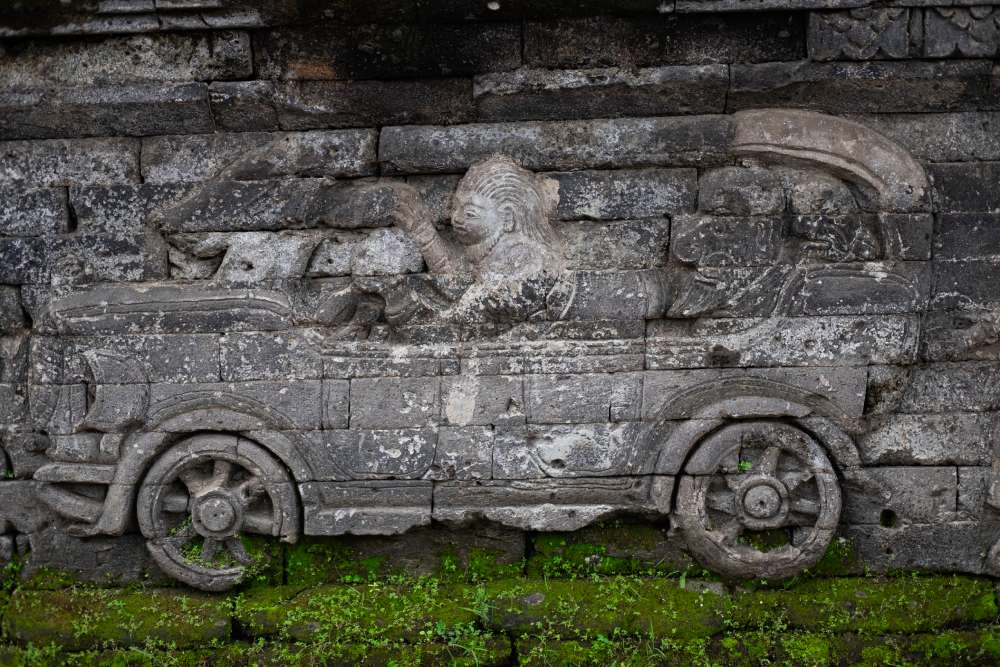
The Balinese only began to take steps to define their collective identity (Kebalian) in Singaraja, North Bali during the first decades of the 20th century. The indirect catalyst of this phenomenon was the incorporation of North Bali into the Netherlands East Indies after a series of violent confrontations that took place between 1846 and 1849. Although the Balinese forces would inflict one of the worst defeats ever suffered by the colonial army (KNIL) at Jagaraga in 1848, this glorious victory quickly waned and the once mighty century old kingdom of Buleleng crumbled before the superior weaponry of the Dutch, and from within bitter rivalries and jealousies that probably resulted in the poisoning of their brilliant General I Gusti Djelantik by rivals fearful he would seize the throne.
As the colonial administration of the Netherlands East Indies exercised direct control over Buleleng, much would change. Long xenophobic and isolated, the capital of Singaraja became a bustling port and gateway to the greater world. New roads and bridges boosted commerce, enabling clove and coffee plantations to open in places like Munduk. Regular KPM (Koninklijke Paketvaart-Maatschappij, the Dutch Royal Packet Navigation Company) boats brought an increasing number of visitors and outside goods. Exports also boomed. One of the most lucrative was live swine destined for Surabaya, Jakarta and Singapore. The volume was so great and squeals of the porkers so loud that the boat was nicknamed ‘Kapal Babi’, the pig boat.
The new prosperity gave rise to a new class of elites that included Balinese, Chinese and Arabs. In a strange twist of fate, the defeated noblemen became keen entrepreneurs especially in providing transportation. All were eager to educate their children. This led to the founding of the first school with a western curriculum in 1875. Others followed especially in the wake of the implementation of the so-called Ethical Policy in 1901.
Opened in 1914, the Hollandsch-Indische School (HIS) was certainly the most influential and important of them because it served the children of Balinese nobility and other elites. Notably, classes were taught in Melayu, the lingua franca of the archipelago, and Dutch, that of the colonial masters. The intention, to cultivate candidates for the colonial bureaucracy, was obvious. As had occurred on Java, one of the side effects of the introduction of western education and ideas was the rise of what the first Balinese intellectuals, an admittedly Eurocentric point of view. They would engage in many often-contentious debates about religion, customs, culture, art, caste and literature and even publish magazines.
The Dutch were not the first outsiders to confront the Balinese. In 1284, Kertanegara, the mighty tantric king of Singosari, seized the island and ruled for eight years until he was murdered by a rebel. The invasion of the Majapahit in 1343 was far more transformational. After quickly deposing of King Beda Ulu, he was conveniently vilified as an evil sorcerer with a pig’s head. but things calmed down rapidly, certainly because there were few differences between the Javanese and Balinese at that time. During the next 150 years, Bali was a dynamic province in a great cosmopolitan empire. A cultural, artistic, economic and military powerhouse, the Balinese so embodied the spirit of the Majapahit that they assumed its legacy after the mother country broke up and disintegrated at the end of the 16th century. Although often exaggerated, the fall of Java did precipitate a migration of priests and lords like the high priest Danghyang Nirtha, who built temples and reformed rites. The reverence of this past is also mirrored by Balinese royalty who continue to claim they are descended from Majapahit royalty, often without much evidence. One of the most flamboyant and charismatic is I Gusti Ngurah Arya Wedakarma, who declared himself to be the legitimate ruler of the Majapahit throne in a grand ceremony held in Besakih Temple in 2009.
The Coming of Islam
While many would like to believe histories exaggerating the schism between Islamic Java and Hindu Bali, the main issue for the Balinese, at least in the beginning, was not a clash of creeds but rather the imperial designs of their new neighbors. This came into sharp perspective in 1638, after Sultan Agung of Mataram invaded Blambangan, a vassal of Bali’s Gelgel Dynasty, nobody doubted that Bali was his next target. Arguably, he might have succeeded in his quest if it were not for the Dutch who broke the back of his forces while stoutly defending the walls of their fortress in Batavia (Jakarta). With empty coffers, famine and peasant uprisings, Agung’s dream of united Java and Bali came to an end. He was not the only Muslim seeking to capture Bali. One, perhaps apocryphal, story recalls a threat by the Sultan of Gowa, Sulawesi, to send 10,000 warriors to take the island. His haughty response was, “Most welcome, I have prepared ten thousand spears greased with pig fat to welcome you”.
After a brief bromance, following their ‘discovery’ of Bali in 1596, the commanders of subsequent Dutch fleets quickly forgot Bali and turned their attentions to a more lucrative endeavor – control of the Spice Islands. Securing all strategic commercial ports, they soon controlled all the sources and trade routes. With no major spices and poor harbors, Bali’s traditional rulers were free to rule their kingdoms as they wished if they avoided alliances with other nations and obeyed international maritime law. To ensure obedience, the wily Dutchman, Huskus Koopman, tricked the Balinese kings to sign perpetual binding agreements by mistranslating their contents in 1839. It was the demand to return the cargo of stranded ships to their owners that led to the downfall of the Balinese who customarily practiced ‘tawang karang’, the equivalent of ‘finders’ keepers, losers’ weepers’. The conflict between the two interpretations lead to Bali’s downfall.
As discussed in part one of this series, Hinduism started as an arbitrary western concept that for many years had no meaning in India or Bali, neither which had any pan-religious identity. You belonged to a lineage determined by family, clan, village and local beliefs. Society continued following the rites and rituals handed down to them by their parents without any compulsion to use a universal.
As had happened in India at the end of the 18th century, Bali was first described as Hindu by westerners, somewhat briefly by Sir Stamford Raffles in his History of Java (1817) followed by the British orientalist John Crawford who presented the paper “On the existence of the Hindu religion on the island of Bali” to the Asiatic Society in London entitled in1820. The Dutch joined the bandwagon after 1848 when they charged the German, Rudolf Friederich, one of the greatest early scholars of Sanskrit and Hinduism, to undergo a study. As for Crawford, his observations were based on information given by members of the priestly caste who make up only a small percentage of the population. Friederich, a notorious bon vivant, consumed prodigious amounts of alcohol supplied by his host, the Danish merchant Mads Lange in Kuta. In 1849 he penned The Civilization and Culture of Bali, which was translated into English only in 1959. While his work was seminal and influential, like Crawford before him, he made many assumptions, such as the Vedas were known on the island, which as not accurate. They would nonetheless put the wheels of the Bali-Hindu bandwagon, long before the Balinese.
In Part Three, we will return to the 20th century and the long process that would lead the Balinese to declare themselves Bali Hindu in the 1950s.
This is part two in a series of four essays by Bruce Carpenter, inspired by Kebalian (2024), a brilliant book by his dear friend, French scholar Michel Picard. It is his hope to point readers in the right direction in understanding Bali’s most fundamental identifying characteristics. Read part one here.