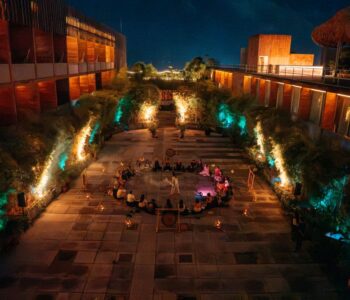



Bali has a strong visual language, seen across the island through its vernacular architecture and iconography found in temple complexes, traditional homes and other heritage-inspired buildings. Here are some of the most recognisable architectural elements that together build the cohesive aesthetic identity of Bali.


Candi Bentar
The towering split gateway that marks the entrance to compounds and temples, the candi bentar is recognised through its two symmetrical halves and open entryway or threshold. Within temple compounds, this open gateway marks the boundary between the central and outer courtyards.
This perfect division and symmetry is symbolic of Bali’s respect for dualism, the rwa bhineda philosophy that outlines the balance of opposites. These beautiful gateways are typically made from red brick or volcanic stone, with a varying degree of ornamentation depending on its purpose, location and indeed maker.
Kori Agung
Structurally similar to the candi bentar, what differentiates the kori agung is its superstructure or roof, creating a doorway rather than an opening. It serves as the most important threshold into the inner sanctum of a temple compound.
Larger kori agung will feature three doorways, structurally tiered with the central doorway towering above its flanks, symbolic of the the sacred mountain. The kori agung are elaborate and ornate, often featuring the kori kuwadi Balinese door at its centre, above which the carved face of Boma wards of evil spirits, and the central structure may be crowned with a murdha.
Kori Kuwadi
The traditional Balinese door, once reserved for the entrances of royal (puri) or priestly (griya) compounds as symbol of status or sanctity, has become a ubiquitous decorative addition to homes, resorts and public spaces.
The split door is made of two panels (daun pintu, or leaf door) that open at the centre, placed within a wooden frame. Carved by hand, typically out of teak or jackfruit wood, both the doors and the frame will feature highly-ornate carvings (ukiran) of a chosen pattern (pepatran).
Murdha
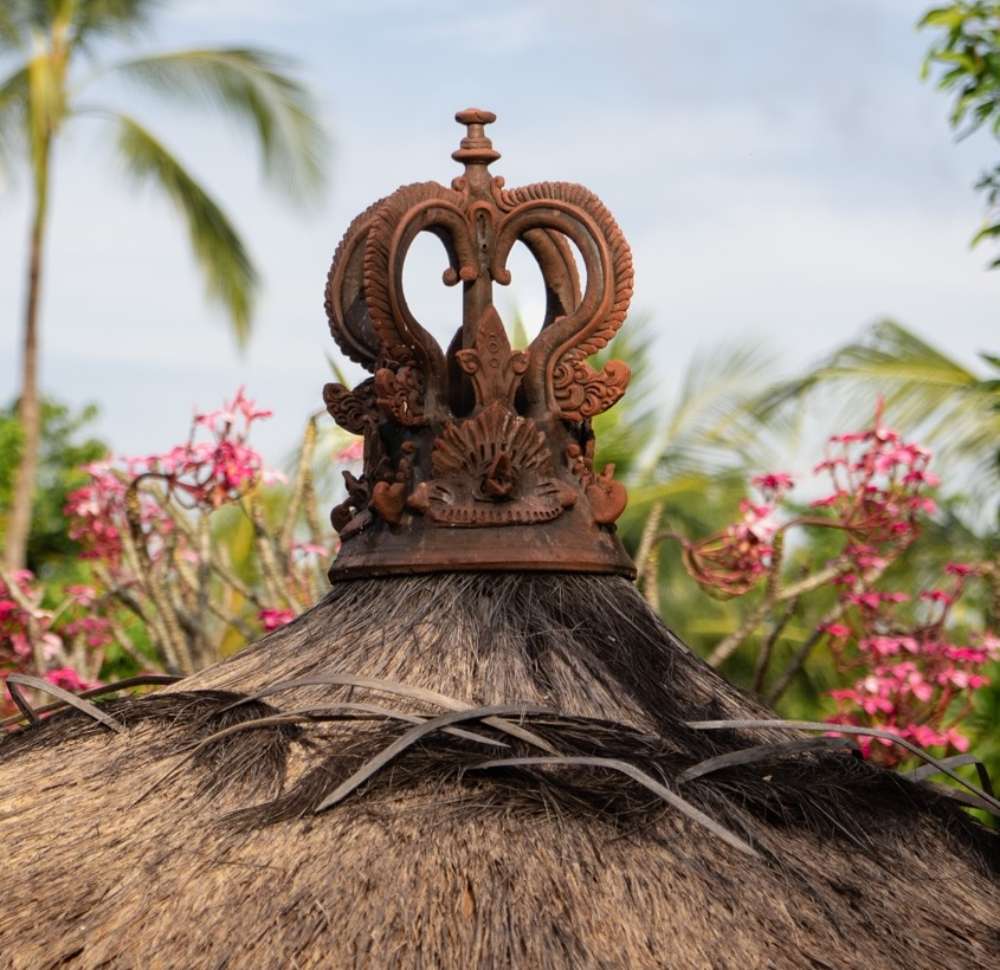
The ‘crown’ of Balinese architecture, the murdha is an ornament placed at the very top of structures, including bale and wantilan buildings, meru towers, pelinggih shrines, and even kori agung gateways. Whilst traditionally made from carved wood, when used decoratively they have also been made using terracotta or indeed cement or stone.
The word murdha comes from the Sanskrit word for ‘head,’ representing the upper realms, the peak of Mt. Meru the cosmic mountain, thus connecting the earthly and heavenly worlds.
Visually these can vary from genta priest bells to lingga-yoni forms, or lotus flowers or indeed crowns. On straight roofs, these are often paired with celedu ornaments that are set at roof ridges or gables.
Pepatraan

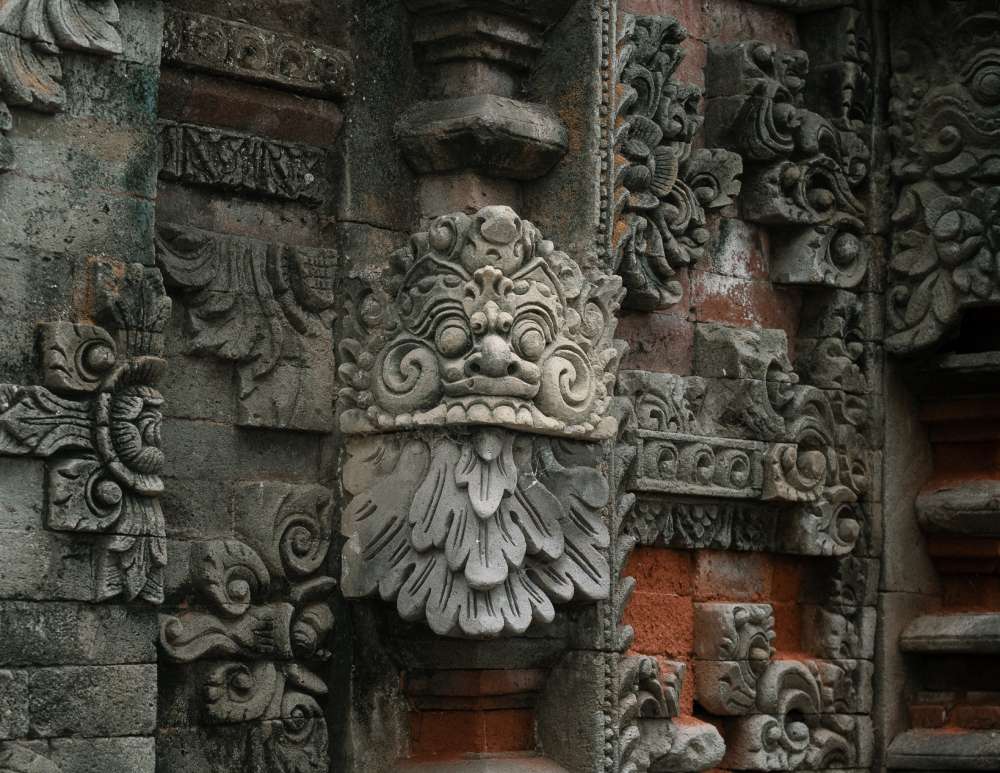
These are the patterns or motifs of Bali’s traditional carving (ukiran), found decorating a long list of surfaces and façades, from walls and standing screens, reliefs and friezes, beams and doors. They are the embellishment of choice when it comes to delivering a vernacular style and feel, carved into wood, paras stone.
Peptraan is the overarching term for the carved patterns, which come in an array of motifs, including patra ulanda and punggel (curled leaves and vegetation), patra sari (lotus), patra cina (hibiscus, Chinese-inspired), patra mesir (geometric and rectangular). These motifs can often be merged into one panel in creative ways.
Kekarangan
These are the more extruded, sculptural motifs that decorate the edges and corners of structures, often depicting zoomorphic or mythical beings, adding both personality and dimension. These are used at transitional or liminal points of architecture (entrances, thresholds).
The most famous of the kekarangan is that of the face of Boma, placed above entry ways to block negative forces, whilst more common iterations are the karang goak (crow), karang asti or gajah (elephant) and karang tapel (mask). As these are found on building corners or walls, they are typically stone-carved.