


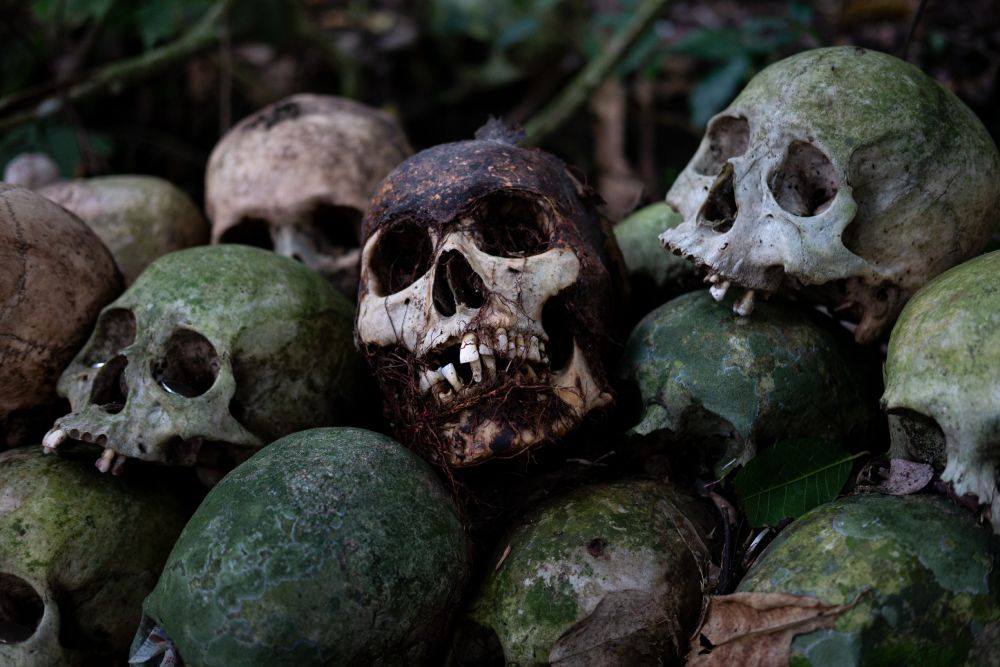
Much of Balinese culture today is considered a continuation of the Majapahit Empire who invaded Bali in 1343. With the arrival of these new rulers, the courtly arts flourished on the island – literature, architecture, music, dance and art, these were some of the major imports of the Hindu-Javanese civilisation. From the wayang shadow puppets to the gamelan orchestra, there remain many cultural similarities between modern day Bali and Java thanks to this historic connection.
Of course, there were already inhabitants living on Bali before 1343. Prior to the Majapahit, Bali was under the rule of two dynasties of the Bedahulu Kingdom (8th to 14th centuries), Warmadewa and Jaya. This was centred in the region of Pejeng, tied to many of the archaeological sites around that area, including Goa Gajah, Yeh Pulu and Gunung Kawi. This time is what is known as Bali’s ‘ancient period’.
But it isn’t only monuments, carvings and statues that have survived this ancient period, communities have too. These are the Bali Aga, the indigenous Balinese, considered the original inhabitants of the island. Over centuries, these communities managed to resist the cultural influences of the Majapahit, in many cases due to their isolated geography and distance.
According to an 80’s census, there are 38 distinct Bali Aga villages on the island, and what is perhaps most fascinating is that some of them still uphold the customs, beliefs and rituals from the time before the Majapahit. They have remained time capsules of Bali’s ancient period, living examples to the past.
A distinct visual and cultural heritage is more evident in certain Bali Aga villages, where visitors are invited to witness unique customs from another era. An invitation to explore the more rural pockets of this rich, and diverse island.
Desa Trunyan
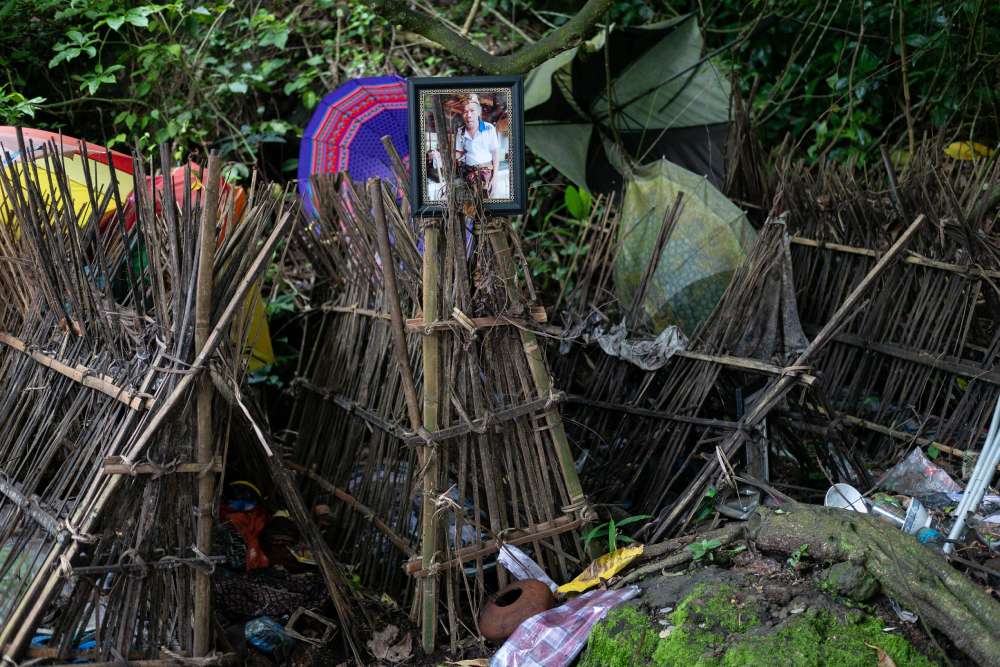
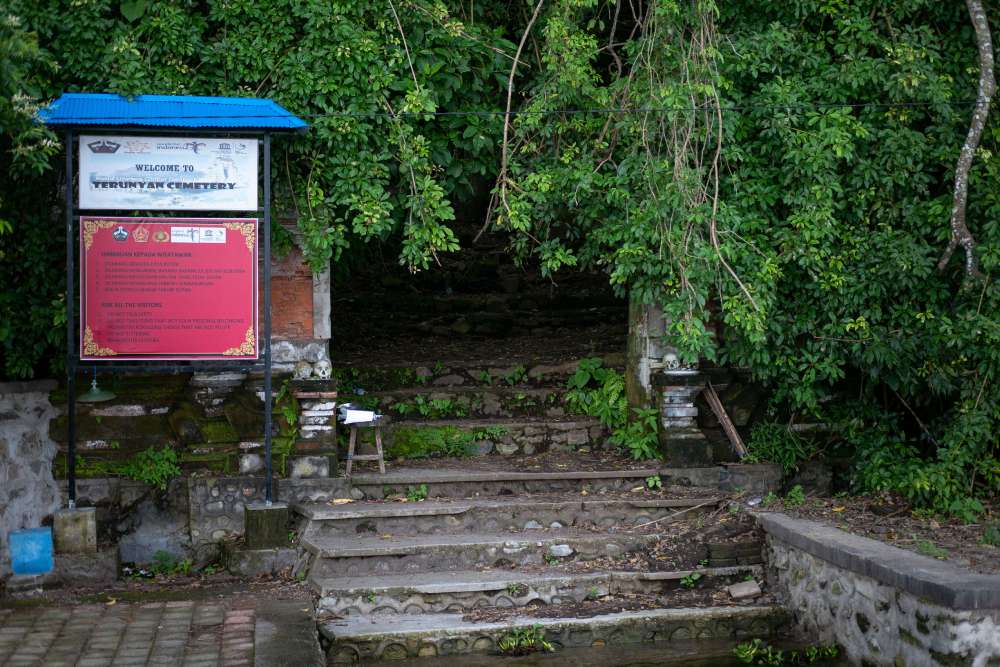
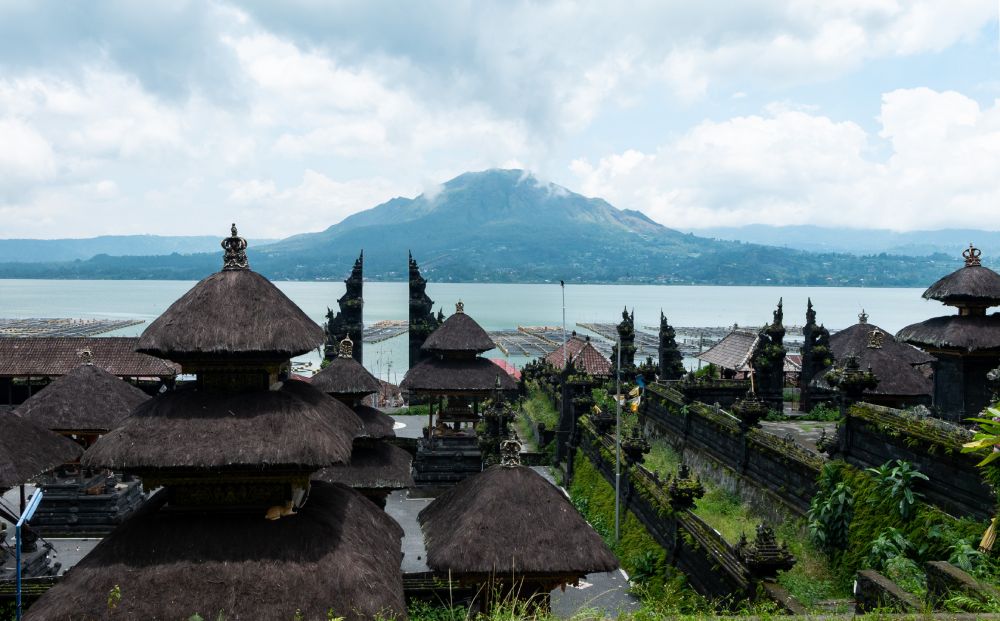
Found on the eastern shores of Lake Batur, Kintamani, Desa Trunyan –or Terunyan– is known predominantly for their distinctive burial practices, but that is only one of the village’s unique customs.
Wedged between the waters and the steep caldera walls that enclose one full side of the village, Desa Trunyan was once only accessible by boat, making it one of the most isolated communities. This is how their special customs have remained to this day, including how they deal with their dead.
Bali is known for their ngaben cremation ceremonies, but in Trunyan, the bodies of the dead are brought to a separate cemetery site 15-minute boat ride from the main village. Here, they are laid above ground, covered only by a bamboo cage (ancak saji), under a special tree from which the village gets its name: the grand Taru Menyan (some frankincense or olibanum type), quite literally meaning ‘fragrant’ (menyan) ‘tree’ (taru). This tree’s is said to have the ability to abosrb the smells of decomposition – and indeed, upon visiting there is no bad odour.
Across the entire cemetery are skulls and bones, the remnants of village ancestors put on display. This may come across as morbid at first, but really in Trunyan the body is seen as nothing more than a vessel for the soul. Visitors are welcome to visit the cemetery for a price.
Another example of Desa Trunyan’s ancient roots lies in their one-of-a-kind ritual performance seen during their main village temple’s ceremony. This the Barong Brutuk performance, of which 21 dancers perform dressed in wild and shaggy banana leaf costumes and simple, painted masks made of coconut shells. This is one of the earliest examples of masked dance in Balinese history, predating any Majapahit influences.
Read our full article on Desa Trunyan
Desa Bayung Gede
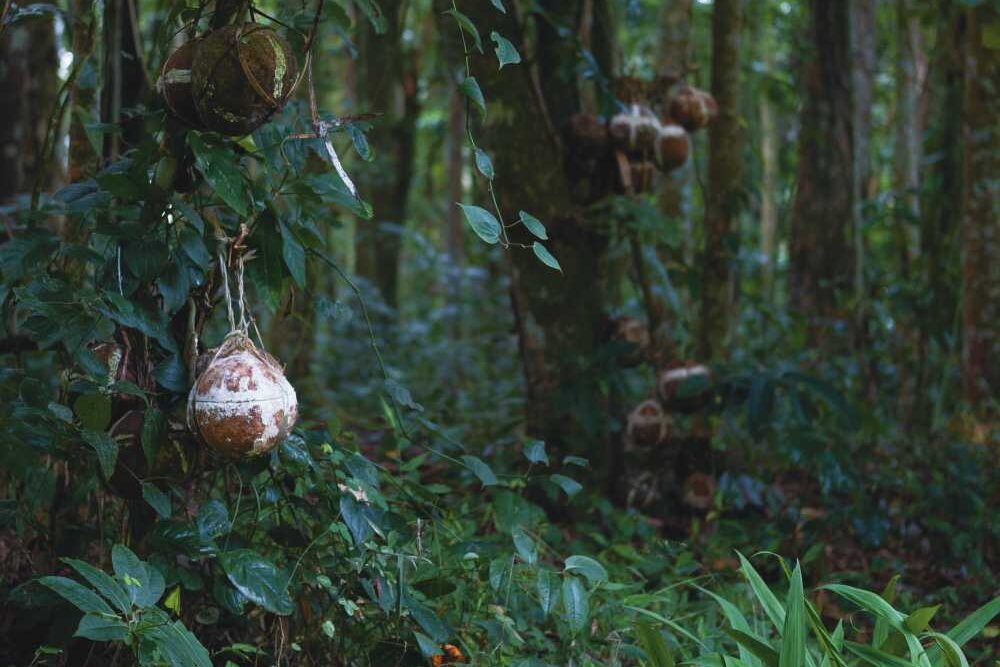
Tucked into one of the gaping valleys of Kintamani, Bayung Gede Village is certainly off the beaten track, accessed off the main artery road from Ubud to the Batur Caldera. This Bali Aga village is known for its unique ritual for newborns, but before this was well-known, it was where anthropologists Margaret Mead and Gregory Bateson lived in the 1930’s, who wrote that this was where they could witness ‘Balinese culture stripped to its essentials.’
Moss and foliage layer the stone gapura entrance into Bayung Gede, like a signal to visitors that this is a place lost to time. Through the tidy streets, all the way to most southern end of the village, do we find Bayung Gede’s special cultural calling card.
Here, there is an enclosed forest area where curious coconuts hang from the trunk and branches of the young bukak trees (sea mango tree, Cerbera manghas). Though they may appear like the fruits from these trees, they are in fact hung there by the local community every time a baby is born. Inside of these coconuts are placenta, or ari-ari.
In Balinese Hindu custom, the placenta is believed to be one of the ‘four siblings’ (kanda empat) which are born alongside all humans, including amniotic fluid, blood and the vernix caseosa (the biofilm around a newborn). As they all ‘enter the world together’, they are considered siblings and in fact play an important part of ritual life for each person. In regular cases, the placenta, being the only substantial remnant of the birthing material, is treated with spice and holy water, sealed in a coconut and buried in front of one’s home.
As such, this special treatment to the ari-ari is not unique to Bayung Gede, but certainly the custom to hang them up on trees is something one will only see at this Bali Aga village.
Read the full story on Bayung Gede
Desa Julah and Desa Sembiran
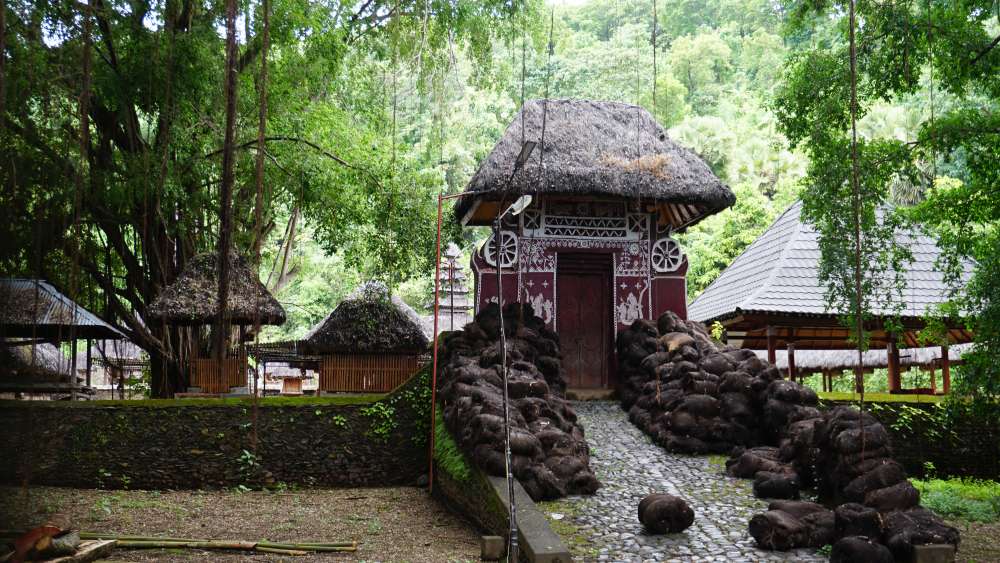
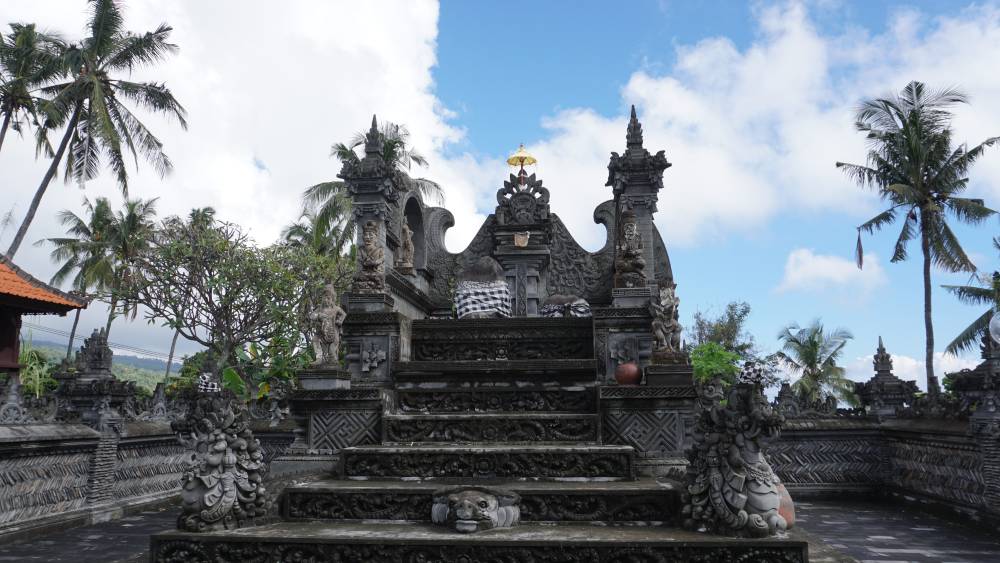
The district of Tejakula, Buleleng – the northeastern corner of Bali – is a hotbed of prehistoric findings. These regions have shown evidence of human life dating back to the Palaeolithic era – yes, the Stone Age! It’s hard to imagine that hunter-gatherer communities once roamed the island, but the discovery of stone blades and axes, human remains, stone thrones, menhirs and sarcophagi have provided hard evidence of this. Visible examples include the stone sarcophagus on display in front of the region’s important sea temple, Pura Ponjok Batu; whilst in the village of Pacung, bronze-iron age remnants were found, including bracelets, bronze moulds and tools – remarkable findings.
Two ‘twin’ villages, Julah and Sembiran, are another great example of Bali’s long-forgotten history. An excavation site near Julah village, known as Batu Gambir, revealed local earthenware (plates, bowls, basins, lids, pitchers), Chinese ceramics dating from the Song, Yuan, and Ming dynasties (10th–16th centuries) and fragments of Chinese coins. A key copper inscription dated between the 10th-12th century records the site as being an uphill safe haven from coastal attacks.
In these ‘desa tua’, or old villages, one can still see traces of their own traditional customs. Not unlike Trunyan, Julah diverges from the rest of Bali in its treatment of death: again there are no cremations here, they practice mekelin, a traditional form of natural burial where the body is laid to rest unclothed, with the face covered in leaves, and placed under a bamboo wadah.
Other Bali Aga traits are found in the neighbouring Sembiran, like at Pura Dulu, the village’s ‘Mother Temple’ and spiritual heart. Within its sanctum lie four sacred stones, believed to date back to the Megalithic era. These stones are not randomly placed, they are arranged in a meaningful configuration: two at the centre, forming the main axis of spiritual focus, and one stone each to the left and right, symbolically balancing the sacred space. Their placement reflects a deep ancestral cosmology, linking the community to its prehistoric past and the enduring power of the land.
Another temple, Pura Desa, guards a rare prasasti (inscription) that is only shown during special ceremonies. Sembiran’s spiritual landscape is marked by 23 temples, 17 of which exhibit megalithic traits—standing stones, ancestral shrines, and earthbound altars that predate currently practiced Hinduism. Unlike priests in southern Bali who chant Sanskrit mantras, those in Sembiran speak in sesontengan.
Read the full story on Desa Julah and Sembiran
Desa Adat Tenganan Pegringsingan
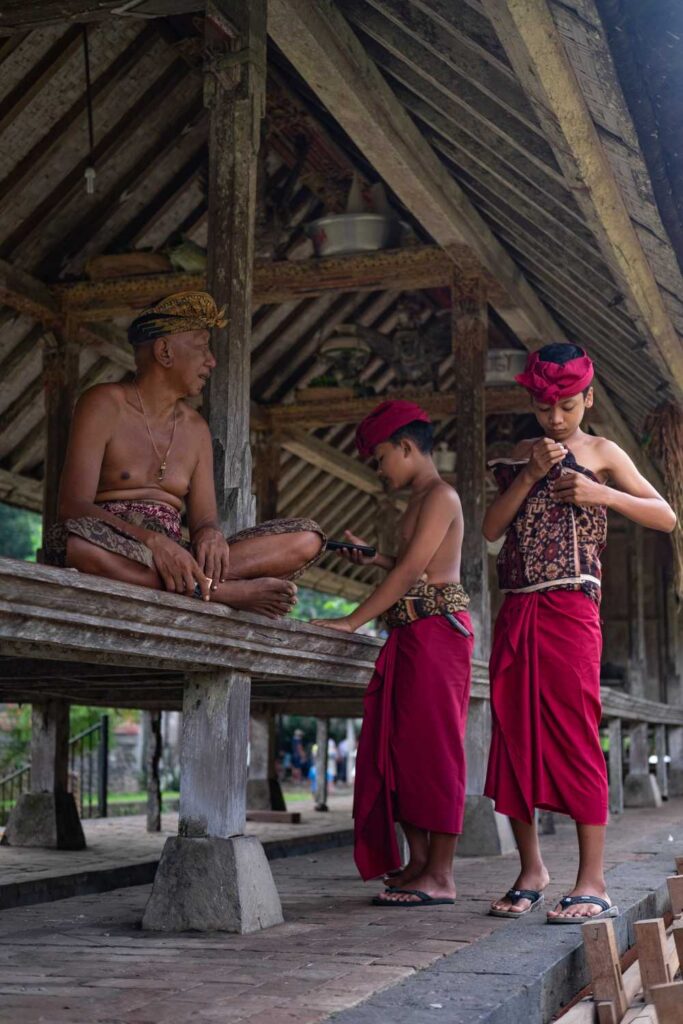
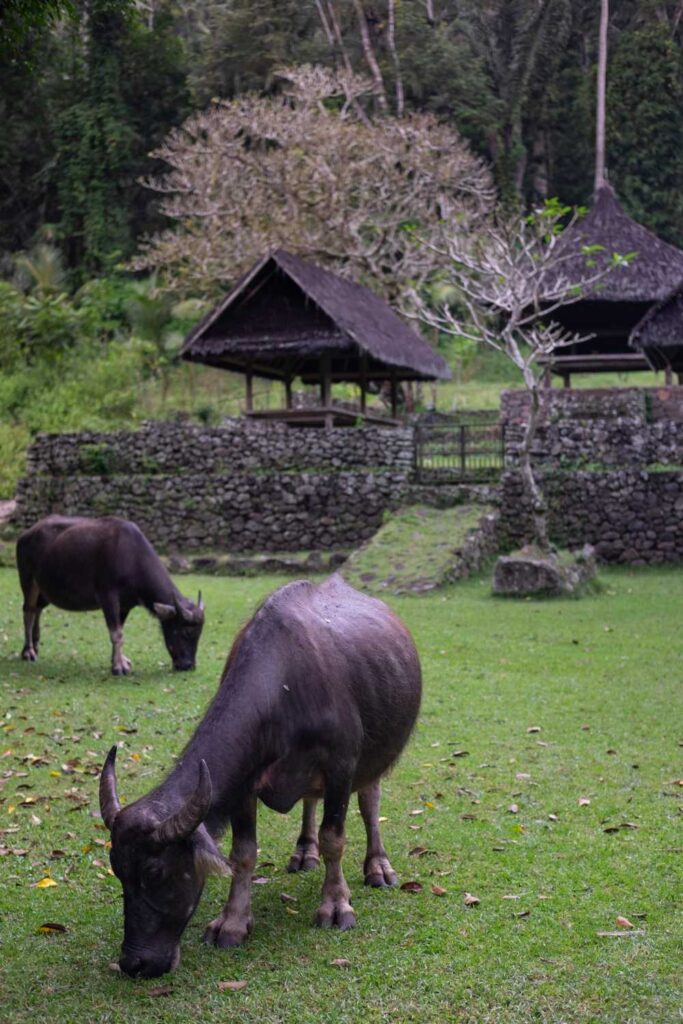
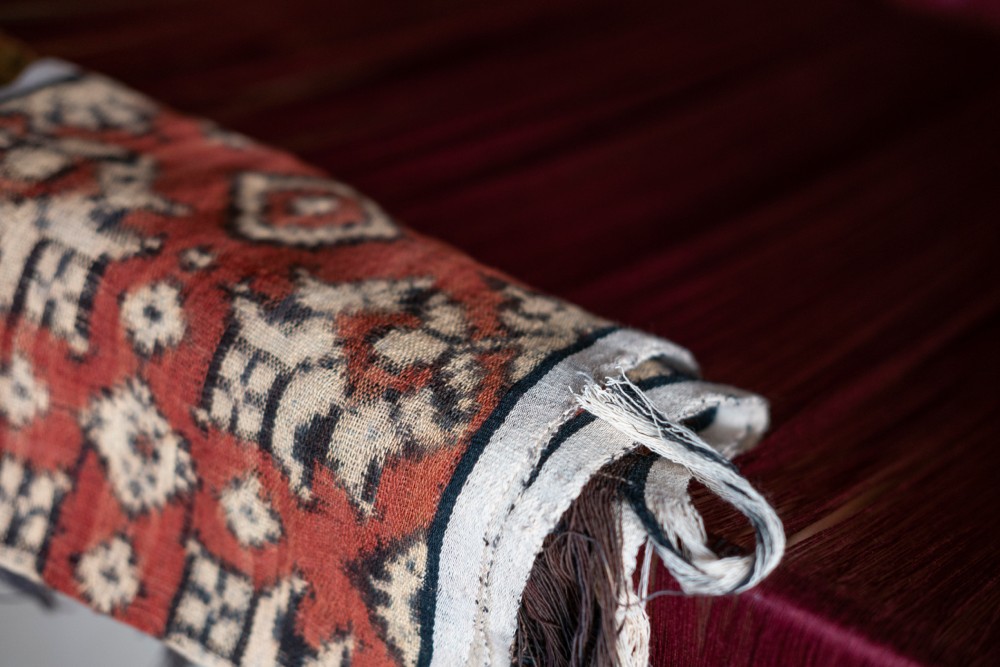
Perhaps the most well-known of all the Bali Aga villages is Desa Adat Tenganan Pegringsingan. Found 3km north of the popular coastal town of Candidasa, the village is the cultural and administrative centre of the Tenganan area: 917 hectares of prosperous forest, farmland and floodplain that stretch out across the verdant Karangasem terrain of east Bali.
At Tenganan, the customary roots remain visible year-round, seen instantly with the traditional structure and organisation of the village itself. The main village is oriented north to south, with homes east and west of the central corridor where different bales (bale pertemuan) running lengthwise of the village serve as the principle meeting, storage and ritual points for different groups. Villagers open their homes to visitors, where Tenganan’s signature geringsing cloths are either on display or actively being weaved. This is a special ceremonial cloth that uses a rare double ikat method of weaving only found in three places in the world – it is used on special ceremonies and is said to protect its wearer from sickness.
The most interesting time to visit Tenganan is during the fifth month of their ritual calendar, the month of usaba sambah, during which the village’s most distinct customs are put on show. This includes the mayunan ritual swing, the mekare-kare pandan wars and vibrant rejang dances. With the traditional village setting, backdropped by Karangasem’s rolling hillsides, these ceremonial spectacles are enriching experience of Bali’s living culture.
Read the full story on Desa Adat Tenganan Pegringsingan
—
This is but a handful of the Bali Aga villages or ‘desa tua’ (old villages) found on the island. They distinct customs are the perfect example of desa kala patra, a Balinese philosophy that accepts differences caused by ‘place, time and situation’ (respectively). Read more about each Bali Aga village through their individual stories linked above.