


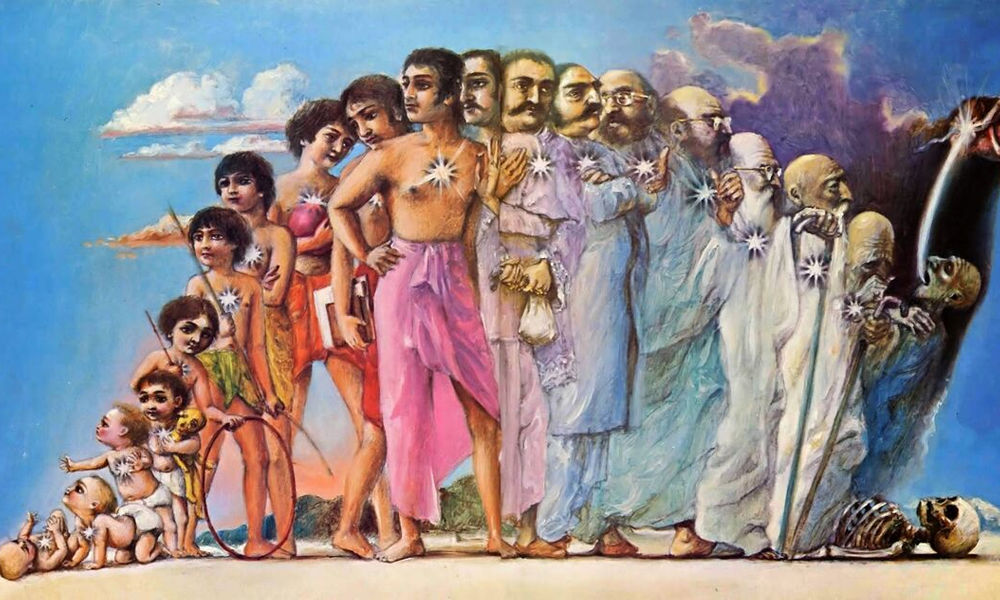
Of course, you’ve heard about reincarnation, right? But my guess is that you have heard about the formal, reformed-Hindu version of it: “You will reincarnate as a dog if you behave like one!” In other words, your future incarnations will be a consequence of your current deeds.
Yet, whilst there are some modern Balinese that ascribe to this notion of reincarnation the majority of Balinese Hindu will tell you that here, people reincarnate among their kin. Samsara, the cycle of reincarnation, continues down the generations of families. This is the traditional way, as it has always been in Bali… although, as I shall explain, there is a transformation now taking place.
Reincarnation, the Balinese Way
Ancestors have been called yeh (water), and therefore to incarnate is to come down as titis, or water drops, from the abode of the spirits found above the mountains – tanah ane wayah, the old country. A slightly less romantic name for the incarnating soul is warih, the ancestor’s urine!
Nevertheless, when a child is born in good condition this is the result of having paid proper attention to the soul’s incarnation, starting from the parent’s act of conceiving. Such an act, that is creating life, is under the watch of the gods: the god of love, Smara, and his consort Ratih, the moon goddess.
And who gives life to this newborn child? It is the soul of one’s ancestor who come down and reincarnated into this earthly realm. But to have the right soul come down, everything should be well prepared, including the correct offerings and prayers, done at the correct place. The first place to worship – and request – would be at the Rong Tiga, a shrine found in the family temple dedicated to Batara Hyang Guru, the divine teacher. This three-doored altar is the sanctuary of the purified ancestral spirits (dewa pitara), considered one’s teachers (‘guru’) in life.
If the prayers here fail to fulfill their purpose, i.e. pregnancy of the expected ancestor, one can go to a more specialised altar, known through word of mouth, usually located in the middle of some preferably tenget (haunted or magically-charged) forest, mountain or riverside. Among these are the Ratu Brayut shrines, those of the ancestral figures Men Brayut (mother) and Pan Brayut (father) who were known to have many children.
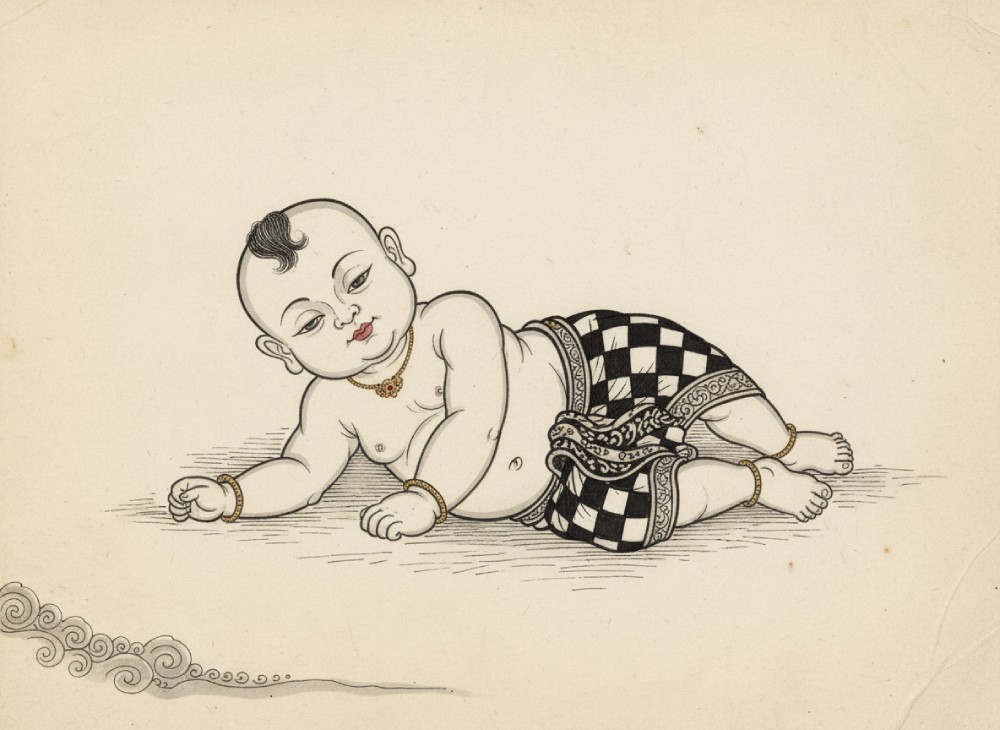
If all the prayers and offerings have been accepted, then there will be a sign (pawisik) that informs the wife that she is pregnant, or in other words, that an ancestor’s soul has found a place to come done from above. Here in its temporary new home, the ancestor waits for birth; and when he or she does, that newborn baby will still be considered a dewa, an incarnating god.
In the highly unfortunate circumstance of a failed pregnancy or stillborn, there is a spiritual explanation too: it is said that these are the souls that had not fulfilled their time in purgatory early, and were incarnated before their time – only to be pulled back to tegal penyangsaran, the field of sorrow and purgatory.
But let us assume all has gone well, and that the little god baby has gone through its pre- and post-birth rites, then we come to the interesting part: who is it that has reincarnated? Little guess work is needed here, because there are those trained to intercede with the invisible world (niskala) to find the exact answer to this most anxiety-inducing question. So, it is12 days after the birth of the child where the family can visit the balian, the medium or shaman, who will reveal all.
The Incarnation Inquiry
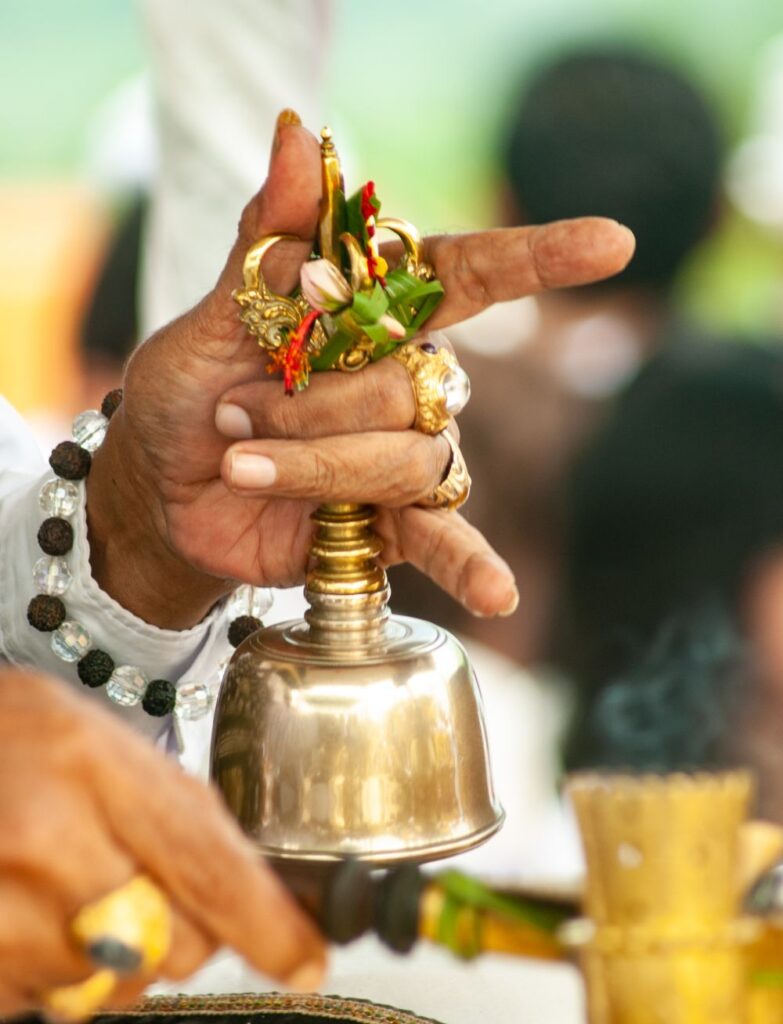
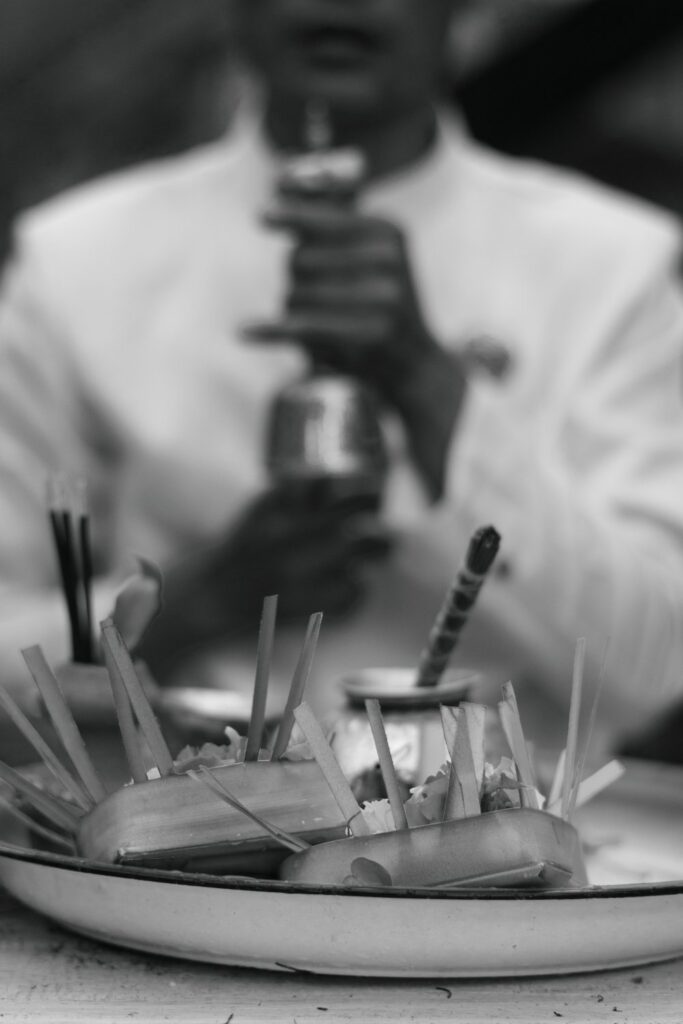
Ding… ding-ding-ding-ding… dingdingdingdingding….
The bell of the balian jingles for a long, long time as he mutters his mantras addressed to the gods of the three worlds. The smoke of the burning incense wafts above the nearby altar, rising as the ‘stairs’ for the gods and ancestors so that they may come down and take a seat (napak) upon the balian himself. Two women helpers are coming and going with offerings, placing them at required locations.
Through all of this, Nyoman Kemprot pays no attention. He is holding a baby girl a few days old, and he – as well as all his relatives present – wants to know who it is who has thus come down from the ancestral abode, and whether he or she wants to be given something in particular for their upcoming otonan (first anniversary in the Balinese 210-day calendar).
All of a sudden, the balian’s mantras become a jumble of inaudible sounds; he shudders and his eyes roll back. The incarnating soul is obviously having difficulty expressing itself through the shaman, but finally, through the bearded man’s mouth it blurts out in a hoarse, feminine voice: “Do you hear me? Finally. I have erred too long in the world above, so I return to ‘ask for rice’ (nunas nasi, incarnate) among you now – will you be able to look after me?
“Of course!” replies Nyoman Kemprot, anxious to please. “But, please, tell us who you are?”
“It is me, Ni Kerti.”
Ni Kerti… how is that possible? Nyoman thinks to himself. “How is it that you have come down to us?” He asks. “You were married with a family, you should have become a member of your husband’s kinship group and incarnated amongst them.”
Through the balian’s own mouth she replies, “Oh, I never completed the rites to leave our ancestors when I married! I bring little fortune with me, but I also ask for nothing from you – please just let me come down and be amongst you all.”
The balian closes his eyes and falls silent, the communication is over.
Nyoman Kemprot is sure that this Ni Kerti was none other than his long-passed aunt. She had forfeited her ritual duties and never did the mepamit when she got married – a ritual obligation women have to follow when shifting to their husband’s clan. And now she has to pay for it in a strange way: by returning back to her parent’s kin.
This unique incarnation was the result of her own actions in her past life, her own karma – a type of karma that is far more Balinese than it is Hindu, steeped in the ancestors.
Is This Reincarnation Changing in Modern Times?
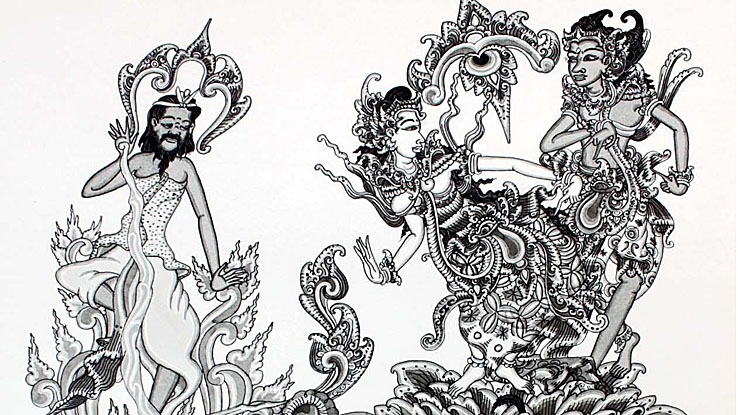
The most remarkable aspect of the traditional notion of incarnation depicted above is that it remains prominent in Bali, despite the “Hinduisation” process, which originated from Java and has continued to take place for more than 1,000 years. Texts, some of which date back to the 9th or 10th century, such as the Sarasamuscaya, consisting of ethical advice with Sanskrit formulas translated into Kawi (Old Javanese), have long been known and studied. Yet, they have not significantly transformed the beliefs of the Balinese with regard to the fate of the soul. Thus, while lettered men disseminated the principles of a karmic world of cosmogonical gods—including the karma-generated status of souls and Samsara transmigration—in learned languages, the village tradition continued untouched.
Across the centuries, there were insertions of novelties, such as the twice-born priesthood in the 16th century—mostly Brahmana—but while such novelties enriched the rituals (with the processing and sprinkling of new, Indian-named holy waters such as Tirta Gangga) and also added sociological layers (the Catur Wangsa caste system), they did not radically alter core beliefs. New Hindu notions and rites were thus added on top of existing ones without replacing them.
Today, a Hindu notion fully internalised by all Balinese is that of Karma Phala (or Karma Pala), which dictates that one must “bear the fruits of one’s own deeds.” Yet, apart from some Brahmana and other highly lettered people – and even if there is the vague idea of an animal incarnation as a retribution for horrible deeds, –the Balinese Karma Phala does not typically imply a change of species from human to a lower or higher status. While the notion of reincarnation is indeed present, the related notion of Samsara – the cycle of the soul from one reincarnation to the next – is largely absent. One will come back anyway to Bali, reincarnating among one’s grandchildren. The impact of karma will show in a better or lower status incarnation…. retribution may also be visible in birth or character defects, or even in a loss of social power, for example.
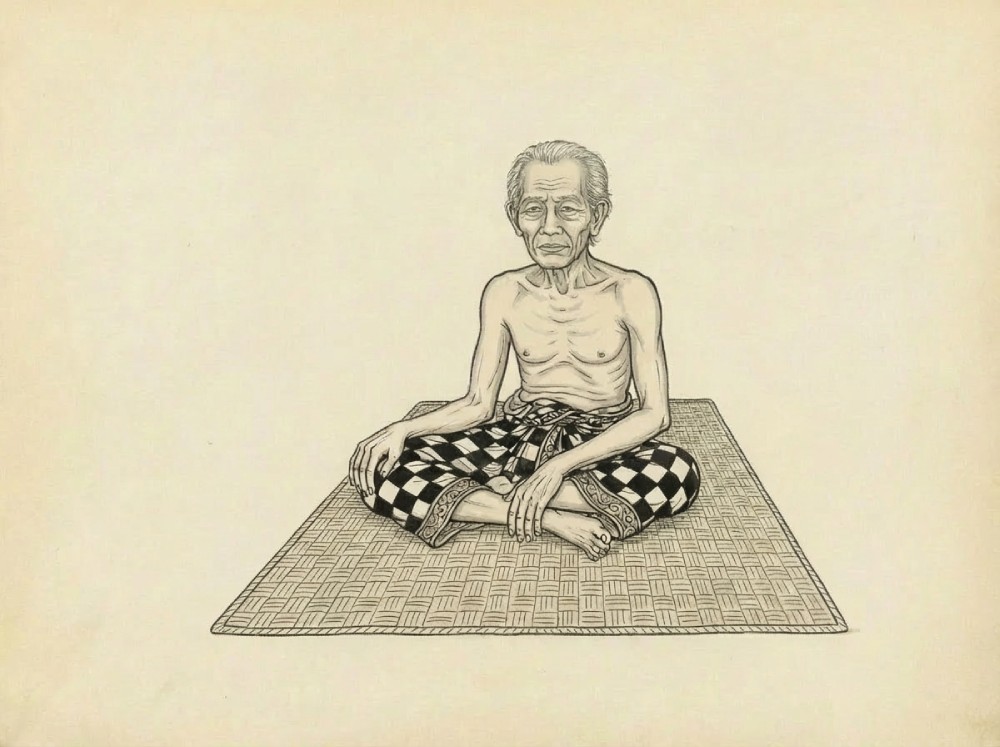
The ritual system confirms this tradition. Once the rites of death (cremation, etc.) are all finished, the ancestor comes down and resides among their kin during ceremonies until they eventually come back and reincarnate.
It is only recently, after independence, that the balance between the old ancestor worship and formal Hinduism has started shifting in favour of the latter. For the first time, “Dharma” as “religious truth” is taking over from mere karma as the key principle, as promoted by the official modernist Balinese religious organisation: Parisadha Hindu Dharma (the organisation of Hindu Truth). Today, children are not simply being transmitted “customs” through tradition and theater; they are now being taught at school “principles”—the Panca Śraddhā or five principles of Hinduism.
This theologisation of Hinduism has consequences across the board. The norm is no longer given by the local traditional reality, but by “the” truth based on foreign texts, which little-by-little is creating a shifting belief system that is closer to that found in mainstream Indian Hinduism. In other words, Balinese Hinduism is getting increasingly ‘Sanskritized’. As a result, the ancestors (Pitara) are often no longer defined as returning kin, but as souls on the road to Moksa, or ultimate enlightenment. In other words, after 1,500 years of this highly localised form of Hinduism, we may be witnesses a sort of syncretism evolving on the island, due to a variety of factors.
For now, at least, the ancestors continue to ask for rice among their kin.