


As the ninth month of the Saka Year, Sasih Kesanga, approaches its conclusion, Bali awakens from the prolonged lethargy of the monsoon. Clouds dissipate, and the celestial expanse offers a renewed clarity. It is a season of curious transitions; the Balinese observe that the canine population is in heat (cicing kesanga) and the initial rice cycle (kerta masa) is poised for commencement. Yet, throughout the solar year, spiritual and physical impurities have accumulated—both within humanity (manusa) and in the macrocosm at large. It is the moment for a formidable bouleversement of the spiritual order: a ritual process of Somya, transmuting the forces of decay into the forces of vitality. This is the realisation of the paradox: Dewa ya, Buta ya!—the profound intuition that the divine and the demonic are but two facets of the same cosmic energy, perpetually fluid and essentially interchangeable.
This purification cycle initiates with a ritual ablution for the village deities, as their impurities are surrendered to the sea (or sometimes into a river, according to the village tradition). It continues with territory-level exorcisms conducted at the principal intersections of the island. Subsequently, in a final paroxysm, the demons are symbolically emancipated, granted a temporary, chaotic dominion to traverse the earth, only to be neutralised during the night of the final dark moon. It is then that the Ogoh-Ogoh emerge in a final display of symbolic violence. When the world awakens to the nascent Saka year, it is greeted by the absolute, startling silence of Nyepi.
Melasti Procession
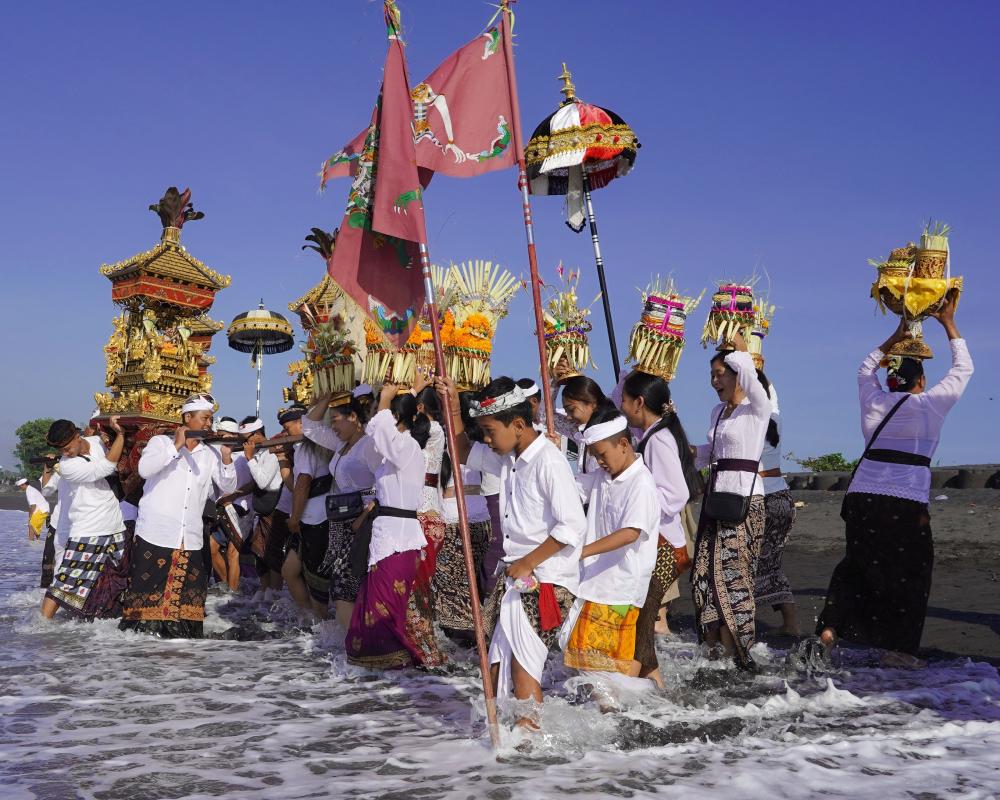
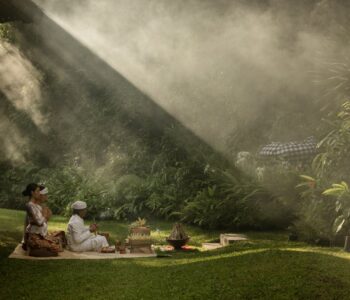
The cycle of rites commences with the Melasti pilgrimage. Several days prior to the saka new year, the deities of Bali journey to the aquatic frontier with a singular raison d’être: to expiate the psychic weight of the vanishing year. The ritual initiates at the village sanctuary (Pura Desa) with the Maspada rite, when the village officiant (pemangku) invokes the divine ancestors, summoning them to descend and inhabit their Pratima (sacred effigies) for the duration of the cycle. Only once these icons are energised by the presence of the gods can the journey proceed.
As the matinal sun ascends, the villagers adorn the Pratima in the finest silks and golden textiles, which they subsequently bathe in floral essences. Positioned upon ornate palanquins and accompanied by the resonance of the gamelan, the shaggy Barong, and a forest of towering umbul-umbul banners, the long procession of the gods spills onto the thoroughfares, winding toward the coast or the nearest sacred riverbank.
There, a Pedanda high priest waits enthroned upon a towering bamboo structure, already immersed in his incantations. As the procession reaches the water’s edge, village officiants cast the offerings intended for the Buta Kala into the surging tide—most notably ducks, selected as creatures of both land and water to bridge the two realms. It is at this precise moment of the ritual that Batara Baruna, the sovereign of the sea, emerges as the “Divine Transformer.” The ocean is the only force of sufficient magnitude to “digest” the accumulated spiritual weight of the community; Baruna does not merely accept these impurities, he dissolves them within the alchemy of his infinite depths.
The ceremony attains its apogee as the priest, to the rhythmic chime of his bell, retrieves the amerta—the nectar of immortality—from the purified waters. This consecrated water is subsequently aspired toward the Pratima and the assembled multitude, frequently inducing trances as the divine energy assumes control. It will later be distributed among the members of the community.
The re-energised effigies are escorted back to the village in yet another joyous procession. Yet, rather than being immediately returned to their individual shrines, the ancestral deities are arrayed together upon the superior platform of the Bale Agung—the grand meeting pavilion of the village temple. Here they reside “in state” as a council of ancestors. From this central vantage point, they witness the imminent exorcisms and the chaotic nocturnal theater of the Ogoh-Ogoh, their presence anchoring the village in both its past and future as the old year perishes and the new is conceived.
Tawur Agung Exorcism
From the coastal reaches of Melasti, the ritual cleansing shifts on the final day of the Saka calendar to a more centralised, public mise-en-scène. The focus expands beyond local village deities to encompass the entire world—Gumi Bali—which undergoes a monumental exorcism known as Tawur Agung. This rite is the supreme expression of Bhuta Yadnya, the rituals of cosmic sacrifice. It involves the symbolic heart of the island, the residing gods of Besakih, but also permeates the very fabric of Bali, descending by degrees from the regencies to the districts, the villages, and ultimately, to every major crossroads on the island.
The Tawur Agung addresses the totality of the Balinese geography, reaching into vertical space and encompassing the celestial Swah and the chthonian Bhur realms. This island-wide purification initiates with the preparation of a dedicated holy water at Pura Besakih, the “Mother Temple.” During the Tawur Agung, this Besakih tirta emerges as the divine counterbalance to the chthonic forces emancipated during the ceremony’s cosmic exorcism.
The Tirta Tawur Agung is consecrated in a grand ritual nearly a week prior to the exorcism. It is a confluence of waters from other pivotal temples—such as Pura Batur and Pura Uluwatu—to manifest a symbol of the island’s divine unity. This water emanates from the central source, collected in sacred vessels by representatives of each kabupaten (district), fanning out on the morning of Tawur Kesanga. It traverses the districts and villages, arriving at the local intersections at high noon—the precise moment the purification rites are destined to ignite.
Meanwhile, at the village level, the mise-en-scène is formidable: a high bamboo platform (bale pawedan) has been constructed at the principal intersection. The populace waits, their deities already reinvigorated by the Melasti. They have spent the morning preparing wong-wongan decoys and Ogoh-Ogoh effigies, keeping torches in readiness for the night. As the sun attains its zenith, the ceremony reaches its theological apex: the three Sadhaka priests ascend the platform to commence their collective labor.
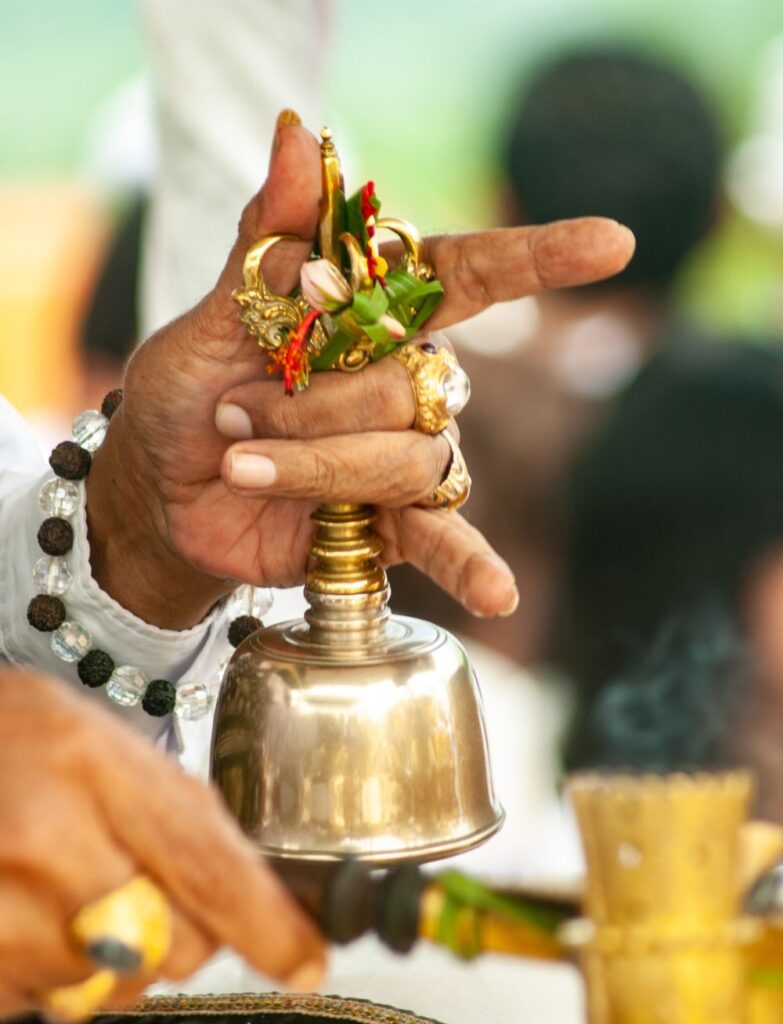
Through a synthesis of sacred mudras and Vedic mantras, they perform the Arga Patra—a complex internal alchemy. They do not merely recite; with every respiration, the priest attracts the accumulated impurities of the community and “cooks” them into purity within the furnace of his own anatomy, projecting that transformed energy back into the world through the resonance of his bell. The Pedanda Siwa invokes the celestial Swah Loka, calling upon Siwa to purify the soul. The Pedanda Buda focuses on the Bhuwah Loka, the intermediary world of humans, harmonising the realm through meditation. The Sengguhu, meanwhile, addresses the underworld, Buta Kala-laden energies of the Bhur Loka. By performing this ritual at the “navel” of the village, the priests create a vortex of purification. They perform Somya, transforming destructive energy (Bhuta) from all levels into a calm, helpful energy (Dewa).
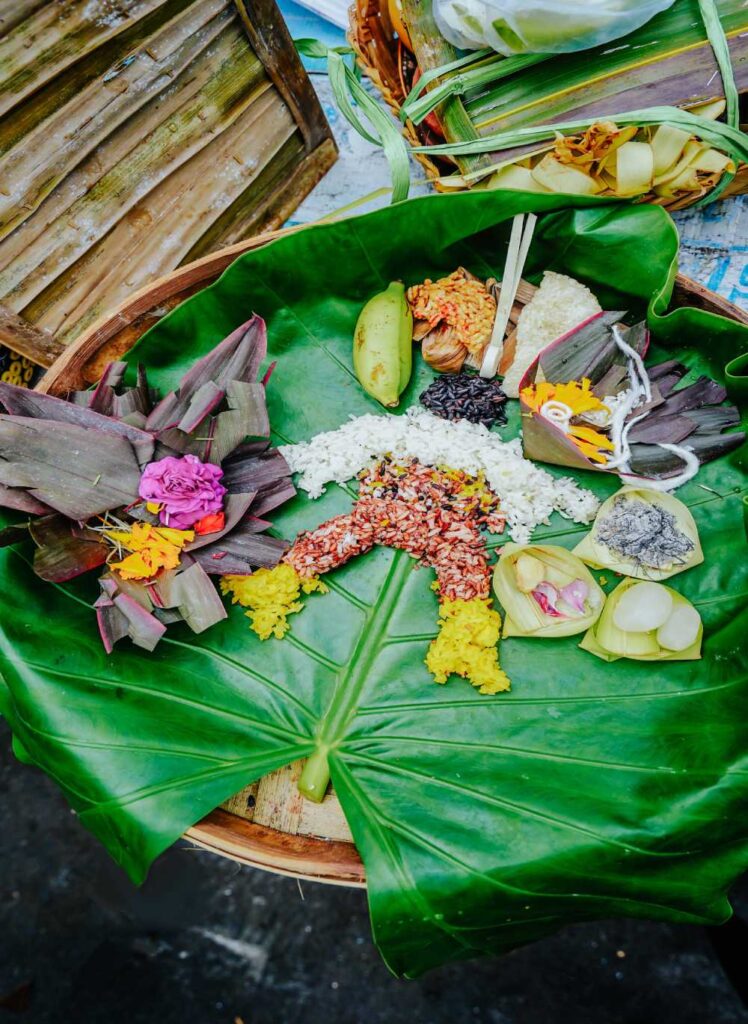
As the high priests’ bells resonate, village officials execute the physical side of the exorcism: the Banten Caru. These are sacrificial offerings where the vital energy of ducks, pigs, or cattle is surrendered to the terrestrial forces. The animals are selected to correspond with the Panca Warna, the five cosmic colors of the Balinese mandala: white (East), red (South), yellow (West), black (North), and the multi-colored brumbun (Center).
By spilling blood at the village navel, the community “nourishes” the underworld. These forces are not merely appeased but “tamed” and restored to their proper station within the cosmic hierarchy, ensuring they remain neutralised before the absolute sanctity of the upcoming silence.
Once the three Sadhaka conclude their ritual, the combined holy waters are distributed to each family to shield their compounds against the impending chaos. This water is aspired upon the family sanctuary (Sanggah), connecting the residence to the Mother Temple and the cosmos at large. Only once the home is under this divine protection does it become possible for the family head to perform his own domestic Somya.
This is achieved through a precise caru exorcism at the intersection of the culinary space and the courtyard—the “stomach” of the home—and at the principal portal. These are accompanied by wong-wongan: human-looking decoys constructed from rice-paste in five colors. By offering these figures, the family performs a ritual substitution: “Accept this representation of our physical form, satisfy your hunger, and leave our actual bodies in peace.” By offering the wong-wongan at this exact moment, the family effectively “negotiates” its safety, transmuting potentially destructive energy into harmony.
Ngerupuk and the Birth of Silence
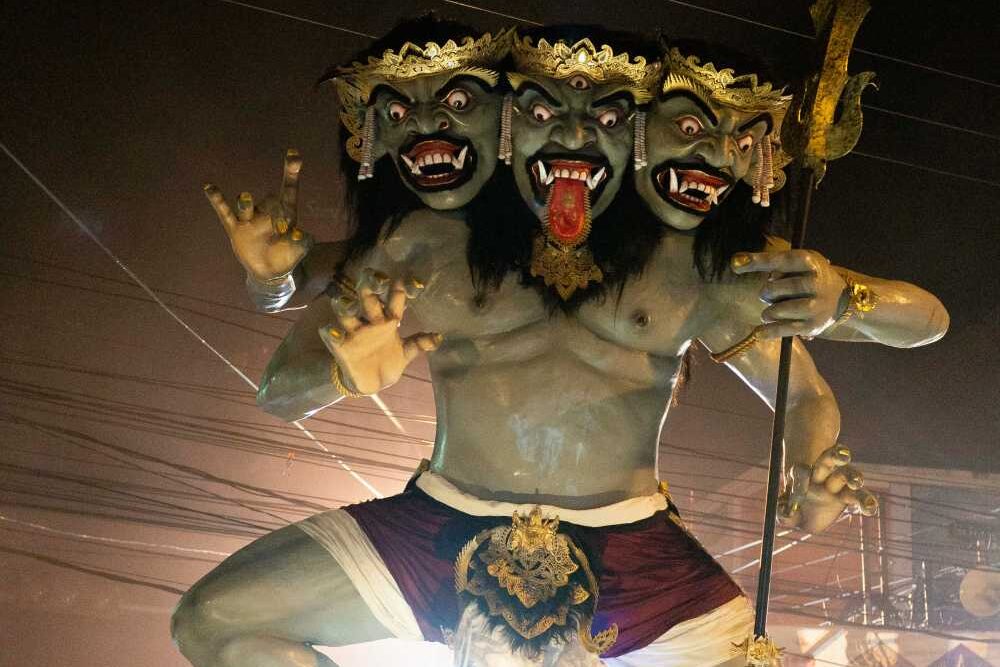
Once the sun has fully descended, the ritual transitions from tranquil offerings into a period of cacophonous purification known as Ngerupuk, the “chasing away” of demonic forces. This represents the physical “sweeping” of the island. As the shadow energy of the new moon reaches its maximum during the gloaming, the community must forcibly expulse demonic energies from human-inhabited spaces using flaming torches (prakpak) and the discord of wooden drums (kulkul).
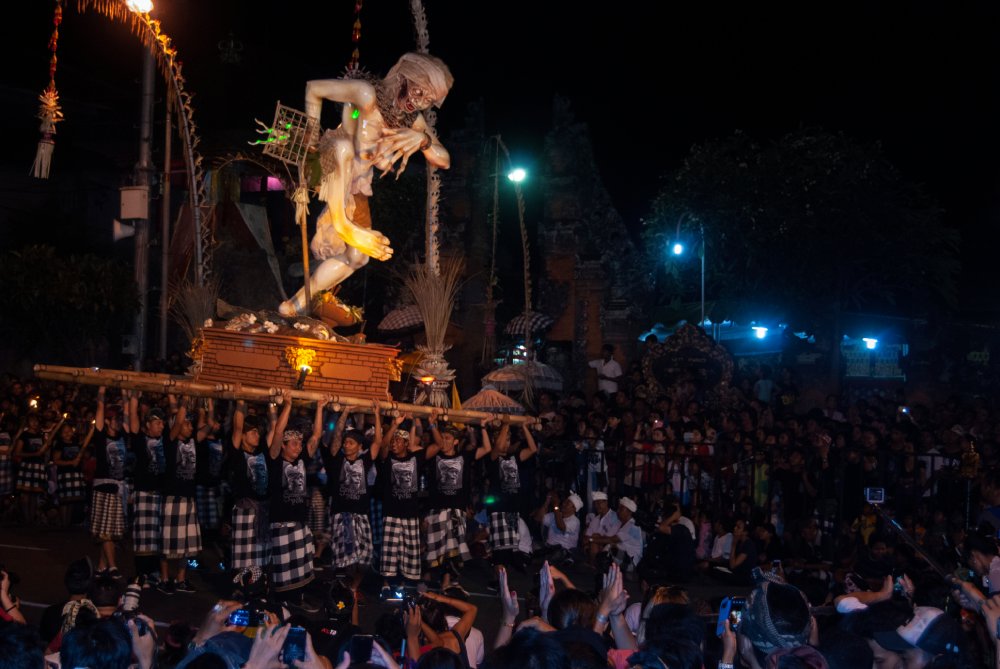
The climax is attained with the Ogoh-Ogoh (a ritual-cum-social novelty introduced in the 1980s), sent to evict the Buta Kala from the village. This is the Ngerupuk cavalcade, held all over Bali, though the most fantastic is undoubtedly that of Denpasar. Heading for Gajah Mada Street, the monstrosities manifest by the hundreds—monstrous guitarists, bikers, or even microbes—all with fangs and protuberant eyes. Each is transported upon the shoulders of dozens of youth who lunge and sway to project the impression of a demonic dance.
The Ngerupuk culminates at the crossroads, where the Ogoh-Ogoh are rotated three times to disorient the spirits within, before being led to the cemetery (Setra) for the coup de grâce—the surrender to the conflagration. This ending, the symbolic Pralina of Hindu cosmology, returns the concentrated energy to the earth, completing the cycle of Somya. By the time these three levels of ritual are complete, the world has been “scrubbed” of its impurities. The wong-wongan has satisfied the domestic spirits, the Ngerupuk has cleared the thoroughfares, and the Tawur Kesanga has realigned the macrocosm. This creates the perfect spiritual vacuum required for the silence to follow.
Toward Nyepi Silence and a New Saka Year
The hours immediately succeeding the Ngerupuk belong to the final, chaotic conclusion of Tilem Kesanga. As the Ogoh-Ogoh are consumed by the flames, turbulence continues, albeit gradually diminishing, until the horizon meets the initial light of the new year. At this precise crepuscule, the transition from the old year’s shadow into the new year’s dawn, the first day of the tenth month (Sasih Kadasa) commences.
With the ascension of the sun, the chaos instantly vanishes, replaced by twenty-four hours of absolute Nyepi silence: Amati Geni (no fire), Amati Karya (no labor), Amati Lelunganan (no movement), and Amati Lelanguan (no revelry). Silence is total. It is a day when the Balinese practice “Mulat Sarira,” a profound internal reflection of the Cosmic Oneness. It remains a powerful annual assertion of ancestral sovereignty over the Gumi Bali, a day when the island belongs entirely to its own silence.